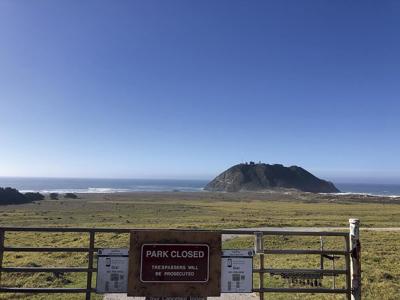

Along Highway 1 in Big Sur, the Point Sur Lighthouse is among the most iconic features. Here, the coastline abruptly changes from high, winding cliffs to flat, sea-level grasslands with a dramatic sandstone outcropping. The 40-foot-tall lighthouse appears even taller, perched on a 361-foot-tall rock. At mid-morning on a Saturday a tour should be beginning, but these days a sign on the locked gate reads “PARK CLOSED.”
Point Sur has a long and colorful history. The light in the lighthouse was first illuminated on Aug. 1, 1889. It was home to military during both world wars, and the site of some high-powered submarine detection technology during the Cold War. For years, the operation required constant tending; until 1974, when the light was automated, lighthouse keepers lived on the rock in order to tend the light 24 hours a day. It was an isolated life – food and supplies were delivered by boat before Highway 1 was completed, and residents had to walk up and down the rock’s nearly 400 stairs to retrieve goods or venture out to visit neighbors.
The land was established as a state park in 1986, and soon the nonprofit Big Sur Natural History Association began leading tours. Today, the light of the lighthouse comes from an LED sitting out on the deck, and the Central Coast Lighthouse Keepers, another nonprofit, formed in 1993, operates tours for public access and raises funds for restoration.
Linda Rath has been a volunteer at Point Sur for six years. A former State Parks employee, she spent part of her career working as a supervising ranger with State Parks in Big Sur, and decided to get involved again after retirement. “It’s a fun community,” Rath says.
Docents at Point Sur are officially State Park volunteers – Central Coast Lighthouse Keepers (CCLK) exists as the funding source for restoration projects. It’s been a successful source of revenue, too. The money raised through tour fees, combined with donations, grants and gift shop sales, has allowed CCLK to restore most of the buildings on the rock.
The details of the three-hour-long walking tour depend a bit on who’s leading it. “Every docent kinda has their own tour,” Rath says. “I usually concentrate on what life was like up there. It was just a different life. Very isolated. Some people loved it, some people hated it.” Rath has vivid anecdotes to share – the lengths keepers’ children had to go to to get to school in the Big Sur valley, the arduous journey down those 400 steps to milk a cow.
For now, these images can only be conveyed by phone. Volunteers haven’t really found ways to contact would-be visitors during the closure, Rath says, though the lighthouse does boast a fairly active Facebook page. After more than 131 years of continuous operation, and around 30 years as a museum, Point Sur has been closed to the public for the better part of the past two years.
Things have been “crazy” the past few years, Rath says. The rock was closed because of repairs to bridges leading to the top for more than a year, and was going to reopen in mid-March of 2020, just as a pandemic hit the U.S. During the first wave of Covid-19 closures, the park remained closed. Then in October, CCLK – abiding by outdoor museum guidelines allowing docents to lead outdoor-only, masked and distanced tours – resumed tours. Docents led 20-person groups instead of the typical 40. Those outdoor tours were short-lived, however; the county’s Dec. 13 stay-at-home order, which remains in effect, prohibits even outdoor tours.
And this is in addition to last year’s closures forced by fires and other adverse weather. “We have no idea when we’ll be allowed to start tours again,” CCLK’s Carol O’Neil says in an email.
Both Rath and O’Neil say keeping volunteers active and engaged during the closure is a challenge, but neither seems too concerned about the lighthouse itself. It’s been around. And for Rath, whose experience at Point Sur is vast, the evolution of the place is part of its appeal. “It’s gorgeous,” she says. “It changes every time you go up there.”


(0) comments
Welcome to the discussion.
Log In
Keep it Clean. Please avoid obscene, vulgar, lewd, racist or sexually-oriented language.
PLEASE TURN OFF YOUR CAPS LOCK.
Don't Threaten. Threats of harming another person will not be tolerated.
Be Truthful. Don't knowingly lie about anyone or anything.
Be Nice. No racism, sexism or any sort of -ism that is degrading to another person.
Be Proactive. Use the 'Report' link on each comment to let us know of abusive posts.
Share with Us. We'd love to hear eyewitness accounts, the history behind an article.