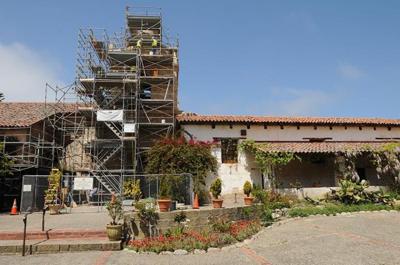
Southern drawls, Brooklynese and rolling Spanish “rr”s melt into a united murmur as tourists shuffle through the gates of the Mission San Carlos Borroméo del Río Carmelo, better known as Carmel Mission. Construction workers pry away at rotted walls, scraping metal tools against cement and grime. A congregation surrounds the church with bowed heads and hands moving Father-Son-Holy-Ghost style. Lush gardens and purple flowers draw bees and buzzing alarms of springtime.
The bustle is familiar to the walls of the Basilica. They’ve seen it since 1771, when Spanish padres and Native Americans clustered around the second erected California mission, the centro to the side filled with shops and a meat and produce market. Crops flourished nearby, the Carmel River providing necessary support for robust agriculture.
A community, a town, a history: All have been built around this intergenerational commotion.
The adobe walls were later replaced with sandstone, in keeping with Father Junipero Serra’s plans for greater permanence. In 1931, a renovation crew added cement in an attempt to make it more durable to weather. Starting last year, the Carmel Mission Foundation set out to restore the mission to its original appearance by removing the cement and replacing it with the original sandstone quarried from nearby. But that was just the beginning of an ambitious remodel running $7 million in individual donations. The first phase was completed last week, with more to come to the surrounding museums and quadrangle.
Vic Grabrian, president and CEO of the Carmel Mission Foundation, gazes up at the Ave Maria Purisima bell tower. As it swings back and forth, the powerful ring vibrates through everyone standing on the mission grounds.
“We hope what we’ve done will last at least 60 to 75 years,” he says.
A seismic retrofit sunk 300 steel cores in the walls of the church sanctuary, or basilica, each 2 inches in diameter, though intentionally little has been done to modify the inside.
“We want to preserve the mission, not rebuild one,” Grabrian says.
The next steps were mostly cosmetic: LED lighting in the basilica to light up artwork, spotlights on the first three arches to illuminate the reredos – the intricate, hand-painted structure behind the altar – plus new tiles on roofs and fresh surfacing on crumbling walls.
The cumulative effect makes wandering into the space – past the double set of organ pipes and into the sanctuary that has seen hundreds of thousands of services and ceremonies – more vivid than ever, and more than walking into history. It’s walking into art.
The science behind that art is the subject of the foundation’s first lecture of the 2013 series Saturday, May 18, as members of the restoration team join a panel discussion.
~ ~ ~
More than a quarter million visitors walk through that art each year, making the mission one of the biggest draws in the county. Which means that Junipero Serra – who designed the mission himself, planning what’s now the quadrangle of the school and mission museums and who is buried to the left of the altar between two other deceased pastors of the parish – has a presence that’s very much alive. And the mission is still very much a center, albeit not quite as much as it was when he used this as headquarters for all 21 California missions, and lived in the convento wing, now a museum that houses several artifacts and Serra’s Bible.
“It’s the start of California’s history!” Grabrian says enthusiastically.
Plenty of others share Grabrian’s enthusiasm, like Julie Melcarek, a woman from Coco Beach, Fla., who came to accomplish a top item on her bucket list. She started from San Diego and made her way up the state, viewing mission after mission.
“It’s so exciting!” she gasps, looking up. “The [missions] are so beautiful. And this one is in such great shape!”
Outside, wedding guests flood in through the gates. Families file into the church, parents hushing the children. Upon entering, visitors bless themselves with holy water from the fountain.
As the Ave Maria Purisima bell rings again, loud and strong, one can squint and almost see Spanish and native congregants instead, padres following in silent prayer, heads bowed with rosaries dangling. Here, with a little restorative help, history continues to be made.
CARMEL MISSION, 3080 Rio Road, Carmel, is open 9:30am-5pm Monday through Saturday, 10:30am-5pm Sunday. The Mission Foundation hosts a panel there on the topic of restoration. 7:30pm. Saturday, May 18. Admission is $6.50/adults, $4/seniors, $2/children 7 and up, free/6 years and under. 624-1271, www.carmelmission.org


(0) comments
Welcome to the discussion.
Log In
Keep it Clean. Please avoid obscene, vulgar, lewd, racist or sexually-oriented language.
PLEASE TURN OFF YOUR CAPS LOCK.
Don't Threaten. Threats of harming another person will not be tolerated.
Be Truthful. Don't knowingly lie about anyone or anything.
Be Nice. No racism, sexism or any sort of -ism that is degrading to another person.
Be Proactive. Use the 'Report' link on each comment to let us know of abusive posts.
Share with Us. We'd love to hear eyewitness accounts, the history behind an article.