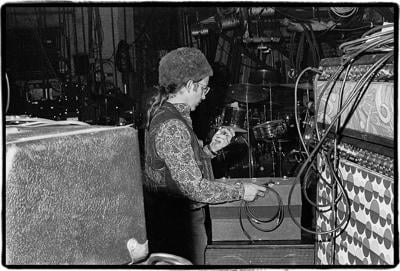
“In many ways, the Summer of Love actually began at the Monterey Pop Festival on June 16-18, 1967,’’ Carmel-based author Robert Greenfield writes in his new book, Bear: The Life and Times of Augustus Owsley Stanley III.
Stanley, better known as “Owsley,’’ aka “Bear” (because of his protuberant chest hair), was one of the world’s first private LSD manufacturers. The legendary Grateful Dead soundman (part of his considerable resume) was no ordinary dope dealer, however, but a man on a mission.
Part of that mission, at the behest of Mama Cass Elliott, who was friends with Monterey Pop organizer Lou Adler, was to make sure there was a plentiful supply of ultra-pure acid for the popfest.
“With 30,000 people jamming the Monterey Fairgrounds each day, the legendary performances put on by Otis Redding, Janis Joplin and Jimi Hendrix immediately catapulted them to a level of stardom they had never before known,” Greenfield continues. “Because many of those in attendance were stoned on a brand-new batch of Owsley’s acid known as Monterey Purple, much the same could also be said for him.”
Greenfield, who’s written biographies of Jerry Garcia, Bill Graham and Atlantic Records co-founder Ahmet Ertegun, interviewed the elusive psychedelic pioneer for Rolling Stone’s 40th Summer of Love anniversary issue, then tracked him down in Australia, culminating in a rare visit to Carmel before his death in 2011. With the 50th-anniversary of the Monterey Pop Pop Festival coming this weekend (see story, p. 18), he reflects on Owsley’s most memorable contributions to the original gathering, documented in the book, which was released last fall.
It’s been a long strange trip, indeed.
Owsley was no garden-variety peace-and-love hippie. Greenfield says he could be “controlling’’ and stubborn about getting his own way.
“People have a misconception of the ’60s as this idyllic time,” Greenfield says. “But the people who created it were determined that they couldn’t exist within the structure of the very straight society that existed. Each of them was very difficult in their own way, and they did shatter the mold.”
That was certainly the case in Monterey.
Owsley, with his girlfriend Melissa Cargill and his friend and coworker Tim Scully, took a side trip to Denver and came back with 100,000 tabs.
“John Lennon had become obsessed with the idea that he wasn’t going to have enough LSD,” Greenfield says. “He wanted a lifetime supply, so he sent in a ‘photographer’ to film the festival, whose real job was to smuggle the acid back in a film cannister.”
The rights to film Monterey Pop film had already been granted to documentarian D.A. Pennebaker, but he too experienced complications due to the chemicals, as well as love, that were in the air.
“Chip Monck, who later become known as the ‘voice’ of Woodstock, was the lighting director for the movie,’’ Greenfield says. “He’d never taken acid before, and while he was onstage, he took what he thought was a Purple Heart – a Dexedrine – to help him stay awake. It turned out to be Monterey Purple.
“Laura Nyro was onstage, and by that time Chip was gazing at her in wonder. They were trying to get him to change the lighting scheme but he just sat back and watched the rest of the show. That’s why everything toward the end of the film is in red.”
Greenfield reports Owsley, who was in the habit of offering acid to people as a conversational opener, was rebuffed by Indian sitar master Ravi Shankar. “Shankar was offended by the offer and walked away. There’s no knowing how many others took it,” Greenfield says.
Monterey Pop was a crucial counterculture turning point, the biographer adds: “It wasn’t the festival itself that had such a great effect, it was the documentary. When young people like me saw it back in New York, it was an overwhelming advertisement for the music. Janis Joplin, the Jefferson Airplane, Simon and Garfunkel – if you were back East, you probably hadn’t seen some of them yet. It really blew the door off the music scene and absolutely led to the idea that you could do something like Woodstock.”
For his part, Owsley wasn’t nostalgic about the days of the Pop Festival. On his 2007 visit to Carmel, Greenfield says, “He was multi-tasking – pulling things out of his aluminum briefcase, showing me jewelry, making cassette tapes. But it never occurred to him that he was five minutes away from the Monterey Fairgrounds.
“He could have gone back there but he didn’t live in the past. He lived in the moment.”


(0) comments
Welcome to the discussion.
Log In
Keep it Clean. Please avoid obscene, vulgar, lewd, racist or sexually-oriented language.
PLEASE TURN OFF YOUR CAPS LOCK.
Don't Threaten. Threats of harming another person will not be tolerated.
Be Truthful. Don't knowingly lie about anyone or anything.
Be Nice. No racism, sexism or any sort of -ism that is degrading to another person.
Be Proactive. Use the 'Report' link on each comment to let us know of abusive posts.
Share with Us. We'd love to hear eyewitness accounts, the history behind an article.