
Two shadowy figures lean against a pale blue building and murmur to each other under a flickering light. Another walks past them, stamping out a grape Swisher beneath his Air Jordans before ducking behind a glass door. Two older women in matching bright windbreakers follow. Then comes another figure, a slender woman trotting behind them in black stilettos.
They all scurry inside a brightly lit hall. Inside appears a diverse crowd, all of them fading into a single mass once they’re seated at one of the folding metal chairs lined up parallel to the rows of shaky card tables. Their heads drop with a prayer-like concentration. A consistent “thu-thump-thu-thump” echoes.
Then something breaks the intensity: A hand shoots up followed by a shout of “BINGO!”
It’s 6:45pm on a Tuesday in Marina and someone has already pocketed a cool $250. He’s the early-bird winner. Sometimes there’s only one, sometimes more, but ostensibly that means anyone who arrived on time is already late to the first game, which starts 15 minutes before the announced schedule.
Welcome to bingo night, happening at the Filipino-American Center, as it does six days a week, run by a few dedicated Samoan community members.
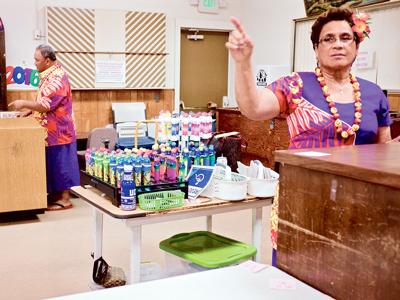
Tuesday and Thursday bingo nights are run by Malaetele Tiliaia, who is simply known as Mr. T. He walks through the crowd with a smile, greeting people selling various peel-back or scratch prize cards with his troupe of volunteers, all dressed in the same bright purple pattern, accented with white and orange flowers. The uniforms are consistent – button-up shirts for the men, and full-on traditional puletasis and a hibiscus flower tucked behind one ear for the women.
It’s not for the faint of heart and requires a lot of concentration.
Melinda Rodriguez, a regular, says she’s not banking on winning the jackpot. There are other benefits to coming: “It’s a great way to gossip and win some side money for groceries or gas.”
Mr. T explains the statistics: On average, 100 to 120 people play a night. The basic entry fee runs from $35-$45, which pays for 20 games of bingo or so. Players can also buy extra sheets to increase their chances in the regular game, or drop $25-$75 for different side games volunteers successfully hawk.
Side games are played between the regular game of bingo and include scratch or peel back cards – he thicker peel back squares could reveal prizes of up to $250 under one of the flaps, while the scratchers are more like a game of slots: Find the same image three times can mean up to a $250 prize.
Tonight it’s a $45 game with 145 players. Via simple math, that’s a lot of cash.
“Sometimes they walk with $2,000, sometimes $3,000,” Mr. T says. He laughs because the house isn’t losing. The jackpot is matched by consistent player turnout and their entry fees.Operator profits come from the side games.
He attempts to distinguish “real” gambling from his friendly bingo nights.
“There’s no ‘counting’ here,” as in counting of cards like in blackjack or other gambling games,” he says. “You can’t really cheat, you just gotta play.”
But by the look of the turnout and how long it has been running – since 2001 – there’s some sort of attraction at work. Players’ eyes move from their cards to one of the two large bingo boards or toward the tiny television screens showing numbers being called out.
The consistent tapping of dabbers – inky markers designed to efficiently mark the bingo card – proves it’s a fast game that can engulf its players. It’s not for the faint of heart and requires a lot more concentration than it would seem. When that focus is broken, a loud sigh or a disheartened f-bomb surfaces through the rhythm of players dabbing away.
• • •
Looking proud, Mr. T describes the outcomes of bingo simply: “Sometimes we have a lot of winners, and sometimes we don’t.”
It’s a game of luck and he can’t recall a single player with a winning streak. In short, there is no strategy. You pay. You play. And you win… or not.
The entry fee is just the beginning. Players could spend more than $1,000 – monthly rent for some – buying extra bingo sheets or side games ranging from $25-$50 and still win nothing. But perhaps even the losers can feel better that they’re keeping a good thing going.
That good thing is contributing to programs at the local Malamala Fou Church, where Mr. T and his team attend, including the youth group program and children’s ministry.
Whatever this bi-weekly game’s reputation, be it for a good cause or its habit-forming draw, brings in a crowd from as far as San Jose. It’s an impressive feat for a weeknight game that gambles on player turnout.


(0) comments
Welcome to the discussion.
Log In
Keep it Clean. Please avoid obscene, vulgar, lewd, racist or sexually-oriented language.
PLEASE TURN OFF YOUR CAPS LOCK.
Don't Threaten. Threats of harming another person will not be tolerated.
Be Truthful. Don't knowingly lie about anyone or anything.
Be Nice. No racism, sexism or any sort of -ism that is degrading to another person.
Be Proactive. Use the 'Report' link on each comment to let us know of abusive posts.
Share with Us. We'd love to hear eyewitness accounts, the history behind an article.