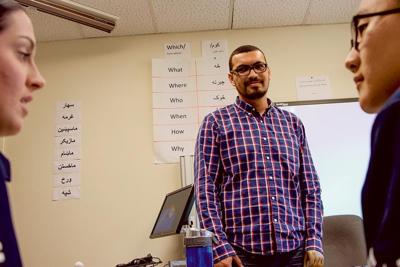

Six airmen sit in a small classroom at the Defense Language Institute Foreign Language Center at the Presidio of Monterey, chatting and joking in Pashto. Their instructor Sebghatullah Bashardost looks on with an approving grin. Then a student asks a question ending in unmistakable English, “Protein shake?” Bashardost thinks for a second and responds with a nod.
The students are only 17 weeks into their 64-week course, so it’s understandable if they don’t yet have a strong command of how to describe nutritional supplements in Pashto, a language spoken by nearly 60 million people, mostly in Afghanistan and Pakistan.
“As-salamu alaikum,” a student greets me as I enter the classroom.
“Wa alaikum assalaam,” I respond, nearly maxing out my Arabic. The influence of Islam and the fact the Quran is primarily read and recited in Arabic has greatly affected Pashto.
“Peace be with you,” is how the common greeting translates. Bashardost, an affable 30-year-old from Takhar, a rural province in northeastern Afghanistan, hasn’t known much peace: From the Soviet occupation of the 1980s and the civil strife of the 1990s to the U.S.-led occupation of the past decade and a half, his home country has been at war.
Bashardost came to the United States on a Fulbright scholarship in 2010 shortly after graduating from the University of Takhar. Most of the 1,800 teachers at the language center – commonly referred to as the DLI – are like Bashardost, native speakers of one of the 22 languages taught there, including Indonesian, Tagalog and Hebrew.
“Very few Americans are fluent enough for the task,” says DLI spokesperson Natela Cutter, who taught Serbian/Croatian at the institute before becoming a public information officer.
The institute is the most rigorous language school in the United States, Cutter says, where all four branches of the military send troops, although the majority of the 3,500 students are from the Army and Air Force. Students have six to seven hours of class a day, with two to three hours of homework a night, five days a week. Languages are broken down into four categories based on difficulty.
Pashto, Mandarin and Arabic, among others, are Category IV languages where it takes 64 weeks to obtain proficiency. The difficulty stems from completely different structure than most European languages, combined with a new writing system. Category I languages, like French and Spanish, only require a 26-week intensive course.
The school was first opened at the Presidio of San Francisco in 1941 at the beginning of U.S. involvement in World War II, then moved to the Presidio of Monterey five years later. With painful irony, the first language taught was Japanese by Japanese-Americans whose families were being rounded up and sent to internment camps.
When I enter a Farsi class, two soldiers, two airmen and two sailors – Army, Air Force and Navy respectively – are being asked a question in English.
“What did Iraqi troops do in 1359?”
The question seems odd given there was no “Iraq” in 1359 – until I realize the date is based on the Iranian calendar, with which 1359 refers to 1979, the thick of the Iranian Revolution and the beginnings of the devastating Iran-Iraq War.
Through the course of their instruction students also learn the politics, history and culture of the native speakers. Most students are in military intelligence; this encourages a sensitivity among the students, faculty and military administration about how they will use their newfound language skills when they leave the scenic confines of the Presidio. Many students will become cryptologic linguists who monitor a variety of foreign communications, from websites and social media to cellphone and radio correspondence. For instance, the much-publicized case of Bowe Bergdahl, the Army soldier who deserted his post in Afghanistan and was held captive by the Taliban-affiliated Haqqani network for nearly five years, likely has a DLI link.
As reported on the podcast Serial, currently telling Bergdahl’s story, Army intelligence was monitoring the communications of Pashto-speaking Taliban in the aftermath of his disappearance. Those deciphering radio and cellphone communications of the Taliban were using skills commonly developed at DLI.
When I ask a student how they will use Farsi in the field, his reply is quick: “To preserve and protect our country.”
Graduates are now likely monitoring ISIS communications in the Middle East and tracking Russian movements in Syria. The skills students hone in Monterey continue to prove instrumental for U.S. military operations across the globe.


(0) comments
Welcome to the discussion.
Log In
Keep it Clean. Please avoid obscene, vulgar, lewd, racist or sexually-oriented language.
PLEASE TURN OFF YOUR CAPS LOCK.
Don't Threaten. Threats of harming another person will not be tolerated.
Be Truthful. Don't knowingly lie about anyone or anything.
Be Nice. No racism, sexism or any sort of -ism that is degrading to another person.
Be Proactive. Use the 'Report' link on each comment to let us know of abusive posts.
Share with Us. We'd love to hear eyewitness accounts, the history behind an article.