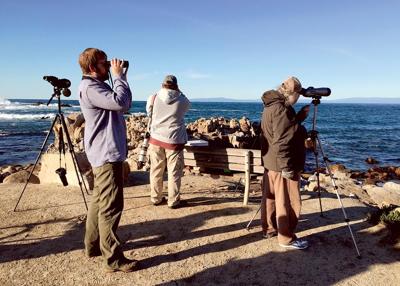

Tony Leukering stands off the road near Point Pinos, looking toward the sea on a sun-splashed winter afternoon. He’s wearing binoculars and holding a “clicker” to tally seabirds flitting by in the sunshine, heading south for winter. About a half dozen volunteers stand nearby.
It’s mid-December, the last day of “Seawatch,” a six-week count of various seabirds migrating south through Monterey Bay en route to Mexico.
“We’ve always known what goes by,” Leukering says, “but we don’t know how many of them go by.”
Though seabirds are a crucial part of the local ecosystem, Seawatch is the first-ever count of those birds undertaken. Leukering and a team of volunteers have been tracking numbers from dawn to dusk every day from Nov. 1-Dec. 15.
The primary bird Leukering and everyone else focus on is the Pacific loon, for two reasons. The first is that the loon is a migratory bird that breeds in the Arctic, a vast landscape where it’s prohibitively expensive to do any kind of nest counts. (This is in contrast to a bird that may breed on islands in the Sea of Cortez, where all scientists need to do is take a few hikes.) As such, the sample data scientists have about loons is small.
“That’s not a good way to know what is happening,” Leukering says. “Let’s say there are 1.5 million loons, and we lose half. We might not notice it without counting the loons going by.”
The second reason is loons hug the coast as they migrate, and are generally more visible and predictable than many other birds.
“The loons are really nice to count, because they’re easy,” says Brian Sullivan, a Cornell University ornithologist who is based locally and is standing a few feet away. “Some of the more interesting birds are hard to count. Their daily patterns aren’t as obvious.”
Leukering echoes this, but adds nuance. “There’s a timing in the day that has a pulse to it,” he says, adding that mornings and late afternoon are the peak times. “But there are curveballs.”
Sullivan, who hatched the idea for the count, says Monterey Bay is one of the premier places on the West Coast to see migrating seabirds, and that there is no place locally that tops Point Pinos.
“This is by far the best place to see them from shore,” Sullivan says. Even the birds that don’t hug the coast and shoot straight south from Santa Cruz pass by the point.
“Probably over half the world’s supply of Pacific loons pass by this point,” Leukering adds.
The hope is that the count is the first of many, and will provide a baseline number of certain migratory seabird populations, which can be used to understand the health not only of the bird populations, but of various ecosystems along their migratory path.
“The idea was to measure the heartbeat of the Monterey Bay,” Sullivan says, adding that what’s happening in the Bay, and with its fish stocks, is intertwined with the number of birds.
Together, the two men contain a wealth of bird knowledge: Leukering, who lives in Florida, has been studying birds for more than 30 years. Sullivan is the project leader for eBird (ebird.org), a Cornell-developed online database and mobile app that provides a real-time ability for scientists and birders to log sightings.
“We gather 5 to 10 million bird records a month,” Sullivan says.
“It’s revolutionized birding,” says Carol Rose, a Monterey birder who’s standing nearby.
Also in the group is Don Roberson, who’s been birding locally for about 45 years, and who is staying focused on counting as others talk to me. Roberson has an extensive knowledge of the local bird populations, and is somewhat surprised by what the count has revealed.
“It’s less than we thought. Maybe the population’s gone down,” he says.
Roberson tells of a count sometime in the ’80s off Pigeon Point in Pescadero where about 1 million Pacific loons were counted in spring as they migrated back to the Arctic. This winter at Point Pinos, Leukering and other counters have only tallied around 250,000.
“That’s surprising,” he says.
Moments later, a gray whale surfaces a few hundred feet off the point, and everyone’s eyes come off the sky.
“That’s about eight for the day,” Leukering says.
As the whale dips back under the surface, Rose makes an announcement: “There are two black oystercatchers coming, and you can hear them the whole way.”
Sure enough, they glide by from the southeast, chirping the whole way as they pass the point and head south.
Despite the afternoon being sunny, winter has arrived, and these seabirds know where they must go: south.


(0) comments
Welcome to the discussion.
Log In
Keep it Clean. Please avoid obscene, vulgar, lewd, racist or sexually-oriented language.
PLEASE TURN OFF YOUR CAPS LOCK.
Don't Threaten. Threats of harming another person will not be tolerated.
Be Truthful. Don't knowingly lie about anyone or anything.
Be Nice. No racism, sexism or any sort of -ism that is degrading to another person.
Be Proactive. Use the 'Report' link on each comment to let us know of abusive posts.
Share with Us. We'd love to hear eyewitness accounts, the history behind an article.