"Everybody thinks dying people have the answers, Ric Masten told me less than a month before he left. “I don’t.”
It would be hard to blame people for thinking this particular dying person had the answers, because Masten has spun them simply and insightfully for decades, despite the depth and severity of the questions he confronted.
The old poet was merely trying to decipher the world: “I don’t write about things I understand,” he said, “I write to better understand things.”
In the face of war he wrote, “I ain’t afraid to step in your bitter streets/ And walk away from war/ I ain’t afraid though the boulevard’s full of heat/ And hate – an open sore…But when I see all the hate in me – I’m afraid.”
In the face of cancer, he gave us defiance and candor: his self-researched medicine transformed a four-month allowance to live into nine years he called the best of his life – “I’m blessed with a constant reminder to never let another unexplored moment slip by” – and told an online audience of each milligram of medicine and each fierce bit of coping with chemo (“soreness in my pubis has almost disappeared. The electric shooting sciatic pain in my right thigh and knee is quite another story. I’m now walking with a cane, bent over and looking like a tall troll.”)
And in the face of imminent death, he gave us honesty. He wrote about suicidal thoughts and fears for his wife’s care and dying friends. And he kept shooting us straight: “Toko writes, ‘Death poems are an illusion – death is death.’/ so try as I might my attempts/ all turn out to be about life.”
Legacy Writ Large: “My father was a big man - not of stature, but of spirit,” says Jerri Masten.
They called him a humorist and a philosopher and a free spirit. They called him a songwriter, they called him the soul of Big Sur, and they called him a survivor.
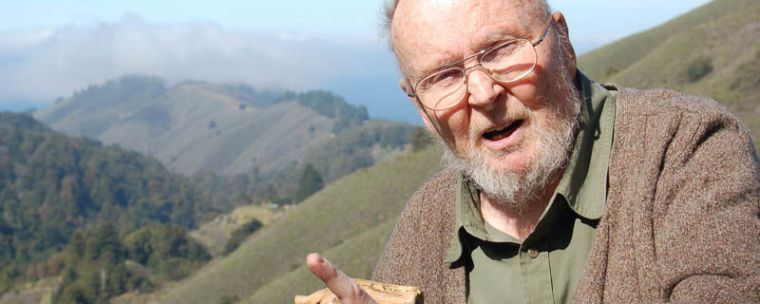
But Ric Masten knew what he really wanted people to call him. “I’m an ordained troubadour minister in the Unitarian church, and I’ve got an honorary doctorate from CSUMB,” he told me while standing atop a piney Big Sur ridge near the land where he built his family’s home. A giggle glowed in his eyes, as it often did. “I want people to call me ‘reverend doctor.’ Then I’ll get business cards that say, ‘Rev. Dr. Ah Soh.’ ”
Jerri Masten called him Dad.
She was there with all but two of his survivors (his wife Billie Barbara, his other children April, Ellen and Stuart, and five grandchildren) – when her father’s chest went still 10 minutes short of midnight Friday, May 9. The family gathered in the candlelight around him and sang the piece with which he often concluded each poetry reading, the poem whose title he had tattooed upon his shoulder on a relatively recent skin-ink session with his grandson, the verses that doubled as his life mantra until the end: “Let It Be a Dance.”
“I know it sounds a little corny, with the family all around singing,” Jerri says, “but Dad was a little bit corny – and a little bit rock and roll. It was a great ending.
“When he died, I kissed his face, and walked out of room, joy in my heart, and yelled, ‘Yee haw, he did it’ – he lived in a good way and died in a good way.”
Ric Masten lived in a good way – and, just as importantly, he lived his way.
In what he called one of his proudest moments, the five-time college dropout received a distinguished fellow of the arts nod from CSUMB. “Rather than be stuck with me, a poet, for the next 50 minutes,” he told the students, “go in your mind to that activity and place where you would rather be now and ask yourself if you could earn a living doing that – there.”
He lived his dreams, which knew several iterations early – after growing up in Carmel the son of a journalist and a domineering mother (then a step-dad optometrist), he flunked hard in college, then studied art in Paris and was (briefly) a prolific painter, then jumped to theater, then moved into songwriting in Hollywood, ultimately penning close to 100 songs that included several hits. He soon shifted his focus to a more-selfless form of music – folk – which along with a spiritual yearning, led him to travel from coast to coast reciting meaningful and magnetic prose and poems that brought people to a questioning church (“They called me a troubadour minister,” he says. “And the first guy to sing his way into the ministry.”)
Ultimately he became a poet because, according to him, he couldn’t remember the words to his songs. As a poet, he said, he wouldn’t feel bad lugging his binders on stage.
Locally his First Night Monterey appearances were frequently the most popular components of the many-layered events. He published 23 books, right up until his death. The latest of his franchise of drawings and paired poetry, Ric Masten: Words and One-Liners, came out this month; Going Out Dancing: Poems will appear June 6. His art reiterates the revealing eye that appears in his poetry. Meanwhile, he continued to spurn fancy wordplay by necessity, and for potency. “I’m not trying to impress you with the ways I push words around,” he says. “I’m trying to reach you with the experiences that have marked me…we aren’t that much different.”
Masten wasn’t much different less than three weeks before he would leave his body like he was on another cross-country tour (“I’d have a hard time leaving here to go on tour,” he said, “but when I hit the corner of Palo Colorado and Highway 1, I was gone”). He lay in his bed on a Saturday afternoon, with a dream catcher woven through a turtle shell above him, a lifetime of portraits looking on, and the scent of wild Palo Colorado herbs in the air.
The conversation swung from art (“All you have to do is experience something and it’s ‘art’ ”) to religion (“It’s easier to kill than convert,”) and settled on dying: “I was born during the Great Depression. Wouldn’t it be great to make it to my birthday [June 20] and die during the second great depression?!”
The candor was there, too, as always. “Morphine is great – I have no pain, but a dead face which I don’t like – it’s hard to eat, I don’t know where my mouth is.”
His eyes still leapt; his hands still swooped and his laugh still danced.
“I now understand what my doctor meant in that first meeting [after he was diagnosed with cancer], ‘I promise you a graceful end.’ That sort of moved me down the road a little, put me back in the human race, where I’m better off.”
Then conversation came back to him and his audience. He paused, smiled, and then fixed his lively eyes upon his audience again.
“You have a heart I’d be happy to be carried around in.”
The Masten family plans a public memorial on Ric’s birthday, June 20. Details will be available at www.ric-masten.net
Keep it Clean. Please avoid obscene, vulgar, lewd,
racist or sexually-oriented language. PLEASE TURN OFF YOUR CAPS LOCK. Don't Threaten. Threats of harming another
person will not be tolerated. Be Truthful. Don't knowingly lie about anyone
or anything. Be Nice. No racism, sexism or any sort of -ism
that is degrading to another person. Be Proactive. Use the 'Report' link on
each comment to let us know of abusive posts. Share with Us. We'd love to hear eyewitness
accounts, the history behind an article.


(0) comments
Welcome to the discussion.
Log In
Keep it Clean. Please avoid obscene, vulgar, lewd, racist or sexually-oriented language.
PLEASE TURN OFF YOUR CAPS LOCK.
Don't Threaten. Threats of harming another person will not be tolerated.
Be Truthful. Don't knowingly lie about anyone or anything.
Be Nice. No racism, sexism or any sort of -ism that is degrading to another person.
Be Proactive. Use the 'Report' link on each comment to let us know of abusive posts.
Share with Us. We'd love to hear eyewitness accounts, the history behind an article.