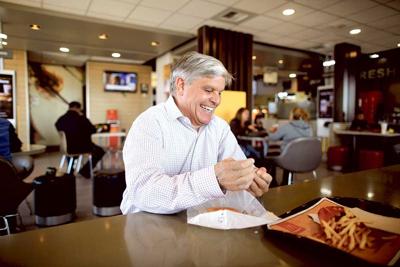

It was a hardscrabble childhood for Raymond Costa and his five brothers and sisters, growing up on a small dairy farm in the Central Valley near Turlock. Their father died when Costa was 9, and the dairy never made any money. He eventually enrolled in a community college, but flunked out. He landed a job at a local milk plant, where he worked until the plant closed down, leaving him searching for work – and a way to be his own boss.
“After I lost my job at the milk plant, I thought, ‘This isn’t going to happen to me again,’” he says.
He found work delivering packages for UPS, and spent his free time reading about business. He wasn’t a fan of fast food, but he had a dream: “I read a lot about McDonald’s, and they’ve made more millionaires than any company in the world.”
So Costa applied to a rigorous McDonald’s corporate training program that accepts five people a year. In an applicant pool of 23,000, he was rejected – twice. On his third try, he was accepted and enrolled, and on top of his 40 hours a week at UPS, worked 30 hours in McDonald’s learning the ropes before buying his first franchise in Fort Bragg at age 40. He sold that one and moved to Salinas and bought a franchise in 2000. McDonald’s owns the building and the dirt; the franchisee owns the license and all of the equipment inside. On a recent afternoon, he’s concerned about a new toaster at the Boronda store, installed just hours earlier. The buns for burger and English muffins for McMuffins should be heated to about 170 degrees, warm to the touch; he spears a bun using a thermometer with a long needle, and the temperature reads 165. They’ll need to adjust the controls.
The toaster sits at the beginning of an assembly line and a crew busily prepares an order of 11 Egg McMuffins, starting by cracking eggs into the poacher. Costa enumerates the ways in which he thinks McDonald’s is misunderstood: They use real eggs and real coffee beans they grind for espresso drinks in the store. They now serve apple slices with happy meals (and a smaller serving of fries); as a result McDonald’s is now the largest purveyor of apples in the country. Sodium levels has been subtly shrinking. When they introduced smoothies 10 years ago, they bought 43 million pounds of frozen strawberries out of Watsonville – just to start. And within a few months, they’ll be switching the beef in quarter-pounders from frozen to fresh. The price, $4.69, will not change.
There’s a devoted following for McDonald’s coffee, in particular among seniors, who pay 65 cents and get free refills. One regular, 71-year-old Zygmunt Leszczynski, comes in daily around noon for coffee. Leszczynski says he’s never found the same boost anywhere else: “It gives me a jump start, a burst of energy,” he says. “It’s so cheap, sometimes I feel like I’m stealing.”
Margins are small, and expected to get smaller with rising costs, in particular minimum wage. Costa is eyeing more franchises, and says that’s the corporate vision: fewer franchisees who each own more stores as a more effective business model. (As his own small empire has grown, so too has the corporate scale: The Alisal store is McDonald’s No. 690, and Greenfield, which opened in 2016, is No. 37,400.)
As Costa has built his business, he has also cultivated a charity. Last year, he put $100,000 into a scholarship fund at the Community Foundation for Monterey County. Employees and their family members can apply for up to $5,000 toward tuition costs, something Costa intends to continue doing annually. His own son is now studying communications at Arizona State University.
“My message to my son is, don’t do it my way. Go get an education. I worked twice as hard as I should’ve to get where I got.”
Even today, Costa allows himself just one afternoon off, usually Sundays, each week. He says he wears out a pickup truck every three or four years driving around to all 10 stores, from Salinas to King City, delivering parts, fixing stuff and checking in. Six months ago, he got his first office space, where he and his management team will work on training materials – for 700 employees.
“It’s been a rags-to-riches story,” he says. “It’s been a lot of hard work.”
And it’s built on the simple concept of the all-American food: the burger. “There’s nothing better than a hamburger,” Costa says. (Chicken is more popular in California, but burgers remain king on the East Coast, he adds: “They’re red meat people over there.”)
His favorite menu item is the small hamburger, but he’s partial to the burgers he makes himself at home using ground beef from Star Market. After wrapping up a burger-and-fries lunch at the Boronda store, he says, “There’s nothing better than a burger. I’ll eat one here, then tonight I’ll go barbecue a burger for dinner.”


(0) comments
Welcome to the discussion.
Log In
Keep it Clean. Please avoid obscene, vulgar, lewd, racist or sexually-oriented language.
PLEASE TURN OFF YOUR CAPS LOCK.
Don't Threaten. Threats of harming another person will not be tolerated.
Be Truthful. Don't knowingly lie about anyone or anything.
Be Nice. No racism, sexism or any sort of -ism that is degrading to another person.
Be Proactive. Use the 'Report' link on each comment to let us know of abusive posts.
Share with Us. We'd love to hear eyewitness accounts, the history behind an article.