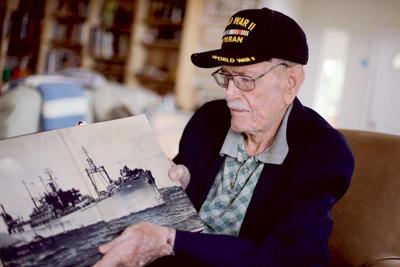

Philip G. Nelson sits in his communication command center: a large tan reclining chair in his Prunedale family room, flanked on both sides by small tables that hold a desk phone, important mail and files he might need at a moment’s notice. A flat-screen TV sits atop a tall oak entertainment center, often tuned to favorite old Westerns like the The Big Valley or Bonanza, and it serves as 91-year-old Nelson’s window to the world.
Another wall in full view of his recliner is loaded with photos and memorabilia of a different communication center he once operated, a radio shack aboard the the USS Chandeleur. For most of World War II, Nelson sent and received secret Morse code messages in the South Pacific as a radioman while the Chandeleur ran covert missions, carrying men and supplies to islands captured from Japan by the Navy. From his perch inside the ship’s radio room, Nelson witnessed kamikaze planes swoop in with machine guns blazing – only one shipmate died during one such attack – and dive into nearby ships.
“We worried like hell at them kamikazes, and you couldn’t shoot them down,” says Nelson, who today loves to share news clippings from his life and a book of memories about the Chandeleur with visitors. Even now, at 91, Nelson’s memory of those years at sea are vivid.
Although he and his shipmates risked their lives, the thought of danger didn’t occur to Nelson prior to enlisting in 1942.
“I wanted to go into the Navy and be a sailor, that’s all. And when I did, I never gave any thought to combat,” he says. “I was too dumb to be scared.”
When Nelson showed up as a small-framed, baby-faced kid of 17 – a “squirt,” he says – Navy recruiters didn’t believe he was old enough to enlist. His mother had to come with him to vouch for his age. Once he joined, it didn’t take long for other sailors to christen him with the nickname “Pee Wee.”
The Chandeleur took the young sailor to tropical islands all over the South Pacific, and at least twice over the equator, crossings that were celebrated with raucous King Neptune ceremonies where first-timers got their heads shaved and covered with axle grease. Nelson proudly shows off his ornate King Neptune certificate now hanging in his bedroom.
One sailor on board with Nelson during a crossing was a young Marine lieutenant named Joe McCarthy, who went on to become the infamous U.S. senator that fomented the Red Scare. Nelson remembers McCarthy from an earlier era, and recalls him slipping on a ladder during the ceremony, and getting a small cut that drew blood. Nelson says McCarthy claimed the injury was a “war wound,” worthy of a medal.
During one kamikaze attack, Nelson got himself tied up into knots, so to speak, before running for cover.
“I used to be pretty limber and I could pull both feet up behind my neck. Well, I was showing the guys how I could do that, and all of a sudden here comes the kamikazes out of the sky, and I couldn’t get unwound,” he laughs. “So they had to unwind me and get me down from on top of the radio shack.”
Perhaps because he could type, or maybe it was his ability to spin yarns and tell jokes, Nelson was enlisted to publish the ship’s newspaper. He put out a special edition at the end of the war with a hand drawn cover, that announces in bubble letters, “GLOBAL WAR ENDS!!!! Total Victory for Allies.” He keeps a copy in plastic sheet protectors to share with visitors.
Nelson remembers Christmastime aboard the ship, when the crew did “crazy stuff.” “We had guys that dressed up like women, they’d do a little skit,” a la South Pacific. Nelson himself was once asked to perform, but he says he “begged off.”
There were more somber times on the Chandeleur, but despite enduring the trials of wartime, Nelson says he loved his time with the Navy: “I wouldn’t take anything in the world for the experiences I had.”
Sit awhile with Nelson, and the stories keep pouring out, like “his fairytale” – the time he gave “the most beautiful girl in the world” a friendship ring that she enthusiastically mistook for an engagement ring. (The mistake turned out OK: Nelson and his wife Polly were married in Aromas and raised four children, spending 55 years together before she died in 2013.)
Nelson supported his family working at the Moss Landing power plant for 18 years for Pacific Gas & Electric (it’s now owned by Dynegy) as a cement finisher, and was later elected as the business agent and financial secretary for the Cement Masons and Plasterers Union. When he first retired, he played golf four days a week, but these days he spends more time in his big tan recliner.
“I’ve led a charmed life,” Nelson says. “I don’t know how I got this far.”


(0) comments
Welcome to the discussion.
Log In
Keep it Clean. Please avoid obscene, vulgar, lewd, racist or sexually-oriented language.
PLEASE TURN OFF YOUR CAPS LOCK.
Don't Threaten. Threats of harming another person will not be tolerated.
Be Truthful. Don't knowingly lie about anyone or anything.
Be Nice. No racism, sexism or any sort of -ism that is degrading to another person.
Be Proactive. Use the 'Report' link on each comment to let us know of abusive posts.
Share with Us. We'd love to hear eyewitness accounts, the history behind an article.