
When terrestrial forests burn, or are decimated by disease or industry, the impact is visual and visceral, the reaction loud and urgent. Screaming firetrucks race by, politicians gather and declare, interest groups organize. Funding is funneled and argued over.
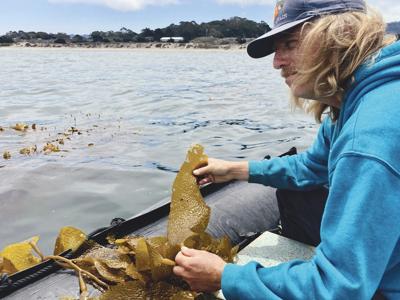
Over the last eight years, Monterey County has experienced significant deforestation of its own, and as Keith Rootsaert kills his motor and drifts above the rubble, he acknowledges the challenges of addressing a silent and mostly invisible crisis.
“When forests burn on land, it smells and it chokes you and you see it and you have thousands of people go out and do something about it,” Rootsaert says aboard his two-person boat, looking across Monterey Bay. “But under here, no one even knows it’s burning. No one has been putting it out, no one has been allowed to put it out.”
Rootsaert, a diver in the Monterey Bay since the 1980s, says the bay’s kelp forests have long made it an international diving destination. However, since 2013, the bay’s forests have been mowed down by sea urchins, a population that has exploded thanks to a disease that wiped out the sunflower sea star—a key urchin predator. Ten years ago, the tips of 30-foot kelp stalks might have dragged across the bottom of Rootsaert’s boat as he drifted off the coast of Del Monte Beach. “Underneath us right now,” he says, “is just rock and urchins.”
With the blessing of the California Fish and Game Commission, Rootsaert is leading an experiment under the bay’s surface: Humans with hammers are playing urchin predator. The humans—trained and organized volunteer divers with fishing licenses—are using pointed welding hammers to, one-by-one, systematically eliminate large swaths of the urchin population, all within a 100-by-100-meter grid about 265 yards off Del Monte Beach.
Since the start of the program in April, Rootsaert says the growing team of about 60 trained divers has killed more than 105,000 urchins.
“At one point, we were doing 55.8 urchins per minute,” Rootsaert says. “During one session, I stayed in one spot and culled 400 urchins. The team got like 2,000 urchins in 25 minutes.”
The numbers reflect the dramatic imbalance that has evolved on the bay’s floor. At Lovers Point in 2014, nonprofit Reef Check counted 26 stems of giant kelp and four sea urchins. In 2019, the group counted zero giant kelp stems and 782 urchins. Across the bay, the giant kelp population dropped more than 50 percent between 2013 and 2019, while the urchin population shot up nearly 26,000 percent.
“You realize almost right away once you go down there that it’s just overwhelming,” Rootsaert says. “Unless you’re organized with a lot of people, you’re not really going to be able to do anything.”
The program requires a fishing license and many divers take a culling class now offered at Bamboo Reef or Aquarius Dive Shop. The class emphasizes the importance of not disturbing the ecosystem. Proper culling of an urchin is not as simple as a single tap of the hammer. The goal is to completely damage the urchins’ reproductive organs to prevent repopulation, which takes a few swings.
Questions have swirled over whether striking the urchins is the best method, since healthy urchins reproduce by sending clouds of egg and sperm cells into the water in the hopes the cells find each other and mix. Cracking them open can trigger this spawning and some wonder whether relocating the urchins into a landfill is better.
Steve Webster, marine biologist and co-founder of the Monterey Bay Aquarium, says urchins typically reproduce in the winter and, since the urchin program runs from April to October, culling them in the bay is “probably fine” as the reproductive cells aren’t as viable in the spring and summer. Rootsaert says they aren’t leaving that up to chance and biologists are actively studying whether culling them on the bay floor is effective.
“We’re still figuring out whether this is a useful tool,” Rootsaert says. “But this is the new way of the ocean. We now have to be permanent stewards.”


(0) comments
Welcome to the discussion.
Log In
Keep it Clean. Please avoid obscene, vulgar, lewd, racist or sexually-oriented language.
PLEASE TURN OFF YOUR CAPS LOCK.
Don't Threaten. Threats of harming another person will not be tolerated.
Be Truthful. Don't knowingly lie about anyone or anything.
Be Nice. No racism, sexism or any sort of -ism that is degrading to another person.
Be Proactive. Use the 'Report' link on each comment to let us know of abusive posts.
Share with Us. We'd love to hear eyewitness accounts, the history behind an article.