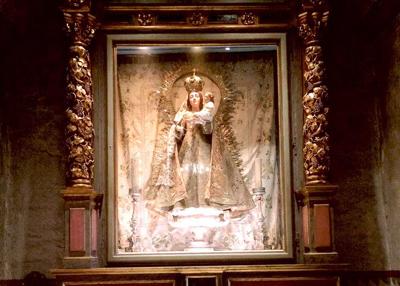
At 5-foot-2, her figure is petite. Her lips are red, her cheeks rosy. Her floor-length dress fans around her in dusty shades of yellow, gold and beige. Hand-carved from wood in the 15th century, she wears a silver crown and cradles baby Jesus in the crook of her left arm. Our Lady of Bethlehem resides at Mission San Carlos Borromeo, better known as Carmel Mission, but the details of her centuries-long history remain largely unknown.
In 2011, Dr. Marian T. Horvat was drawn to Our Lady’s “regal yet maternal” presence. Horvat, a Catholic blogger who lives in Los Angeles, is president of Tradition in Action, Inc., a center for Catholic culture. Horvat wanted to know where the statue came from, and set out to learn its story, unearthing primary documents, mostly in Spanish. (She’s now working on a short book about it.)
Our Lady’s name, Nuestra Señora de Belén, or Virgin of Restelo, originates from a shrine outside of Belem Tower, designed to protect a harbor in Lisbon, Portugal. As explorers sailed, they prayed to the Virgin for protection and safe passage. While the exact origin of Our Lady hasn’t been placed, she likely was carved in Spain, then at some point made that safe passage herself, arriving in the New World.
By 1769, Spain had established missions throughout Mexico, and Father Junipero Serra was tasked with establishing the first mission in Alta California. Don José de Gálvez, General Visitor of Spain, helped Serra plan “The Sacred Expedition,” and Our Lady’s presence was meant to ensure success. Serra promised Gálvez he would ensure Our Lady’s return to Mexico after a cross was planted in Alta California.
Our Lady’s second title became La Conquistadora in Alta California, where she was intended to conquer the souls of indigenous people with her beauty and piety, according to Horvat.
Father Serra left La Paz, Mexico, traveling by land. He would meet a sea expedition, led by Don Gaspar de Portolá, governor of the Peninsula of California, in San Diego, then continue to Monterey. The first leg of the journey was a grueling 750-mile trek to San Diego. Despite a badly infected leg, the 65-year-old priest continued north on foot.
According to Horvat’s research, there were three ships on “the Sacred Expedition.” One was lost at sea. Sailors on another were struck with scurvy. The third, the San Antonio, arrived safely in San Diego, Our Lady traveling in cargo. Her strength, it seemed, was limitless.
The journey continued, and on July 16, 1769, Serra planted a cross. The Spanish had reached Monterey.
On July 3, 1770, Our Lady sailed on the San Antonio back to Mexico, to be returned to Gálvez as promised. But he had a change of heart, Horvat says. He felt she belonged with Serra, so he decided the statue would sail north again, returning to California.
In December 1771, the Mission relocated from the Presidio to Carmel. Native Americans began to frequent the mission and by 1773, Serra reported more converts than at any other mission. Horvat reports some of those new converts thought baby Jesus looked emaciated and was in need of nourishment.
As time went on, Our Lady stood watch to growing unrest in the Catholic Church. By 1836, Carmel Mission was abandoned and its grounds began to fall into disrepair. But Our Lady wasn’t forgotten.
The details of this time period remain vague, but Horvat believes the sculpture was cared for by Dona Maria Ignacia Dutra, a member of the Cantua family, one of the last indigenous families associated with the Carmel Mission. In 1876, Dutra moved to Monterey, taking Our Lady with her. In 1948, Our Lady was returned to the mission, perhaps by distant relatives of the Cantua family.
After her return, Our Lady was hidden away in a dark corner of the mission until she was rediscovered and moved inside a former mortuary chapel.
By this time, Our Lady needed attention. Harry Downie, a cabinet maker with a reputation for skillful attention to Spanish antiques, took on the task of restoration.
Downie had first been recruited by a Monterey pastor in 1931 to restore a few statues, and stayed on for 50 years, repairing and maintaining pieces. (Downie, who died in 1980, is buried at Carmel Mission.)
The statue’s hands and face, made of gesso plaster, held up well through the years, but Downie gave her some touch-ups. He outfitted Our Lady with his mother’s real hair. Her ears are adorned with solid gold acorn earrings dating back to 1773. Even after Downie died, a Pebble Beach woman donated a Spanish rosary made of emerald-colored glass and gold, which also hangs from Our Lady’s neck. She also wears a gold locket, which once belonged to Downie’s mother.


(0) comments
Welcome to the discussion.
Log In
Keep it Clean. Please avoid obscene, vulgar, lewd, racist or sexually-oriented language.
PLEASE TURN OFF YOUR CAPS LOCK.
Don't Threaten. Threats of harming another person will not be tolerated.
Be Truthful. Don't knowingly lie about anyone or anything.
Be Nice. No racism, sexism or any sort of -ism that is degrading to another person.
Be Proactive. Use the 'Report' link on each comment to let us know of abusive posts.
Share with Us. We'd love to hear eyewitness accounts, the history behind an article.