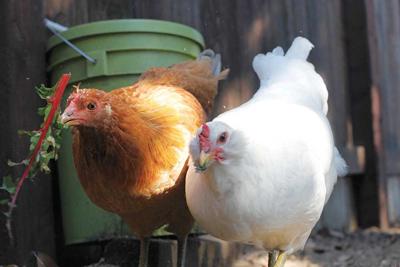

All I wanted was fresh eggs, a pursuit that turned into a crash course in animal husbandry, including learning how to sex chickens.
For years, I have grown my own vegetables in raised beds in the backyard and composted food scraps in an attempt to live more sustainably and to complement home-cooked meals. About a year ago, I decided the next addition should be laying hens.
My research – talking to chicken-keepers, and reading about backyard chickens online – suggested keeping the birds would be easy.
Chris Olow, who co-owns Hacienda Hay & Feed in Carmel Valley with his wife, contributed to that expectation. “It’s five minutes in the morning and five minutes in the evening,” he says. “All you need is food, water and protection from predators.”
Olow estimates his store has sold over 2,000 baby chicks since March 1, to everyone from small-scale urban hobbyists to large landowners in South County who buy upward of 100 birds at a time.
The food, water and shelter parts were straightforward, as promised. I got a water trough and stainless steel cans for food. I built a pen, burying about a foot of chicken wire in the sand to keep out raccoons, and assembled a bright red coop from a $200 Home Depot kit, designed to hold up to four hens.
For food, I stopped by the Feed Trough on Highway 68 in Salinas. The Feed Trough resembles a grocery store, save for bales of hay out back and a container of chirping chicks as you walk in. For $15, I bought 25-pound bags of feed and scratch. (I was back a week later for another bag.)
I also did my legal research. City of Seaside municipal code allows no more than four adult animals (dogs, cats and hens, among others) per household, so my flock would have a population cap. (City code, however, prohibits hooved animals, roosters, geese and peacocks.)
My next step was to buy the birds. The Feed Trough generally sells more than 200 chicks a month, according to manager Jeremy Prather. Most are the little yellow fuzzballs that immediately come to mind when you think of baby chicks, but raising them to laying age is a lengthy process. When the birds are young, they often need heat lamps and a very controlled environment.
I didn’t want to wait five months to start harvesting eggs. So I decided to look for birds 6 months to 1 year old, perusing classified ads and Facebook farming groups.
I found a farmer on River Road in Salinas selling 3-month-old pullets, or adolescent hens. A horse grazed on a pasture near his idyllic small farm, on a dirt road just beyond a few blocks of country-style houses. I ended up buying four birds – one gray, two red, one white – for $12 each.
For a week, everything was easy, just like Olow said it would be. I’d let the birds out of the coop at 6am and they roosted just after dark, around 8:30pm. They ate vegetable scraps out of my hand.
It was about a week later that the crowing started. And it started at 5am.
Before a rooster fully develops an adult crow, it sounds more like a human coughing than a classic cock-a-doodle-do.
So much for my flock of four hens.
I looked for signs of who the rooster imposter was. Beginning around 4 months old, there’s the development of tail feathers and a larger hackle, which is the red growth on the head and bottom of the beak. Nothing.
The most obvious sign, of course, is crowing. But I wasn’t sure which chicken was the rooster culprit; I just heard the crowing at 5am and wanted it to stop.
I sat in the coop before dawn one morning until I saw the suspect crow. The farmer agreed to trade him out for a hen (while we were at it, he agreed to swap out a second suspect bird as well, who was beginning to show rooster-like tail feathers.) Problem solved.
I took an apology tour of the neighborhood. I knocked on doors like a teenager apologizing for breaking a window with a baseball. (Fortunately, only one neighbor had heard the early-morning crowing. I followed up by leaving a note and a bottle of wine on her doorstep. She came over the next day to meet the chickens.)
Mornings were quiet, and the birds went back to munching chicken feed and food scraps.
Then, a week later, the crowing began again. At 5am.
Once again, I called up the farmer. For a second time, we did a swap. As the saying goes, “Third time’s a charm.”
But it wasn’t. All four of the original chickens I bought turned out to be roosters. (On the fourth try, I got my money back instead of a new bird.)
Now I have three hens – yes, hens – and quiet.


(0) comments
Welcome to the discussion.
Log In
Keep it Clean. Please avoid obscene, vulgar, lewd, racist or sexually-oriented language.
PLEASE TURN OFF YOUR CAPS LOCK.
Don't Threaten. Threats of harming another person will not be tolerated.
Be Truthful. Don't knowingly lie about anyone or anything.
Be Nice. No racism, sexism or any sort of -ism that is degrading to another person.
Be Proactive. Use the 'Report' link on each comment to let us know of abusive posts.
Share with Us. We'd love to hear eyewitness accounts, the history behind an article.