
It’s the middle of a busy Wednesday afternoon at CSU Monterey Bay, as students cram for their last finals before winter break. People are hurrying about their business when suddenly, six staff members sprint past a row of cubicles. Their steps slam loudly in a quiet office. They pant heavily as they turn a corner, then pick up the pace. They slam through a door to the outside, and flee the scene – an active shooter is on a rampage through their office.
Only there is no active shooter. There’s just a film crew of three CSUMB grads, CSUMB Police Chief Earl Lawson and Brooke Holmquist, a former KION reporter who’s now in public affairs for CSUMB. Holmquist is directing.
“You guys are just booking it,” she says, showing the cast the escape path before this take. As the cameramen get in position, one member of the group giggles, and Holmquist gives her final instructions, shouting, “Remember, don’t smile! You’re scared, frightened!”
They resume positions and do it all again so the film crew can get this flight scene from another angle.
“It’s not just us and our iPhones or whatever,” Lawson says. “We’re hoping this is going to be production-quality.”
The CSUMB Police Department started offering active-shooter preparedness trainings a few years ago, though at first, they had to ask to be invited. That’s changed, especially in the past year.
“It’s popular,” Lawson says. “It depends on what’s happening in the world.” That translated to a record 17 trainings last semester at CSUMB, which happened against the backdrop of several deadly shootings: On Oct. 1, nine people were killed at Umpqua Community College in Oregon; on Nov. 29, three were killed at a Planned Parenthood in Colorado Springs; on Dec. 2, 14 people were killed at a holiday party for county employees in San Bernardino.
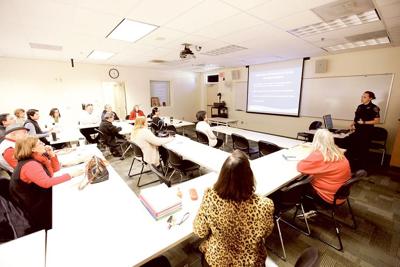
These stories, among others, have lodged themselves somewhere in the consciousness of about 20 faculty members in the school of world languages and culture. They’re eating shrimp cocktail out of plastic cups at their Dec. 16 holiday party, when Corp. Carolyn Peliova arrives to lead a training. The mood almost instantly chills.
“There is no pattern or method to their selection of victims,” Peliova says. “There’s usually no negotiating with these kinds people – that’s why we try to prepare you guys.”
Just five minutes into her presentation, Peliova plays a short video made by the U.S. Department of Homeland Security. It’s called Run, Hide, Fight – your best options, in short order, when it comes to surviving a random attack.
“It may feel like just another day at the office,” the narrator intones, as the camera pans an office and shows people getting into an elevator, drinking coffee, talking on the phone. “But sometimes, bad people do bad things.”
The video shows a man unzip his backpack, pull out a shotgun and open fire; office workers fall dead in the lobby around him.
The narrator goes on to deliver tips for surviving a mass shooting: Run away if you can, and call for help. If you don’t have a safe exit route, find a hiding place; lock the door, turn out the lights and shut off your cell phone – including vibrate. If the shooter finds you, fight for your life with a chair, a belt, anything that can serve as a weapon.
Meanwhile, across campus, Holmquist is working with the film crew to capture the running segment of their own video that will replace Run, Hide, Fight. The cast is looking for a place outside to show them safely hiding from the shooter’s view, then calling 911. But they want to avoid an unattractive electrical box, and just beyond that, a parking lot is landscaped with knee-high grasses – not enough cover. They walk across the parking lot to crouch behind a parked car; when brothers Joshua and Nick Fryou of River Guys Productions edit the video, they’ll make it look closer.
In the background, out of view of the cameras, CSUMB police are doing real-time policing. Just beyond the parking lot where filming is underway, officers approach a probationer who’s yelling profanities at a bus stop, and quietly send him on his way.
The video, which should be complete within weeks, will be about five minutes long and will cost about $5,000. It will not have real shooting, but it does use a real CSUMB PD firearm.
Lawson hopes the CSUMB-specific video is more compelling for students, who are far outnumbered by faculty and staff when it comes to the training. “If this video turns out as well as I hope it does, it will become part of mandated [freshman] training,” Lawson says. As the group of a half-dozen faculty members squat in the parking lot, he adds, “Acting is not as easy as it looks.”


(0) comments
Welcome to the discussion.
Log In
Keep it Clean. Please avoid obscene, vulgar, lewd, racist or sexually-oriented language.
PLEASE TURN OFF YOUR CAPS LOCK.
Don't Threaten. Threats of harming another person will not be tolerated.
Be Truthful. Don't knowingly lie about anyone or anything.
Be Nice. No racism, sexism or any sort of -ism that is degrading to another person.
Be Proactive. Use the 'Report' link on each comment to let us know of abusive posts.
Share with Us. We'd love to hear eyewitness accounts, the history behind an article.