
Stark white construction lights highlight hunched-over workers diligently drilling and hammering away at the walls. The project began as a fascination about Baja California’s biological and environmental diversity three years ago, and now it’s undergoing its finishing touches. It looks like a mess of wires, wood and empty glass displays, but it’s soon to be the Monterey Bay Aquarium’s new exhibit, “¡Viva Baja! Life On the Edge.”
Aquarium Senior Exhibit Developer Raúl Nava calculated the years of careful planning and building to see the exhibit finished on schedule, and ready to take viewers on a journey. Nava says the biggest challenge was “deciding how to frame the entire story.”
The exhibit’s interactive narrative is actually a stitching together of multiple ongoing and past environmental conservation efforts from the region. Baja was the setting for successes such as the locally sustained and budding ecotourism industry of Cabo Pulmo, but also for ongoing battles, like enforcing laws to save the vaquita, a critically endangered porpoise. While the Mexican government has a good track record for enacting regulations, the timing and effectiveness of those laws give many ecological fixes no clear beginning, middle or end – but plenty of plot twists.
The exhibit includes three easy-to-understand sections that reflect Baja’s three major habitats and the importance of active conservation in each.
“Near the Edge” shows the diversity of the coastal deserts of Baja, the only full-time land-bound species the Aquarium has displayed. A large glass case houses desert tortoises. Smaller displays will show iridescent scorpions under black light, and the vibrant red and black marks of a mountain kingsnake. The exhibit highlights the extreme conditions of this habitat with an interactive display revealing reptilian adaptations to extreme temperature changes using cartoon animation.
The next section, “At the Edge,” centers around mangrove forests, where salty waters of the Pacific mix with fresh waters from coastal deserts’ estuaries. Nava calls it a “critical nursery” for many land and marine species, such as the frigatebird. Animation demonstrates how they utilize mangrove trees for shelter, and how they wean and nest their young in the gnarly branches.
Nearby, a circular glass case houses a replica of a mangrove tree sprouting from muddy sand. Its central placement emphasizes how much life revolves around the swampy coastal forest.
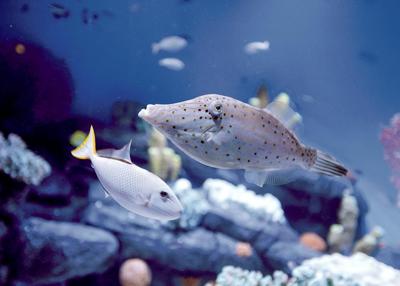
The last section, “Over the Edge,” is mostly made up of displays with replicated corals and artificial sponges. It’s soon to be filled with various colors of angelfish and jawfish. A peculiar group of hermit crabs called staghorns have arrived early, donning their pointy coral homes.
This part of the exhibit shows the diversity of animals, like a school of Mexican lookdowns and Cortez rainbow wrasses, found off the Baja coast in places like the Sea of Cortez. It also integrates a gaming element. Several touch screens are installed; here, visitors can color their own fish and “release” them into the (virtual) wild. The freshly decorated fishes can then be emailed back to the artist as a souvenir.
A few more educational points come from the exhibit’s bilingual storyboards, where visitors can educate themselves on real-life environmental success stories. For example, the “At the Edge” storyboard details the destruction of mangrove forest to build large-scale resorts. The second side describes how the collaborative efforts of conservationists, locals and the Mexican government worked to build and sustain smaller, low-impact resorts and an ecotourism industry.
“A lot of people don’t know this, but Mexico is leading the charge for ecological conservation in Latin America,” Nava says.
So Baja’s tale is one of success, and also a lesson in teamwork.
“We wanted to highlight that collaboration,” Aquarium spokesman Ken Peterson says. “We didn’t want to tell our visitors a story where a bunch of environmentalists went in telling locals they don’t know any better.”
The exhibit is projected to be seen by at least 1.8 million visitors a year. Though Nava admits that “it’s easy to show only the doom and gloom” about such a troubled environment, the aquarium’s focus is to look to what can be done.
“Not only do we have to conserve Baja for future generations,” he says, “but we want to tell people that we have to act now to sustain it.”
It’s a message of urgency conveyed with both reality and vibrancy.


(0) comments
Welcome to the discussion.
Log In
Keep it Clean. Please avoid obscene, vulgar, lewd, racist or sexually-oriented language.
PLEASE TURN OFF YOUR CAPS LOCK.
Don't Threaten. Threats of harming another person will not be tolerated.
Be Truthful. Don't knowingly lie about anyone or anything.
Be Nice. No racism, sexism or any sort of -ism that is degrading to another person.
Be Proactive. Use the 'Report' link on each comment to let us know of abusive posts.
Share with Us. We'd love to hear eyewitness accounts, the history behind an article.