
A structure made of cables, circuits, plastic and metal frames that moves up and down trapping ping-pong balls might sound like a basic game, but this is an intricate process.
A 450,000-gallon pool is half full of murky, greenish seawater, and the balls are confined within a 4-by-4-foot PVC frame. A robotic net moves up and down, trying to grab the balls. On the beach, a team underneath a shade tent is watching a screen, rather than the action in the water – they’re monitoring a camera and watching to see how this robot performs at what could be a useful project removing litter from the ocean.
Middle and high school students have been preparing for this day for months. It’s part of a competition for students working to develop technology skills meant to solve real-world problems with remotely operated underwater vehicles, or ROVs.
On Saturday, June 19, the students gathered at the Naval Postgraduate School’s Sea Land Air Military Research facility on Del Monte Beach in Monterey to test their concepts in front of a panel of judges.
“It’s really about preparing students for the technical workplace. It’s about workforce development, and giving them this pathway to apply their skills to engineer our robots to solve real-world problems,” says Jill Zande, executive director of Marine Advanced Technology Education for Inspiration and Innovation (MATE II).
MATE II is a nonprofit that grew out of the MATE Center at Monterey Peninsula College. The program is built to prepare the next generation of engineers, ocean scientists and technologists.
Students don’t need previous knowledge in STEM or robotics to participate. “We teach them how to design and build an underwater robot,” Zande says. That can include workshops, books and other instructional resources. And when it comes to actually building a robot, MATE II has starter kits: “We realized that a huge barrier to participation was access to parts and pieces, and just figuring out how to get started,” Zande adds.
Kitara Crain, an electrical engineer at Intel and mentor to the Geneseas team at Saint Francis Catholic High School in Sacramento, says engineering can seem scary, especially because in the movies it’s depicted as lab workers in white coats solving complex problems. But it can be simple: “If a parent changes a sprinkler or an outlet, that’s engineering,” she says. “It’s all about problem solving.”
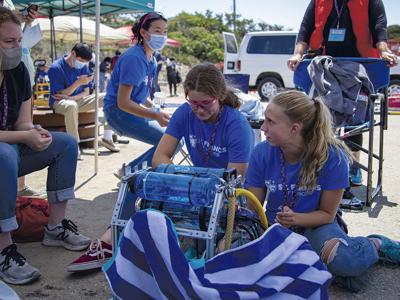
The Geneseas team behind the ping-pong ball-catcher built a robot made largely from water bottles. The bottles are filled with cables, cameras, motors on the sides and a goalie net on top.
On competition day, there were challenges from the start. Only three of their five cameras were working and the compartments weren’t completely sealed – water got to the ethernet cable that transfers data. Once the robot was submerged, they lost two more cameras. But that’s all part of the process, Crain says: “This just gives kids the confidence that they can do anything and that mistakes are OK.”
Challenges aside, the team was able to complete their task, and placed first.
Riley Glenn, an 18-year-old Geneseas team member, notes no one on her team had previous STEM experience, but it was a change to apply science lessons to real life. “We decided to come out here to show how girls in STEM can get involved,” she adds.
This year, the MATE ROV Competition celebrated its 20th anniversary. The big changes in those 20 years, Zande says, are that parts are easier to find and robot sizes have gotten smaller.
The first MATE competition happened in 2001 at the Monterey Sports Center; since then, it has expanded to 42 regional competitions in the U.S. and gone international, with participants in 36 countries as about 800 teams globally compete to land a spot in the international competition.
Geneseas and the Warrior Tides Team from Valley Christian High School in San Jose advanced to the world championship, taking place at East Tennessee State University from Aug. 5-7.


(0) comments
Welcome to the discussion.
Log In
Keep it Clean. Please avoid obscene, vulgar, lewd, racist or sexually-oriented language.
PLEASE TURN OFF YOUR CAPS LOCK.
Don't Threaten. Threats of harming another person will not be tolerated.
Be Truthful. Don't knowingly lie about anyone or anything.
Be Nice. No racism, sexism or any sort of -ism that is degrading to another person.
Be Proactive. Use the 'Report' link on each comment to let us know of abusive posts.
Share with Us. We'd love to hear eyewitness accounts, the history behind an article.