
I am the kind of person who can plan things to a tee, but will at the last minute get nervous and jittery. That’s what living with anxiety is like sometimes: You’re OK, until you’re not.
It makes things that are marketed as “therapeutic” or “restorative” hard sells for me. Massages? No thanks. A pedicure? Please don’t ask me to be in your bridal party.
So despite my initial excitement about floating in a salty pool for an hour in Pacific Grove’s Theta Float Spa, while walking toward the spa, I felt a creeping wave of nervous energy in my stomach.
I arrived in a group of four: myself; my boyfriend, a programmer who is hunched over a computer all day; one of my sisters, a pediatrician who talks to babies six days a week; and another sister, a barista who wakes up at ungodly hours to interact with people before they’ve been caffeinated. We were a crippled bunch, claiming all sorts of ailments from our jobs, our sleep schedules and exercise regimens (or lack thereof).
Upon entering the spa, we first sat down to sign some forms. One page warned us about health risks (for those with diabetes or epilepsy) and not to float under the influence.
The other page was like a survey. Why did we want to float? What mental and physical issues did we want to help mitigate? I checked off anxiety and insomnia.

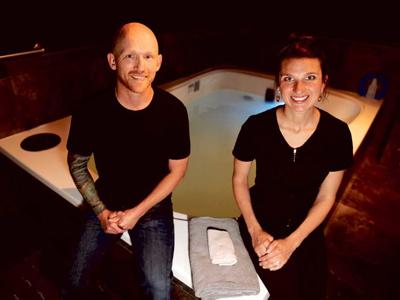
Duke and Caitlin Kelso say it takes about 40 minutes to get to the “theta state,” when your brain finally starts to calm down.
The pools like those used at Theta, which opened in April, aren’t a new technology. It was first developed by neuroscientist and physician John C. Lily, who in the 1950s studied the effects of large-brained mammals – like humans – in environments with no external stimulation. Hence the other name for these pools: sensory deprivation tanks.
Over time, the tanks have come to be used as a type of alternative treatment for people with physical conditions like chronic pain and mental illnesses like ADHD and depression. “Being in a zero-gravity environment helps with alignment,” Theta Float Spa co-founder Duke Kelso says.
By “alignment,” he means that floating helps release the pressure on the skeletal and muscular system that comes from day-to-day stressors like too much exercise or not enough.
Other purported benefits come from the lack of outside stimulation that would usually engage our senses – no bright light, no conversation. Without processing outside stimuli, the floater can focus on what’s in their head.
Like Noah’s Ark, we were off to the pools two-by-two, led into what looked like a hotel bathroom, with low lighting and high humidity, with an extra-large bathtub. I was relieved that it was an open pool – not an enclosed tank.
“Yeah, tanks are kind of scary,” says Caitlin Kelso, a co-founder and massage therapist of the spa (and also Duke’s wife). “We don’t want people to feel claustrophobic.”
My boyfriend and I shampooed our hair and showered to remove any excess dirt and oil. We plugged in our complimentary earbuds, blocking out the noise and hopped into the pool. The water was around 98 degrees – the internal temperature of the human body.
Upon submerging my body up to my neck, I immediately resurfaced – not of my own volition, but because the salinity of the water makes people extra buoyant. Around 1,500 pounds of epsom salt is added to the purified water.
Floating for a mere five minutes, I was aching to do something. I closed my eyes, but it wasn’t enough for me to relax. I began tapping my fingers, touching my toes and fingers to the walls of the pool, anything to get some sensory stimulation. I had to stop and think, “Am I doing this right?”
Caitlin Kelso’s short answer: yes. “That’s normal for the first time,” she says. “It’s the last 20 or so minutes that you reach the ‘theta state.’” That’s the state neuroscientists have observed when your brain is about to fall asleep.
Kelso was right. For 40 minutes I was unable to stay still, floating in circles and orbiting my boyfriend, because I was bored.
Eventually I did yield – to my twitching toes, to my creaky right ankle, to my tapping fingers. I was so into the mellow state that by around minute 55, when I introduced some deep breathing, it was over.
After a quick shower I met up with the other half of my motley crew. Each of us reported some physical lightness. For me, it was increased flexibility in my back. Mentally, I didn’t get there. But as Duke says, it’s not meant as a cure-all, especially on the first go.
“It’s just another tool,” he says. “Use it as you need.”


(0) comments
Welcome to the discussion.
Log In
Keep it Clean. Please avoid obscene, vulgar, lewd, racist or sexually-oriented language.
PLEASE TURN OFF YOUR CAPS LOCK.
Don't Threaten. Threats of harming another person will not be tolerated.
Be Truthful. Don't knowingly lie about anyone or anything.
Be Nice. No racism, sexism or any sort of -ism that is degrading to another person.
Be Proactive. Use the 'Report' link on each comment to let us know of abusive posts.
Share with Us. We'd love to hear eyewitness accounts, the history behind an article.