
Teddy Kuster had reason to feel competitive. His first wife, Una, had left him – then a prominent Los Angeles attorney – for an upstart poet nobody had heard of, Robinson Jeffers. In 1921, Kuster followed the couple from Southern California to Carmel, where they’d go on to build a stone cottage and accompanying tower, perched conspicuously on Carmel Point. Kuster followed with his own stone house, a block away.
The small city was already known for its thriving arts scene, but Kuster was disappointed in the quality of the theater on Monte Verde Street, a hub for artists of all stripes in what was then called the Arts & Crafts Clubhouse. “He took a look at the theater that was going on, and he decided it was very amateurish,” says Stephen Moorer, founder and executive director of Pacific Repertory Theatre. In keeping with his habit, Kuster decided he would spend $75,000 of his own money and build his own theater, just down the street. “It made him kind of a love/hate figure in town,” Moorer says.
It was game on – Kuster set out to build a 300-seat theater on Ocean Avenue, while the members of the Arts & Crafts Clubhouse undertook their own project just a few blocks away. “In 1922-23, in a town that had only 400 or 500 people living in it, there were two 300-seat theaters being built. It was super competition,” Moorer says.
Kuster spared no expense, building a domed ceiling and the best technology, what the San Francisco Daily News called “the most advanced step in theater design in the country.”
By 1935, Kuster’s Golden Bough Theatre was a cultural landmark, putting on plays, hosting touring shows, screening movies. (The competing venue down the road decided to collaborate, and became a rehearsal space for Golden Bough.) Some 100,000 audience members came through each year, and some plays – many of them premiers – ran for only one weekend, meaning the Golden Bough was churning through material, with up to 50 different plays per year; Carmel had arrived on the arts map, including in the realm of the stage. “It was just this huge hotbed of artistic output,” Moorer says.
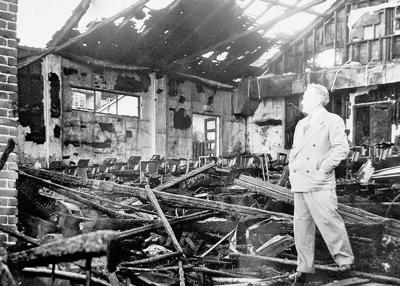
Kuster and the theater remained controversial, with a number of actors and playwrights whose work he’d deemed not good enough for his venue. (There were also regular Communist group meetings happening there.) So there was reason to suspect arson when one weekend in 1935, at the peak of Golden Bough’s success, the theater mysteriously burned down. It was the opening weekend of a production of By Candlelight, a German comedy newly translated into English.
Kuster rebuilt on Monte Verde at the Clubhouse, this time calling it the Golden Bough Playhouse, and the tradition carried on. That was until 1949, when the aging cast of By Candlelight approached Kuster and asked for another shot at producing the play they’d memorized and rehearsed.
Within a week of opening the play, the Golden Bough burned to the ground.
“We’ll never do By Candlelight,” Moorer says. “Now we’ve got our theater built the way we like it.”
Kuster was out of money, but he did rebuild one more time, in 1952, thanks to a massive fundraising effort. The Golden Bough went on to become a movie theater – where Moorer remembers seeing the original Star Wars in 1978 – and was then set to be sold and subdivided into four residential lots.
Fast forward to 1994, and Moorer was running Pacific Repertory Theatre in the Monterey Playhouse, a venue in downtown Monterey, and looking for a permanent home as the lease was running out. On a drive through Carmel, he passed by the site of the shuttered movie theater and saw the for sale sign – the day it had gone on the market. It seemed like the venue’s luck had turned – and so had PacRep’s.
PacRep spent $1.2 million to buy the place – double what the nonprofit theater company had been looking to spend – and has gone on to remodel the Golden Bough into a contemporary theater, with phase two set to begin next year, and fund raising just completed. About 25,000 people come through each year for shows – not as many as in Kuster’s heydey, but still, “in a community this size, that’s a lot,” Moorer says.
Down the street on Ocean Avenue, the Cottage of Sweets now hawks fudge and taffy from the spot where the original Golden Bough used to be. Manager Monse Zepeda says the staff sometimes hears mysterious sounds coming from the attic, or find a fan turning on for no reason – something employees attribute to ghosts associated with the fire. The original box office window remains on an exterior wall, now covered on the inside by jars of candy.
“It’s that classic never-give-up story,” Moorer says. “These theaters keep burning down, but this community keeps building them.”


(0) comments
Welcome to the discussion.
Log In
Keep it Clean. Please avoid obscene, vulgar, lewd, racist or sexually-oriented language.
PLEASE TURN OFF YOUR CAPS LOCK.
Don't Threaten. Threats of harming another person will not be tolerated.
Be Truthful. Don't knowingly lie about anyone or anything.
Be Nice. No racism, sexism or any sort of -ism that is degrading to another person.
Be Proactive. Use the 'Report' link on each comment to let us know of abusive posts.
Share with Us. We'd love to hear eyewitness accounts, the history behind an article.