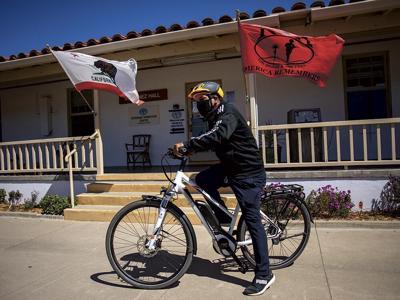

As he locks up his bicycle in front of the Veterans Transition Center in Marina, Benjamin Cobar is wearing navy blue pants and a black, long-sleeved jacket – it looks uncomfortably warm for a cyclist on a near-70-degree day.
Taking off his helmet, the 42-year-old Navy veteran unveils a tuft of stringy black hair that offers no evidence of exertion or perspiration. Cobar lives only a stone’s throw from the VTC, but has just returned from a successful job interview at the Home Depot in Seaside, 6.2 miles away. The trip, he says, took about 35 minutes.
“If that was a normal bike, he’d still be pedaling. And way sweatier,” says Dan Scott, VTC’s intake coordinator, and a passionate cyclist himself.
Cobar is one of two veterans at the VTC who recently received an e-bike, or an electric assist bicycle, from the Sea Otter Classic Foundation, the nonprofit arm of the annual Monterey cycling event. The foundation has donated conventional bicycles to the veterans nonprofit in the past but 2021 marks the first donation of the increasingly popular e-bikes. Jeff Lindenthal, executive director of the Sea Otter foundation, says it is hard to deny the trend and their utility. The nonprofit pitched the idea last year for Monterey County Gives!, and raised $5,700 for its first e-bike purchases.
After a two-year stint in the Navy where he worked kitchen shifts on an aircraft carrier in the Pacific Ocean, Cobar spent six years teaching English in Japan but eventually burned out. When he decided to return to the U.S. in January, he needed help getting on his feet and was directed to the transition center. There, he received help with housing, health care and food.
Finding a job, however, proved challenging without reliable transportation. Not only could Cobar not afford a car without a job, but he doesn’t have a driver’s license – something he says was unnecessary with Japan’s world-class public transportation. In Marina, he had difficulty navigating the local transit system, as buses are infrequent and often late, sometimes by as much as 20 minutes. Cobar, who is also studying for professional certification exams and driver’s license tests, says taking a bus back and forth to job centers like Seaside and Monterey wasted hours he could not afford to lose. Riding a conventional bicycle was more reliable, but considerably more tiring.
The e-bike, Cobar says, offered more independence and convenience, which he feels are important as he tries to build his life in the U.S. (As the Weekly went to print, Cobar had been removed from the VTC program.)
The rise of e-bikes may not be obvious to the casual observer. Aside from the large, rechargeable battery often placed on the downtube of the bike’s frame, e-bikes look like an average bicycle. They come in all shapes and styles, from 10-speed commuter bikes and mountain bikes to beach cruisers. Most sell for $1,500 to $4,000. To move, e-bikes still require pedaling; however, the chosen level of pedal assist determines who is doing more work – the battery, or the cyclist.
I tested an e-bike out for the first time on a ride with Cobar through some back streets around the VTC. An infrequent cyclist, I cranked the assist as we approached a steep incline. I was amazed to find my pedaling felt more like a formality than a crucial act of physical exertion. On the way back down the same hill, I kept the assist cranked just to test it – Cobar did the same. We hit a slightly frightening speed of 25 miles per hour, indicated by the digital speedometer attached to Cobar’s handlebars. (Cobar says his record is 29.) After roughly two miles, I produced not a bead of sweat, even on a warm day.
E-bikes aren’t new – the first patent for an electric bicycle dates back to 1895 – but their popularity is soaring. According to a 2019 report by Deloitte, e-bike sales in the U.S. reached more than 400,000 in 2018, a 73-percent year-over-year increase. By comparison, S&P Global reports that 296,000 electric vehicles were sold in 2020.
After seeing the impact of two bikes, Lindenthal says the Sea Otter Classic Foundation plans to continue donating e-bikes to the VTC.


(0) comments
Welcome to the discussion.
Log In
Keep it Clean. Please avoid obscene, vulgar, lewd, racist or sexually-oriented language.
PLEASE TURN OFF YOUR CAPS LOCK.
Don't Threaten. Threats of harming another person will not be tolerated.
Be Truthful. Don't knowingly lie about anyone or anything.
Be Nice. No racism, sexism or any sort of -ism that is degrading to another person.
Be Proactive. Use the 'Report' link on each comment to let us know of abusive posts.
Share with Us. We'd love to hear eyewitness accounts, the history behind an article.