
As the Blackfin catamaran approaches the Monterey Submarine Canyon on a late October morning, Isaiah Foulks, a naturalist with Monterey Bay Whale Watch, doesn’t have to think long when asked if he’s seen anything unusual this past summer.
“Flying fish is the weirdest thing,” he says. “They’re common in tropical waters, but here in Monterey Bay, it’s nearly unheard of.”
Foulks says he’s also seen mako sharks and great whites, and moments later, he turns to hear chatter from the captain’s cabin in the background, then turns back with a smile.
“Common dolphins are a warm water species extremely rare to Monterey Bay, but you’re about to see 200 of them.”
Over the last year, and even two years, marine and bird life in and around Monterey Bay has been nothing less than spectacular, and often, atypical.
But in an El Niño year, which brings warmer waters to our area, coupled with a separate, recent phenomenon called “the blob” – which has brought record high temperatures to the North Pacific Ocean – typical is not to be expected: Monterey Bay measured 69 degrees this past August, the highest on record.
Hanging out in the captain’s cabin, Chris Hartzell, vice president of Monterey Audubon Society and a marine life enthusiast, ticks off the some the crazy sightings he has logged over the past season: basking sharks in the early summer (“first in many many years”), bonito (“very, very unusual”) and a loggerhead turtle in late September (“maybe the first ever sighting”).
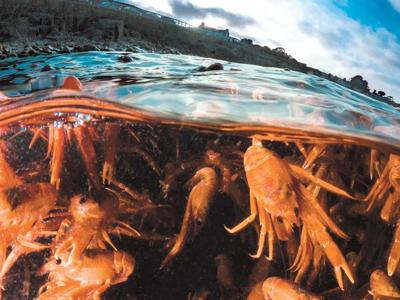
There’s also been the massive influx of pelagic red crabs that hit Pacific Grove early October, the three hammerhead sharks seen by fishermen a few miles off Point Pinos and the dozen or so fin whales seen outside the bay.
Though Hartzell is a birder, he defers seabird questions to Debi Shearwater, a Hollister resident who’s been leading seabird watching expeditions on the Bay for the last 40 years (Shearwater, which is also a seabird species, legally changed her last name years ago).
“She is truly, honestly, one of the world’s leading seabird experts,” he says.
Shearwater, speaking on the phone a few days later from Texas, where she is attending a birding festival, has plenty to say about recent winged anomalies.
She says there has been an explosion of brown boobys – normally seen in Baja – along the California coast, and even a blue-footed booby. Perhaps more remarkable, she says, are the black-vented shearwaters that have been seen in the tens of thousands.
But the rarest thing she’s seen this season is a white-chinned petrel, which is normally only seen “far, far south.” And it put on a show.
“They look like they’re dancing on water,” Shearwater says. “Walking on water like St. Peter.”
Nancy Black, co-owner, naturalist and captain for Monterey Bay Whale Watch, adds her own observations.
“The warm water brought thousands of long-beaked common dolphins, more than we’ve seen in 30 years,” she says. “On some days, we’d see three schools of 5,000 in one day.”
She adds that bottlenose dolphins were formerly unseen here, but migrated north during the ’82-’83 El Niño season and ending up settling here. But she says it’s the whales and sea lions – drawn by the unusually high number of near-shore anchovies these past two years – that have provided the biggest wow factor.
“In August and September, we saw 32 humpbacks all in the same group, when we normally see two to three. The group sizes were amazing,” she says.
Black adds she saw over 1,000 sea lions in a tight group herding anchovies, with humpbacks diving in the middle. She believes they were communicating.
“They were working together as a group, not as individuals,” she says.
Even more memorable was a time she saw orcas attacking common dolphins, and a dolphin knocked 20 feet in the air.
Black says that if any species follows the path of bottlenose dolphins – colonizing the Bay after an El Niño season – she’d bet it’s common dolphins.
“They have a good food source here,” Black says. “It will be interesting to see if that happens.”
Back on the boat, as the Blackfin makes it way back to Monterey after seeing a few pods of common dolphins and five humpbacks, Captain John Mayer pulls up alongside a common sight in the Bay: mola mola, aka ocean sunfish.
The disc-shaped mola mola is turned up to the surface, which Foulks tells the passengers is to absorb heat.
After a few minutes, the mola mola flips vertical and drops below the surface, which feels like a metaphor. It’s time to start cooling off.


(0) comments
Welcome to the discussion.
Log In
Keep it Clean. Please avoid obscene, vulgar, lewd, racist or sexually-oriented language.
PLEASE TURN OFF YOUR CAPS LOCK.
Don't Threaten. Threats of harming another person will not be tolerated.
Be Truthful. Don't knowingly lie about anyone or anything.
Be Nice. No racism, sexism or any sort of -ism that is degrading to another person.
Be Proactive. Use the 'Report' link on each comment to let us know of abusive posts.
Share with Us. We'd love to hear eyewitness accounts, the history behind an article.