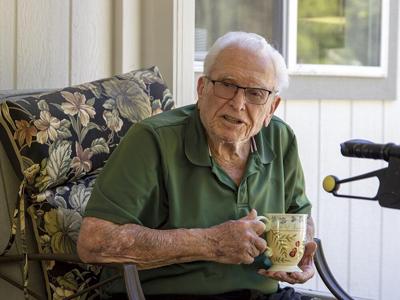

Getting a badge and being a peace officer was very different back in the day. Attending a police academy wasn’t required, once you were hired you were an officer 24/7, and one of the requirements to get hired was knowing how to shoot a gun.
Ted Brown, now 91, retired in 1983 as a Monterey County lieutenant sheriff. He was born in Oklahoma, and as a kid he didn’t like going to school, despite getting good grades. He dropped out when he was 15, and worked as a dishwasher and a cemetery caretaker.
In his late teens, Brown moved to California and worked as an ambulance driver in Salinas. He then became a sheriff’s deputy at 23, and says he learned his day-to-day duties from other officers. “I was forged in that place with a veteran officer that knew what he was doing,” Brown says. “I got a lot of training that way.”
Brown says he almost didn’t get the job, not due to lack of qualification, but because the sheriff at that time didn’t trust “Okies” coming west from Oklahoma.
At some point, deputies’ uniforms changed from caps to stetson hats, and officers were required to have two for when one was sent away for cleaning; each hat cost $25, pricey at the time.
These are some of the details and memories Brown has from early in his career. He reflects on these memories from the screened-in patio at his home near Arroyo Seco during a conversation with Juan Martinez of Gonzales. Martinez is collecting oral histories from people who remember the time when, in 1970, United Farm Workers cofounder Cesar Chavez was incarcerated in the Monterey County Jail in Salinas. Brown was working in the jail during those days.
“He was a good prisoner,” Brown recalls. “We had to keep him isolated because of his status as a civil prisoner.”
Chavez was jailed just once in his activist career, for refusing to call off the lettuce boycott, and spent 20 days in the old jail that today sits unused on West Alisal Street in front of the Monterey County government center. (Martinez campaigned to make the old jail part of the Cesar Chavez National Monument, but lost out to a site near Bakersfield that was a former UFW headquarters and where Chavez died in 1993.)
Two days after Chavez was arrested, Ethel Kennedy, the widow of U.S. Senator Robert F. Kennedy, visited him in jail on the night of Dec. 6, 1970. Brown says there was a large crowd, up to 400 people, and a group of farmers held signs and chanted, “Ethel go home! Ethel go home!” Across the street, UFW protesters expressed support for Chavez; the rally stayed peaceful, but Brown remembers suggesting to Kennedy’s security guard that she depart through a back door, rather than through the tense crowd out front. “We could’ve had a full-scale riot there,” Brown says. They escorted her through the jail’s back door. Riot averted.
In interviews, Kennedy said Chavez was kept in a padded cell, a comment that irked Brown at the time. “We didn’t have a padded cell in that jail,” he says. “It was ridiculous.”
As he collects history about the farmworker movement, Martinez has long been determined to pinpoint which cell housed Chavez; Brown says it was on the first floor, in the second cell to the right of the door.
“I wanted to know about his cell because there were questions about where he was housed,” Martinez says.
Brown has other memories of his years in the Monterey County Sheriff’s Office, including staffing the 1967 Monterey Pop Festival when Jimi Hendrix and Janis Joplin were in town.
During his over 30 years as an officer, Brown shot his gun four times. One time was when he responded to a call at midnight at a labor camp on Natividad Road, and he and his partner detained two men from San Francisco who’d broken into a house after hearing an old man there kept lots of money hidden in his house. Brown says one of the suspects attempted to shoot, but his gun malfunctioned.
Brown says throughout his career, he aimed to just enforce the law: “I never tried to take sides.”


(0) comments
Welcome to the discussion.
Log In
Keep it Clean. Please avoid obscene, vulgar, lewd, racist or sexually-oriented language.
PLEASE TURN OFF YOUR CAPS LOCK.
Don't Threaten. Threats of harming another person will not be tolerated.
Be Truthful. Don't knowingly lie about anyone or anything.
Be Nice. No racism, sexism or any sort of -ism that is degrading to another person.
Be Proactive. Use the 'Report' link on each comment to let us know of abusive posts.
Share with Us. We'd love to hear eyewitness accounts, the history behind an article.