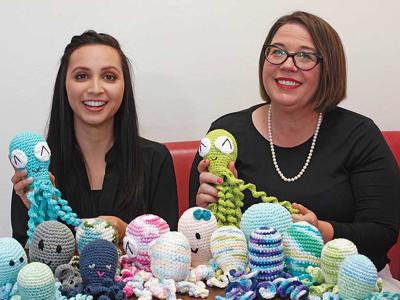
A 6-month-old baby boy wouldn’t stop pulling his oxygen tubes with his tiny hands. He was a client of the foster care nonprofit Kinship Center Family Ties Program in Salinas, where Permanency Specialist Lauren Stroud was assigned to prepare the baby’s legal paperwork in the summer of 2017.
The baby’s caregiver asked Stroud for help: the prematurely born baby was under 24-hour care, and nothing seemed to keep the tubes in place. Stroud recalled social media posts she’d seen on a story about using crocheted octopuses as a form of therapy in the Neonatal Care Unit at the Poole Hospital in the U.K. She shared the idea with the boy’s caregiver, and case manager Esther Hobbs.
Hobbs and Stroud decided to try it. They looked for a crocheted cephalopod companion with no success. Hobbs suggested they ask her friend to make one; Stroud purchased an octopus crochet pattern online, and their first crocheted octopus was born.
While the 6-month-old was sleeping, his caregiver handed him the octopus, which they now refer to as a Tiny Tentacle. One sleeping hand tightly clutched the oxygen tube that was helping the baby breathe. A caregiver put the baby’s free hand on one of the octopus’ arms, and without waking up, he moved his other tiny hand away from the tubes, and around another cephalopod limb.
Soon after, what would become the Tiny Tentacle Project had its second and third client: 3-month-old twins who had been exposed to domestic violence arrived at the Kinship Center. The pair wouldn’t smile, were quick to cry and had difficulty attaching to their caregivers. “[They were] crying when the caregivers were trying to give them the octopuses,” Stroud says. “They placed the twins in their own musical rockers, gave them their octopuses, and within a few moments, they started to calm down.”
With three success stories, Stroud and Hobbs were convinced of the power of tentacles. They decided to pursue a project.
This idea isn’t new: A Denmark-based group first introduced it in 2013. An all-volunteer project there attracted attention, leading to similar efforts in Sweden, Norway, Iceland and Germany, and a smattering in the U.S. Studies conducted in Denmark and the U.K. showed the crocheted creatures help calm babies in intensive care, giving them a tentacle to grip – more than teddy bears or other stuffed animals offer – thereby helping regulate their breathing and heart rates, resulting in stable blood pressure and higher blood-oxygen levels. The thinking is that the octopus arms remind infants of their umbilical cord and, by extension, the womb.
Stroud, 31, says she was fascinated by how effective such a simple intervention could be. Hobbs, 48, has a more personal reason for getting involved: Her younger brother, who was born six weeks premature. (Now 30, he is healthy.)
“Starting off, we weren’t prepared for how [Tiny Tentacles] was going to grow,” Stroud says.
Hobbs and Stroud are still learning to crochet, so they rely on crocheters across the nation. They connect on Facebook, volunteers crochet an octopus, and ship it to Carmel to be distributed. A group of Santa Cruz women recently crocheted 37 Tiny Tentacles that will be given to the Community Hospital of the Monterey Peninsula and Jacob’s Heart, a children’s cancer support service in Watsonville.
A single Tiny Tentacle takes, on average, four to eight hours to make, and not just any pattern will do. “Some of the patterns we’ve found are either too small or they don’t include a face,” Stroud adds.
A friend made them a pattern with what parents are requesting: an octopus with big eyes and a smile. (And that’s not so small that it’s a choking hazard.)
The overall look, size and number of tentacles depends on the pattern and the volunteer artist behind it. Some are small, others have heads about the size of a baby’s, and all have colorful tentacles. There’s an occasional jellyfish or other creature in the mix, but most of the existing patterns are for octopuses.
Demand is growing: The Tiny Tentacles Project gave out 28 octopuses in 2017, and more than 34 so far this year. Families from across the country have reached out via Facebook, requesting Tiny Tentacles creatures for their babies. “We had a waitlist because we ran out,” Stroud says.
For now, they’re focused on seeking additional funding via grants, with a target of $10,000, and better coordinating volunteers so supply is consistent.
And Hobbs and Stroud are still learning the art side themselves. “Crocheting is a really personal experience,” Hobbs says, “where you can kind of set your intention and hopes for the baby.”


(1) comment
Esther and I are truly grateful for this story being shared as this project means so much to us. If you don't have Facebook and would like to connect with us about helping The Tiny Tentacles Project, please email us directly: thetinytentaclesproject@gmail.com We typically respond within 24 hours!
-Lauren Stroud
Welcome to the discussion.
Log In
Keep it Clean. Please avoid obscene, vulgar, lewd, racist or sexually-oriented language.
PLEASE TURN OFF YOUR CAPS LOCK.
Don't Threaten. Threats of harming another person will not be tolerated.
Be Truthful. Don't knowingly lie about anyone or anything.
Be Nice. No racism, sexism or any sort of -ism that is degrading to another person.
Be Proactive. Use the 'Report' link on each comment to let us know of abusive posts.
Share with Us. We'd love to hear eyewitness accounts, the history behind an article.