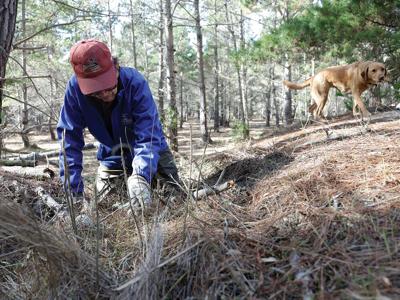
When I first see Alan Washburn on a foggy November morning in Pebble Beach, he is on his knees among the pine needles of the Del Monte Forest. He reaches for the handle of his orange weed wrench as easily as someone reaching for a cup of coffee. His labrador retriever, Maisie, runs to me along the trail, tail wagging, glancing back only to confirm that her human is still behind her, still working.
A professor emeritus of the Naval Postgraduate School, Washburn has spent his retirement walking the forest with a singular, stubborn purpose: removing French broom. Not casually pulling a stray sprig here or there, but committing himself to a near-daily practice, an almost monastic ritual, of spotting the spindly Mediterranean invader and wrenching it from the soil, roots and all.
“I’ve learned to hate it,” he says, matter-of-factly. “Look.” He points to a seed pod split cleanly along the seam. “Those explode. They fling seeds everywhere. If you don’t pull them, you’ll have a hillside full of it before long.”
We stop at a slope where he nods toward what used to be a thicket.
“All French broom,” he says. “You couldn’t even walk up there. They crowd the trees. They crowd the trail.”
The hillside now looks like well-maintained forest, pines rising through a carpet of red-brown needles, small openings where huckleberry and native brush can return. The change is not obvious unless you’ve spent years watching this place. Washburn has.
French brooms have soft yellow blooms in spring, pea-shaped and measure less than a half an inch. Pretty. No irrigation needed. But its charm hides an ecological imbalance. French broom chokes out native species, fuels hotter fires and leaves behind a seed bank that can persist for decades. They can produce more than 8,000 seeds a year.
Washburn started in Monterey’s Quarry Park after a neighborhood volunteer day introduced him to the plant. Eventually, he realized that Monterey prohibits herbicide use on city land.
“You can’t get rid of broom without herbicide,” he says bluntly. “If you avoid pulling it and avoid spraying it, you’re choosing broom.”
Pebble Beach, by contrast, allows herbicide application for follow-up treatment once the big plants are removed. So Washburn began spending his mornings here instead, combining his dog walks with the inevitable workout of weed removal.
He shows me a towering pile of dead branches, one of many. “I pulled all of that,” he says, a little proud, a little amused at his own pride. He works alone most days, but often has helpers on weekends and joins a monthly crew supported by the Pebble Beach Homeowners Association.
The Community Services District, too, has recently conducted large-scale clearing, using mastication equipment to reduce fire fuel. Washburn applauds the effort; he also knows its limitations.
“They cut it and grind it,” he says. “But the stumps will resprout. It’s not their fault; it just means the work has to be repeated.” He squints up the hill. “They took out a lot. More than I ever could. But pulling or spraying is the only way to finish the job.”
Maisie reappears, satisfied with her patrol. Washburn scratches her ear and then hands me the weed wrench. “Your turn,” he says.
I position the orange jaws around the base of a broom stalk. He coaches: “Flush with the ground. Lean back.” The tool bites into the roots. The plant resists. I hesitate. “I don’t like killing things,” I tell him.
He smiles, “I don’t either. But this one is an invader.”
When the plant finally yields, the root snaps free with a dull pop. Washburn inspects the hole.
“Not bad,” he says. “But if you leave any of the pulled plant’s roots attached to the ground, the plant survives.”
Asked why he spends his retirement this way, Washburn shrugs. “I like accomplishing something,” he says. “Golf didn’t do much for me. I’m the kind of person who needs to be useful.” After a pause, he adds, “And I guess I’m apologizing to the Earth. Humans haven’t been very good to her.”
He talks about growing up in Pennsylvania forests, being surprised by things that grow without us. That unpredictability still moves him. “The forest lives on its own,” he says. “It doesn’t belong to us. That’s part of the beauty. The surprise.”


(3) comments
📢 Volunteer as a Weekend Weed Warrior - Jan 10th at Palo Corona!
Come help MPRPD staff tackle invasive weeds on the second Saturday of each month. Each month’s Weekend Weed Warrior event will focus on different areas of our parks and demonstrate various best management practices for invasive species control.
Our first event will tackle French broom (Genista monspessulanus)
🗓️ Jan 10
⏰ 9 am-1 pm
📍 Palo Corona Regional Park Parking Lot
🤸 Participants under 18 must be accompanied by a legal guardian
🥾Recommended items to bring include water, snacks, sun protection, closed-toed shoes, gloves (if you have them), a cheerful attitude, and a willingness to make a positive impact in your parks!
Come prepared to work for up to four hours (as you are able) — and have fun doing it!
Why wouldn't you show a nice close up picture of this invasive plant? Educate us. Will do a search for image. Just seems like an obvious miss. Still LOVE you tons, MNow!
Unsung heros such as Alan deserve recognition. French broom looks pretty, and is a legume similar to our native legumes in the area. However, as Alan notes, it is extremely invasive due to its seed pod ejecting the seeds at high speed, not merely dropping them. We need more volunteers like Alan! https://en.wikipedia.org/wiki/Genista_monspessulana
Welcome to the discussion.
Log In
Keep it Clean. Please avoid obscene, vulgar, lewd, racist or sexually-oriented language.
PLEASE TURN OFF YOUR CAPS LOCK.
Don't Threaten. Threats of harming another person will not be tolerated.
Be Truthful. Don't knowingly lie about anyone or anything.
Be Nice. No racism, sexism or any sort of -ism that is degrading to another person.
Be Proactive. Use the 'Report' link on each comment to let us know of abusive posts.
Share with Us. We'd love to hear eyewitness accounts, the history behind an article.