
Beginning in the 1960s, when human-growth hormone therapy was just emerging to treat very short children, medical examiners in Los Angeles and Minneapolis made a habit of harvesting pituitary glands from cadavers. They’d take the glands, located at the base of the brain, so HGH could be isolated, extracted, then injected into patients.
The news got out that coroners were taking people’s pituitary glands – they’d been doing so without notification to next of kin – and the medical community had a public relations nightmare, not to mention an ethical dilemma, on their hands.
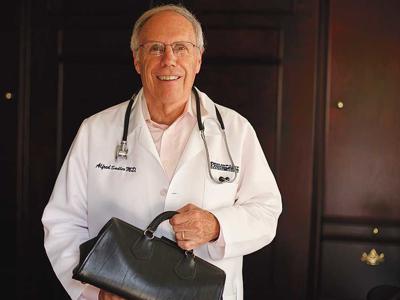
At the same time, in the summer of 1967, identical twin brothers – Alfred, four minutes older, and Blair Sadler – were fresh out of medical school and law school, respectively. They were new at the National Institutes of Health, and Alfred remembers the news of the secret pituitary scheme getting out.
“They said, ‘Sadlers: This is our first problem. What are we doing wrong here?’” Alfred recalls. “NIH said, we don’t want to get in trouble here, any more than we already are. Frankly, it was one of those things that nobody had thought through.”
The Sadlers are the kind of pair who like to think things through, deliberating in philosophical terms about questions of law and medicine. They first realized they might have a good thing going when they got the chance to co-lead a seminar and chose to focus on what are known as Good Samaritan laws, protections for medical professionals (or laypeople) who intervene as passersby in a medical emergency – in some states lacking such laws, they’re not protected legally if the patient dies.
“We did some research on that subject, for no other reason than it was interesting,” Alfred says. “We found that some states had statutes that actually protected the physician or nurse. We gave a talk and thought, ‘People will listen to us young squirts.’”
And listen they did. In 1968, when the brothers were just 27, they published an article titled “Transplantation and the Law: The Need for Organized Sensitivity” in The Georgetown Law Journal. (It was bumped from the first to the second story, to make room for “A recollection of Robert Kennedy as a Lawyer.”)
Both Sadlers talk about their early career rise as “serendipity” – just as they found a niche that interested them from a medical and a legal standpoint, the first successful heart transplant in South Africa made international headlines. “The public interest just skyrocketed in the issue,” Blair says. They went on to help draft a state law allowing organ transplantation, and the National Conference of Commissioners on Uniform State Laws – formed in 1892, and later renamed the Uniform Law Commission – circulated the blueprint to all 50 states. It was adopted everywhere within three years, among the fastest on record in the commission’s history.
“There was a lot of luck that we were in the right place at the right time,” Alfred says.
Organ transplantation laws remain a gold standard today of a uniform law, adopted state by state, that’s held up to the test of time. Fifty years later – and with a notably less cooperative legislative backdrop – the Sadlers are presenting July 20 and 21 in Louisville, Kentucky, when the Uniform Law Commission meets. (On this year’s agenda: regulations related to autonomous vehicles, drones and electronic wills.)
After passing their law, allowing people to opt in as donors of hearts, corneas, livers, kidneys, lungs, pancreas, bone and bowel, the pair went on to start a physician assistant certification program at Yale, then to the Robert Wood Johnson Foundation. Blair never practiced law; he landed at UC San Diego, where he still teaches, and for 26 years was CEO of the Rady Children’s Hospital.
Alfred did go into medicine, though he never transplanted an organ or did a surgery his entire career. He wrapped up his medical residency in his mid-30s – “the old guy in the group” – and went into internal medicine, then urgent care. He moved to Carmel in 1981, and practiced medicine until he retired three years ago. (The Sadlers are now 77.)
“It’s very gratifying, 50 years later, to still see a sound and stable legal framework for something this powerful that’s saving so many lives and improving so many lives,” Blair says. “It’s based on core American values.”
Those values, he says, are volunteerism, consent, autonomy and individuality, noting anyone can opt in accordingly, or choose not to: “It’s not a big government program.”
“This is sort of the best of America. It’s a gift – making the ultimate gift of life.”


(0) comments
Welcome to the discussion.
Log In
Keep it Clean. Please avoid obscene, vulgar, lewd, racist or sexually-oriented language.
PLEASE TURN OFF YOUR CAPS LOCK.
Don't Threaten. Threats of harming another person will not be tolerated.
Be Truthful. Don't knowingly lie about anyone or anything.
Be Nice. No racism, sexism or any sort of -ism that is degrading to another person.
Be Proactive. Use the 'Report' link on each comment to let us know of abusive posts.
Share with Us. We'd love to hear eyewitness accounts, the history behind an article.