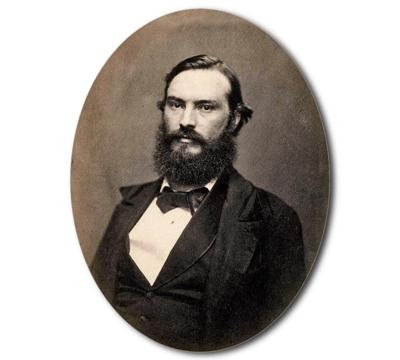

Camp No. 28, Nacimiento River. Saturday afternoon, May 4, 1861
It is a lovely afternoon, intensely hot in the sun, but a wind cools the air. A belt of trees skirts the river. I have retreated to a shady nook by the water, alike out of the sun and wind; a fine, clear, swift stream passes within a few rods of camp, a belt of timber a fourth of a mile wide skirts it – huge cottonwoods and sycamores, with an undergrowth of willows and other shrubs. We have been here three days…
We crossed the San Luis Pass of the Santa Lucia Mountains, a pass about 1,500 or 1,800 feet high, and entered the Santa Margarita Valley. North of the Santa Lucia chain, which trends off to the northwest and ends at Monterey, lies the valley of Salinas, a valley running northwest, widening toward its mouth, and at least a hundred and fifty miles long. This valley branches above. One branch, the west, is the Santa Margarita, into which we descended from the San Luis Pass. We followed down this valley to near its junction with the Salinas River and camped at the Atascadero Ranch, about twenty-two miles from San Luis Obispo and six from the Mission of Santa Margarita.
On passing the Santa Lucia the entire aspect of the country changed. It was as if we had passed into another land and another clime. The Salinas Valley thus far is much less verdant than we anticipated. There are more trees but less grass. Imagine a plain 10 to 20 miles wide, cut up by valleys into innumerable hills from 200 to 400 feet high, their summits of nearly the same level, their sides rounded into gentle slopes. The soil is already dry and parched, the grass already as dry as hay, except along streams, the hills brown as a stubble field.
The Mission of Santa Margarita was in ruins. It is the seat of a fine ranch which was sold a few days ago for $45,000. The owner, Don Joaquin de Estrada, lives now at Atascadero Ranch, where we camped. This last ranch is all he now has left of all his estates.
Five years ago he had sixteen leagues of land (each league over 4,400 acres, or over 70,000 acres of land), 12,000 head of cattle, 4,000 horses, etc. Dissipation is scattering it at the rate of thousands of dollars for a single spree. Thus the ranches are fast passing out of the hands of the native population.
Camp No. 29, Jolon Ranch, on San Antonio River, May 8
The American who has this ranch keeps 15,000 or 16,000 sheep. He is a very gentlemanly Virginian and was very kind to us. He says that the loss of sheep by wolves, bears, and rattlesnakes is quite an item.
We are in a bear region. Three men have been killed within a year near our last camp by grizzlies. Monday we came on here, about twenty-five miles. The day was intensely hot, and as we rode over the dry roads the sun was scorching. We crossed a ridge by a horrible road and came into the valley of the San Antonio, a small branch of the Salinas, and followed up it to this point, where we are camped on its bank.
We passed but one ranch and house in the 25 miles. In one place, two bears had followed the road some distance the night before – their tracks were very plain in the dust.
We are now over 60 miles from San Luis Obispo. Here is a post office, the only one between the latter place and San Juan, a distance of about 200 miles. We found the “office” at the ranch; not one person could speak a word of English, so we searched out our letters from a handful that lay on the mantel, the whole stock on hand.
The last two days we have been exploring the hills. Yesterday, with Averill, I climbed some hills. Today he had to go to a store a few miles distant for flour, so I took a long tramp of eighteen to twenty miles alone. We got an early breakfast, and I started in the cool of the morning, with a bag of lunch, compass, canteen of water, and knife, pistol, and hammer in belt.
As one is so liable to find bears and lions here, it is not well to be without arms. I pushed back over the hills and through canyons about ten miles from camp to the chain of rugged mountains west of us. I was indeed alone in the solitudes. The way led up a canyon about four miles, with high steep hills on each side, then a ridge to be crossed, from which I had a fine view, then down again and among gentle hills about three miles farther…
Here a stream was crossed by pulling off boots and wading, and then up a canyon into the mountains. This last I followed as far as I considered safe, for it was just the place for grizzlies, and I kept a sharp lookout…
The slope was very steep, the soil hot, no wind, and the sun like a furnace. I got the view and information I desired. A very rugged landscape of mountains behind, steep, rocky, black with chaparral, 3,500 to 4,000 feet high.
In front was the series of ridges I had crossed; beyond, the Salinas Valley, with blue mountains on the distant eastern horizon. Some very peculiar rocky pinnacles of brown rock rose like spires near me, several hundred feet high – naked rocks.
I started to return, and had reached the stream, when a crash in the brush nearby startled me, and in a moment two fine fat deer, small but very beautiful, sprang out. I shot at one with my pistol, but only wounded him – so he got away.
I have had the sight recently repaired, and I find to my disgust it is all wrong; had it been correct I certainly would have killed him…
I lunched in the cool shade of a fine oak. The cattle here over the hills are very wild; they will run if they see a man on foot at the distance of forty or fifty rods off. Sometimes an old bull will boldly make an attack, so it is unsafe to go through a herd alone and on foot.
The rancheros consider it desirable that their cattle be thus wild – they are less liable to be stolen or to be caught by wild animals.
I passed near a herd. They first ran, but an old bull took for the offensive-defensive, and made for me. I did not dare trust my pistol, so took “leg bail” and made for a tree, reached it, and then stood my ground, resolved to shoot him when he got near; but a club at last brought him to a stop, and finally he fled…
While speaking of animals – the grizzly bear is much more dreaded than I had any idea of. A wounded grizzly is much more to be feared than even a lion; a tiger is not more ferocious. They will kill and eat sheep, oxen, and horses, are as swift as a horse, of immense strength, quick though clumsy, and very tenacious of life.
A man stands a slight chance if he wounds a bear, but not mortally, and a shot must be well directed to kill. The universal advice by everybody is to let them alone if we see them, unless we are well prepared for battle and have experienced hunters along.
They will generally let men alone, unless attacked, so I have no serious fears of them. Less common than bear are the California lions, a sort of panther, about the color of a lion, and size of a small tiger, but with longer body. They are very savage, and I have heard of a number of cases of their killing men. But don’t be alarmed on my account – I don’t court adventures with any such strangers.
Deer are quite common. Formerly there were many antelope, but they are very rapidly disappearing. We have seen none yet. Rabbits and hares abound; a dozen to fifty we often see in a single day, and during winter ate many of them.
There are many birds of great beauty. One finds the representatives of various lands and climes. Not only the crow, but also the raven is found, precisely like the European bird; there are turkey-buzzards, also a large vulture something like the condor – an immense bird. Owls are very plenty, and the cries of several kinds are often heard the same night.
Hawks, of various sizes and kinds and very tame, live on the numerous squirrels and gophers… But it is in reptile and insect life that this country stands preeminent. There are snakes of many species and some of large size, generally harmless, but a few venomous. Several species of large lizards are very abundant. Salamanders and chameleons are dodging around every log and basking on every stone. Hundreds or thousands may be seen in a day, from three inches to a foot long…
But insects are the most numerous. They swarm everywhere. House flies were as abundant in our tent in winter as at home in summer. Ticks and bugs get on us whenever we go in the woods.
Just where we are now camped there are myriads of bugs in the ground, not poisonous, but annoying by their running over one. Last night I could scarcely sleep, and shook perhaps a hundred or two hundred out of my blankets this morning, I shall sleep outdoors tonight – in fact all the rest are asleep but me, and only one is in the tent.
We are under some cottonwood trees which so swarm with ladybugs that Mike yesterday counted how many he brushed off of him in an hour. They amounted to 250 – but he sat still under the tree. Scorpions occur farther south and are much dreaded. The equally dreaded tarantula abounds here. It is an enormous spider, larger than a large bumblebee, and has teeth as large as a rattlesnake’s. I killed one by our tent at Camp 27, and saved his teeth as a curiosity.


(1) comment
Thanks for undertaking this series. Great idea! I enjoyed the first one very much.
Welcome to the discussion.
Log In
Keep it Clean. Please avoid obscene, vulgar, lewd, racist or sexually-oriented language.
PLEASE TURN OFF YOUR CAPS LOCK.
Don't Threaten. Threats of harming another person will not be tolerated.
Be Truthful. Don't knowingly lie about anyone or anything.
Be Nice. No racism, sexism or any sort of -ism that is degrading to another person.
Be Proactive. Use the 'Report' link on each comment to let us know of abusive posts.
Share with Us. We'd love to hear eyewitness accounts, the history behind an article.