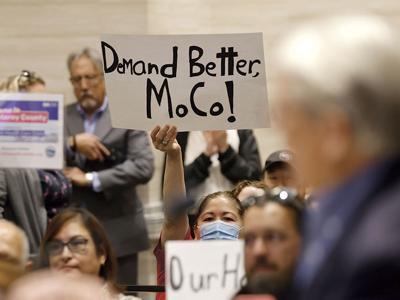

It had been a long day in a conference room in Sacramento on Wednesday, Nov. 20, where the Office of Health Care Affordability Board was in the early stages of deciding how to group the state’s hospitals together for future monitoring as a tool for capping the state’s ever-rising health care costs. After discussing a long list of categories, a staff person asked if there were any others they should consider.
“You mean counties that begin with ‘M’?” one board member asked. The room erupted in laughter.
Everyone knew the “M” stood for Monterey County, where health care costs are some of the highest in the state, if not the country. The quandary of why and what to do about it hangs heavy on the OHCA, with the focus squarely on the county’s three biggest hospitals: Community Hospital of the Monterey Peninsula, Salinas Valley Health and Natividad.
Testimony from Monterey County workers that began soon after the OHCA started meeting for the first time in March 2023 and continued at each meeting forward prompted the board to take their August meeting on the road to Seaside. They called in representatives from Covered California and CalPERS, as well as a university professor who studied the county’s hospitals, to share data and get closer to an answer about why prices are so high. Market concentration was offered as one possible explanation.
One data point showed that the average price for care at California hospitals was 287 percent of what Medicare reimburses. The Bay Area average was 320 percent; by contrast, local averages were higher: SVH was at 340-percent, Natividad was 420-percent and CHOMP was 466-percent above Medicare.
OHCA board members signaled they were interested in further investigation into the county’s hospital prices, with possible referral of findings to the California Attorney General’s Office. They were also interested in possibly capping spending increases at the three hospitals at a lower rate than the phased-in 3-percent cap they agreed to in June for the state.
In October, Elizabeth Landsberg, director of the California Department of Health Care Access and Information (which includes OHCA), told the board that she had directed staff to begin an investigative study on hospital market competition in Monterey County. They are focusing on market consolidation and anticompetitive effects on cost, access and affordability.
The study is estimated to take six to nine months, but could take longer, according to a spokesperson.
Unions and other advocates, convinced that the region is in market failure, are urging OHCA to immediately lower the spending cap for the three hospitals to 0.1 percent beginning in January and through 2029.
“Hospitals in Monterey County have high hospital prices because they can force commercial payers to pay them,” the board from Health Access California wrote in a letter on Sept. 24. “OHCA was created precisely to address such high-cost outliers from market failures.”
Hospital leaders continue to contend that critics have it all wrong. Both Dr. Steven Packer, president and CEO of Montage Health (parent to CHOMP), and Dr. Allen Radner, president and CEO of SVH, told OHCA in separate letters that the data presented in August painted an inaccurate picture. Packer called the competition between the three hospitals “robust.”
They lay the blame for high costs on a few factors, including many government-insured patients relative to commercially insured. They also pointed to high labor costs.
“Labor expenses account for 61 percent of our total costs, 7-percent higher than the state average,” Packer said. “Any significant reduction in expenses would likely result in job losses and lower wages for our 3,300 dedicated team members.”
Packer contended Montage operates its Montage Medical Clinics and Ohana Center at a deficit. Likewise, Radner said that last year SVH’s clinics operated at a $50 million deficit.
But union leaders and others have long contended it’s market concentration that has driven prices higher. Dr. Angela Riley, medical director of Unite Here Health, a national trust fund for hospitality workers, told OHCA in November that the entity paid out $5 million for the cancer treatment for one Monterey County worker, and that one of the chemo drugs used was billed at 800 percent of what Medicare pays.
Mindy Maschmeyer, Montage’s director of marketing and communications, says Montage’s leadership hopes to work collaboratively with OHCA to find solutions “rather than focusing on a singular narrative” in addressing the complex issue of health care costs.
“Health care affordability is an issue that we care deeply about. We are committed to finding ways to address it without compromising quality, access or needed investments,” she says.
A “Community Affordability Initiative” is underway by Montage to cut $50 million in costs by the end of 2026. Maschmeyer says they are looking for innovative ways to increase productivity and efficiency, as well as reducing the length of patient stays by using advanced, minimally invasive procedures, among other strategies. The executive leadership team was reduced by 10 percent, by not filling a vacancy.
The promises from hospital executives may be too little too late. On Dec. 16, the OHCA board will discuss Monterey County’s hospitals in detail, which could include imposing a lower spending cap.


(0) comments
Welcome to the discussion.
Log In
Keep it Clean. Please avoid obscene, vulgar, lewd, racist or sexually-oriented language.
PLEASE TURN OFF YOUR CAPS LOCK.
Don't Threaten. Threats of harming another person will not be tolerated.
Be Truthful. Don't knowingly lie about anyone or anything.
Be Nice. No racism, sexism or any sort of -ism that is degrading to another person.
Be Proactive. Use the 'Report' link on each comment to let us know of abusive posts.
Share with Us. We'd love to hear eyewitness accounts, the history behind an article.