Armando Paolo, founder of Armando’s Pizza in my home town of Cambridge, Massachussets, had a charisma that could make a kid feel cool with just a simple show of recognition. But the real honor was years later, when he showed me how he prepared eggplant cutlet.
He passed away a few weeks ago, just as I finally hit my eggplant stride, and had something worthy of his attention. Not only is it really good; it comes together in about as much time as it takes to call Armando’s and order an eggplant sub.
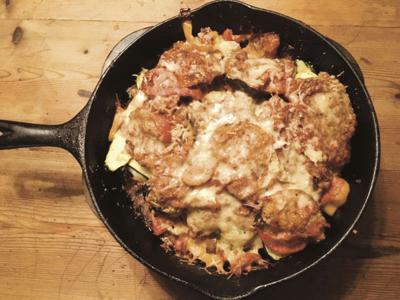
My instant parma was built on what I learned and absorbed from Armando, but differs in several ways from his eggplant submarine sandwich that inspired me. The slabs of eggplant are thicker, as I don’t have a deli slicer. The dish is served in a baked pile, rather than a roll. And while Armando’s subs were tooled to be consistent, cookie cutter copies of one another, mine changes with what’s in my fridge.
Back in the summer, when folks would practically pay you to adopt their excess zucchini, I would layer in some slices, along with peppers and fresh tomatoes when available. In winter it’s simpler, like some onion slabs and mushroom slices layered in amongst the cheesy, sauce-drenched eggplant cutlets. One definite no-no is meat. Eggplant is a meaty vegetable, and can be as lusty as a steak.
The main thing is to have the eggplant and sauces ready ahead of time, and some kind of melt-able cheese on hand. Armando used provolone; I prefer Parmesan. Everything else is bonus.
To assemble, begin with a layer of eggplant on the bottom. This will turn out to be the best layer, as it will soak up all the drippings from above. Next comes sauce, then cheese and grated/pressed garlic. Now, add your zucchini, peppers, mushrooms, onion, olives, or whatever else you think might work. Then, another layer of eggplant, sauce, garlic and cheese. Because of variables in how the eggplant and tomato sauce were made, it’s best to add salt, if necessary, at the table.
Bake at 350, covered, for about 40 minutes. Then uncovered for another 20.
Couldn’t be simpler, assuming the eggplant and sauce are in place. The success and ease of this dish comes down to your sauces and cutlets. Here is what I do.
Eggplant cutlets
Cut the eggplant into ½-inch slices, either crosswise or lengthwise, and place them in layers in a colander. Sprinkle each layer with salt as you layer, at a rate of a teaspoon per eggplant. Let it sit and drain for at least an hour hour, ideally longer, then gently press on the eggplant with a plate to squeeze out more water. Toss the slices in olive oil, about a third of a cup per four eggplants.
Dredge each slice in seasoned flour, then plunge it in a bowl of beaten eggs with a splash of milk, and then bread crumbs or panko flakes. The seasoned flour consists of 1 tsp each of black pepper, garlic powder and paprika, and a half teaspoon of nutmeg powder, for each cup of white flour.
Lay the cutlets on a tray and bake at 400. As soon as you catch a whiff of browning, turn them. Remember, the bottoms will brown first, so be vigilant. When golden on both sides, let them cool to room temperature. Pop the whole tray in the freezer, and transfer the frozen cutlets to freezer bags and freeze.
Simple oven tomato sauce
Virtually any uncommitted tomato sauce will do. By “uncommitted” I mean they don’t have any strong flavors that would clash with certain dishes. You don’t want to use homemade ketchup, for example, because you don’t want the cinnamon, clove and sugar.
I have two uncommitted tomato sauces that I go to when parm calls. One is a simple oven sauce that’s just tomatoes and a tad of salt. It’s simple but has huge flavor. My other sauce is uncommitted salsa. The salsa doesn’t have cumin or cilantro or anything crazy like that. Only ingredients that happen to go well in a parm, like tomatoes, onions, peppers and garlic. Sometimes I’ll use one sauce, sometimes the other, and sometimes I’ll mix them.
I don’t have space for the salsa recipe, but here is what I do. You could easily adapt this recipe, which uses fresh tomatoes, to instead use canned, fire-roasted tomatoes.
Cut the tomatoes in half and lay them on a cookie sheet, cut sides down, and roast them at 400 degrees until the tomatoes collapse into round, wrinkled piles. Remove the tray from the oven. When the tomatoes are cool, lift off the skins and squeeze them between your fingers so the juice falls back onto the tray. Or leave the skins on if you like a little texture.
Dump the remaining juicy pulp into a thick-bottomed pot. Blend it first if you want, but I like it chunky. Simmer on low heat for an hour or two—until it reaches your desired thickness. Season with salt. The sauce can be frozen, or canned in sterilized jars, adding a tablespoon of vinegar for each quart for acidity.
Pretty much any mild-mannered tomato sauce will do, if you’re in a pinch. And if you want to finish it with an Armando’s flourish, serve it with chopped fresh tomatoes and onions, and chopped hot and sweet pickled peppers, aka everything.


(0) comments
Welcome to the discussion.
Log In
Keep it Clean. Please avoid obscene, vulgar, lewd, racist or sexually-oriented language.
PLEASE TURN OFF YOUR CAPS LOCK.
Don't Threaten. Threats of harming another person will not be tolerated.
Be Truthful. Don't knowingly lie about anyone or anything.
Be Nice. No racism, sexism or any sort of -ism that is degrading to another person.
Be Proactive. Use the 'Report' link on each comment to let us know of abusive posts.
Share with Us. We'd love to hear eyewitness accounts, the history behind an article.