The first time I ate Thai food I was completely blown away. My mind was blown away, my taste buds were blown away, my eating habits were blown away. I couldn’t quite comprehend how I’d gone my life without eating this food.
This was about 10 years ago when a friend introduced me to the cuisine in the form of pad thai. We were at a trendy Thai restaurant in Portland, Maine that has since been replaced with an even trendier and more delicious one. (I make sure to hit it every visit for the locally-sourced lime and basil beef panang, as it’s still one of my favorite meals of all time.)
While some places stand strong, it seems there are often new Thai joints to try, most recently Siam Marina Thai Cuisine. A few others occupied the Marina space before Siam, namely D’Anna Thai and Coconut Thai.
Located just a few minutes away from Marina’s major shopping plaza, Siam makes healthy and affordable eating convenient. The scene is cozy and relaxed. The family-run vibe emerges from the moment you walk through the entrance room and open kitchen into the dining room: The chefs greet guests as happily as the hostess. Soothing lavender walls with a variety of Asian art and decor seem welcoming, or maybe it’s just the friendliness of all the staff.
Ready to try the classics, my first visit demanded pad thai and pad see ew. While pad thai is my first Thai love, I went crazy when I tried pad see ew and now it’s usually my go-to. While pad thai usually consists of thin noodles with bean sprouts, peanuts, green onions and your protein-of-choice in a subtle fish sauce, pad see ew uses big, wide noodles with more focus on soy sauce and the addition of Chinese broccoli.
The portions were filling with plenty left over, but both of these traditional dishes tasted a little lacking. The pad Thai with tofu ($9.95) was average – not bad, not great. The sauce was sticky and the tofu cooked skillfully, but I had to request a plate of lime and more scallions to really make the best of it (toppings which were quickly brought out with a smile).
As for the pad see ew with chicken ($9.95), I wondered if they forgot to put sauce on it. While my shopping buddy claimed it was enjoyable, I found myself grateful that I had the pad Thai. I look forward to a pad see ew’s sauce, but this one was so bland and barely covered the noodles. I would try it again someday just to make sure they weren’t having a terrible night and ran out of sauce.
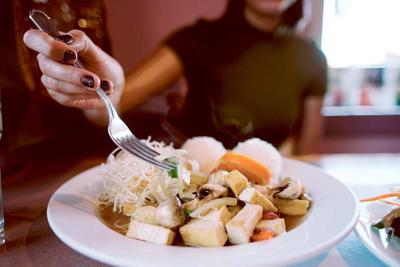
The second visit elicited some of the best Thai food I’ve ever had. Eager to step out of my comfort zone, I asked the server what she liked better out of a few entree options, and she urged me to go with the more “authentic” of my selections – an eggplant dish called pad ma kuer with eggplant bell peppers and sweet basil ($9.95). The fresh, aromatic eggplant delivered a punch of earthy flavor, while the tofu I chose was (again) cooked perfectly: tender but not mushy, and no oil in sight. The bean sauce was brothy and comforting, and red peppers and onions brought everything together. I am still feeling excited about this dish, because it is so healthy (lots of veggies, no carbs, no factory-farmed meat) yet so delicious. Rice doesn’t come standard on the side, it’s $1.50.
Instead of a side of rice, we opted to split a full-size plate of fried rice, or kao pad ($9.95). It came with the usual suspects – carrots, sweet peas, eggs – but was much tastier than the average fried rice and came with more seasoning. A friend at the table ate a plate as his meal, and claimed it was the best he’d had since Thailand. His Thai wife who recently immigrated here heartily agreed as she went to town on some pork larb salad ($8.95).
To round out the menu pickings, I had to try a few bites of the kang panang, or red peanut curry ($9.95). It was spicy enough that the peanut became subtle, and from any perspective it was a great curry. Minimalistic with carrots and zucchini (and the meat choice, which was beef), it had warming depth with the requested medium spice level.
Another liquid taste came from the tom yum hot, sour and sweet soup ($5.95/small). This one was a bit too sweet for me, but on the flipside it did possess a nice tang. Piled very high with lightly-cooked mushrooms, it was tasty, but wouldn’t be my first choice.
For liquid sweetness, the Thai iced tea ($2.95) is unbeatable. Creamy with condensed milk, the caramel flavor is nuanced and so delicious. With boba ($3.95) comes additional fun from chewing the textured pearls.
And speaking of all things sweet, the sticky rice with mango ($6.95) is a Thai tradition, and Siam’s hits the spot in the best way. Cooked in thick coconut milk and complemented by tropical mango, this one is worth a taste even if you’re stuffed (which you might be, because portions are delightfully large).
Overall, I am so glad I went back after that first visit. The eggplant dish made a believer out of me and, since I do love a good shopping trip, I will be back. A lot.
Siam Marina 210 Reindollar Ave., Marina. 11am-3pm, 5-9pm Mon-Sat. • 883-9399.


(0) comments
Welcome to the discussion.
Log In
Keep it Clean. Please avoid obscene, vulgar, lewd, racist or sexually-oriented language.
PLEASE TURN OFF YOUR CAPS LOCK.
Don't Threaten. Threats of harming another person will not be tolerated.
Be Truthful. Don't knowingly lie about anyone or anything.
Be Nice. No racism, sexism or any sort of -ism that is degrading to another person.
Be Proactive. Use the 'Report' link on each comment to let us know of abusive posts.
Share with Us. We'd love to hear eyewitness accounts, the history behind an article.