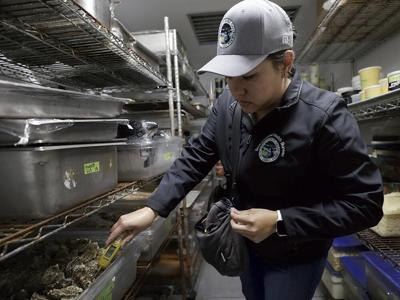

Kyler Asato and Corrine Ow insist that their jobs as Monterey County environmental health specialists – more commonly known as health inspectors – have not scared them away from eating out at local restaurants. If it did, they say, then they wouldn’t be doing their jobs properly.
Asato and Ow are two of the dozen-plus county Health Department inspectors responsible for visiting and reviewing more than 2,000 establishments – restaurants, grocery stores, gas stations, school cafeterias, and “anywhere a consumer can purchase food and beverages,” Ow notes – to ensure that they’re up to code on food safety standards.
That’s not all they do: Working out of the Environmental Health Bureau’s Monterey branch office, Asato is responsible for sampling Monterey Peninsula beaches to monitor their bacteria levels, while Ow surveys the state of detention facilities like Monterey County Jail and police station holding cells.
Yet restaurants and other food retailers comprise the bulk of their workload. Equipped with county vehicles, they traverse a huge swath of coastal Monterey County, visiting establishments from Marina all the way down the Big Sur coast to Gorda. (Colleagues at the Health Department’s Salinas office are responsible for territories further inland.)
It’s thankless yet integral work that many of us take for granted, but it ensures that consumers are protected from any number of food – and hygiene-related hazards due to vendors failing to meet standards. At the same time, Asato and Ow say they have no interest in throwing the book at proprietors trying to make a living.
“There is an aspect of enforcement, but our general approach to things is always education – give them every opportunity to learn and choose to be in compliance,” Asato says.
On a recent spring morning, Asato and Ow let this reporter ride along on several inspections to get an up-close look at their work in action. There’s hardly an aspect of each restaurant’s kitchen operations they don’t examine. Thermometers are used to check that hot water is running at over 120 degrees Fahrenheit, and that hot foods are held above 135 degrees while refrigerated items are cooled below 41 degrees. Stored food should be sealed or covered, while raw foods should be shelved below ready-to-eat items, so as not to drip on and potentially contaminate them.
Sanitizers are checked with testing strips for the right concentration of cleaning agents, while sinks must be kept separate for preparing food and washing, rinsing and sanitizing dishes and utensils. General cleanliness is also monitored – ensuring that stove and oven vents aren’t clogged with grease, that food scraps are disposed of properly in separate areas, and that surfaces and floors are kept tidy.
Red flags include no refrigeration, a lack of potable or hot water, sewage backflows and the presence of vermin – all of which are grounds for immediate closure, and extremely rare, according to the inspectors. (Ow says no more than three to five establishments per year across the entire county are shut down because of violations.)
At Salt Wood Kitchen and Oysterette in Marina, Ow checks the temperature of the ice in which dozens of oysters are stored, and reviews tags documenting when and where the oysters were harvested. Restaurants like Salt Wood must keep their shellfish tags for three months in case of recalls.
Salt Wood Chef Jonathan Rodriguez takes no exception to the thorough inspection. “It’s fundamentally important to have these basics down,” he says. Likewise for Salinas-based Emma’s Bakery and Cafe owner Eddie Estrada: “I think the Health Department is the easy part,” Estrada says of the various permitting and regulatory requirements facing restaurants. “The inspectors do a very good, professional job… If anything, it’s informative,” adds The Oven owner David Rodriguez, whose Seaside pizzeria is also inspected.
All three of the restaurants visited pass their inspections easily, with Emma’s being awarded a Gold Seal for passing multiple consecutive inspections with minimal-to-no violations. (Unlike other counties, Monterey County doesn’t use a letter-grading system for health inspections.)
For Asato and Ow, it’s all in a day’s work – and a good day at that.


(0) comments
Welcome to the discussion.
Log In
Keep it Clean. Please avoid obscene, vulgar, lewd, racist or sexually-oriented language.
PLEASE TURN OFF YOUR CAPS LOCK.
Don't Threaten. Threats of harming another person will not be tolerated.
Be Truthful. Don't knowingly lie about anyone or anything.
Be Nice. No racism, sexism or any sort of -ism that is degrading to another person.
Be Proactive. Use the 'Report' link on each comment to let us know of abusive posts.
Share with Us. We'd love to hear eyewitness accounts, the history behind an article.