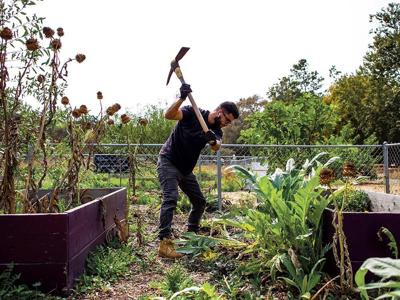

When Salinas residents Berenice Magana and siblings Markus and Emely Zavala found the community garden in Natividad Creek Park, weeds almost entirely obscured the chain-link fence. The soil was dry and whatever plants that once thrived there were now starved out by dead grass. “When we found out about the garden, I thought, wow we live in such a fertile place, but it’s just so sad here and it was meant for the community,” Emely says.
It was sad, that tangle of untamed nature. But instead of abandoning the garden and allowing it to further fallow, they saw its potential.
“We saw the garden and realized it needed some love – it was just sitting there,” Magana says. So give it love they did, beginning in June.
It took two weeks – one week planning, another doing labor – to uncover and revive the community garden.
“We first started only using hand tools, but then we realized that wasn’t going to be enough,” Markus says. So they brought in two weed whackers and borrowed Magana’s dad’s lawnmower. “The weeds were so thick we actually accidentally broke the lawnmower,” Markus says. The three, who all have non-gardening day jobs, for a week came straight from work at 6pm and worked, sometimes until 9pm.
They brought in a small group of volunteers and consulted the only landscaping experts they knew at the time – Magana’s dad. They didn’t ask the city of Salinas whether they had permission to work on the city-owned park. They didn’t want to deal with the potential red tape; they just went for it.
“That’s where our name comes from,” Markus says of the ongoing grassroots project they call Guerrilla Gardening. “The process of asking permission can slow things down that people really need right now.”
From Guerilla Gardening’s perspective, Covid-19 brought increased food insecurity, despite many of the trio’s own family members having worked in the neighboring ag fields.
Then the ongoing wildfires and smoke meant their immediate community had to stay inside.
“ASKING FOR PERMISSION CAN SLOW THINGS DOWN.”
But this inability to escape into nature, even for a moment, was not a new issue for the group. They knew many Salinas residents, despite fueling the labor demand for agriculture, the biggest industry in the county, often live in crowded conditions with little to no gardening space of their own.
“In East Salinas, it’s a luxury to have that space in your backyard,” Magana says. “They grow crops in the field, but here they can come and grow food for themselves.”
In the months after weeding and refreshing the soil in the garden beds, people came with their families to grow basil and corn. Currently they have a successful crop of tomatoes. “It’s important to create these spaces. But it’s not just us – we’re seeing other people take initiative,” Magana says.
“‘We saw this as an opportunity to show our community that strawberries and lettuce aren’t the only thing that can grow here,” Emely says.
Eventually, the trio’s work uncovered a dozen small garden beds and 10 bigger beds.
Reclamation was the first step. As the project went on, they learned of the garden’s origins and that there were dozens of small public gardens all around Monterey County. They discovered the garden was started in 2016 by Urban Gardeners, and spearheaded by Leticia Hernandez as a learning garden, sort of an outdoor classroom. And that there were many more of these potential outdoor classrooms, abandoned in schoolyards and neighborhoods for various reasons.
For now they’re fostering partnerships with groups like Blue Zones Project, and grassroots groups like Agents of Change 831. They consult local organic farmer Matt Loisel of Lazy Millennial Farms to keep the garden organic and sustainable. They’ve organized food drives and installed a miniature library for children.
Moving forward, they want to keep doing food drives, but also revitalizing more gardens in schoolyards and neighborhoods, and setting up more gardening workshops.
As for the broken lawnmower, Magana replaced it for Father’s Day. “It’s all fine now, I bought him a new one,” she says. “It was all worth it.”


(0) comments
Welcome to the discussion.
Log In
Keep it Clean. Please avoid obscene, vulgar, lewd, racist or sexually-oriented language.
PLEASE TURN OFF YOUR CAPS LOCK.
Don't Threaten. Threats of harming another person will not be tolerated.
Be Truthful. Don't knowingly lie about anyone or anything.
Be Nice. No racism, sexism or any sort of -ism that is degrading to another person.
Be Proactive. Use the 'Report' link on each comment to let us know of abusive posts.
Share with Us. We'd love to hear eyewitness accounts, the history behind an article.