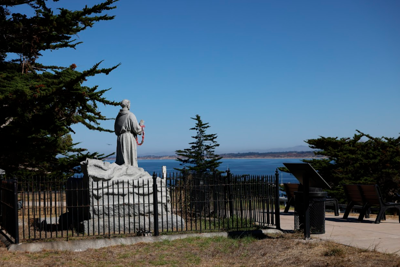

Tim Thomas, a thorough student of the Monterey Peninsula, its people and its maritime past, is known for giving informative walking tours. When I spoke to him before last month’s Abalone Festival, he told me that the question most often asked by area residents is how Monterey came by its name.
Dave Faries here, with a simple answer. The city is named for Monterey Bay.
Of course, a few details are probably in order. It was in June of 1770, that Father Junípero Serra held mass under an oak tree. He was part of a Spanish expedition intent on building a fortification overlooking the bay. Captain Gaspar de Portolá borrowed the name given to the bay 168 years earlier.
But the story comes to life in Thomas’ telling. There is the sorry condition of Spanish sailors plying the trade routes across the Pacific—the scurvy, hunger and death. There is the Viceroy of New Spain, who in the early 1600s recognized the need for safe harbors where galleons returning from their voyages could put in and perhaps crew members could regain some strength. And there is Sebastián Vizcaíno, who landed in 1602, held mass under an oak tree, and dubbed the waters Monterey Bay—or something close to that, like Monte Rey Bay.
“I thought that was smart,” Thomas says, observing that most Spanish captains named locations in honor of saints or religious orders. (The Carmel River is Vizcaíno’s tribute to the three friars that joined him on a voyage.) But Gaspar de Zúñiga Acevedo y Fonseca, the Count of Monterrey and Viceroy of New Spain, had sponsored Vizcaíno’s ships. So—forshadowing naming rights of today—it became Monterey Bay.
“He named it for the guy who paid his bills,” Thomas says with a laugh.
Vizcaíno conveniently ignored the name bestowed on the bay 60 years earlier. When explorer Juan Rodríguez Cabrillo first identified the feature in 1542, he called it Bay of Pines. With no reference to religious figures or state sponsors, it was easily erased from history.
Thomas can go into greater detail. His interest in Monterey’s past was sparked, ironically, by its absence in schools. “Back then they didn’t teach local history,” the 71-year-old says. He has been giving walking tours for some 20 years now.
As for the tree so important to both the naming of Monterey Bay and Monterey, an oak at the site described by Vizcaíno stood until 1904. William Randolph Hearst tried to purchase the lot. But it was declared dead and cut down. The men responsible for disposing of the tree dumped it into the bay.
Upon learning of the deed, the minister of the Cathedral of San Carlos Borromeo in Monterey had local fishermen search for the floating treasure. They eventually located it and hauled the tree from the ocean. Parts of it became a monument on the cathedral grounds, parts of it became chairs, one of which was recently on display at the Japanese American Citizens League building in Monterey.
There are now plaques at both the tree’s original location and the spot at the cathedral where bits of it once stood.
As Thomas concludes, “Monterey is unique in many ways.”


(0) comments
Welcome to the discussion.
Log In
Keep it Clean. Please avoid obscene, vulgar, lewd, racist or sexually-oriented language.
PLEASE TURN OFF YOUR CAPS LOCK.
Don't Threaten. Threats of harming another person will not be tolerated.
Be Truthful. Don't knowingly lie about anyone or anything.
Be Nice. No racism, sexism or any sort of -ism that is degrading to another person.
Be Proactive. Use the 'Report' link on each comment to let us know of abusive posts.
Share with Us. We'd love to hear eyewitness accounts, the history behind an article.