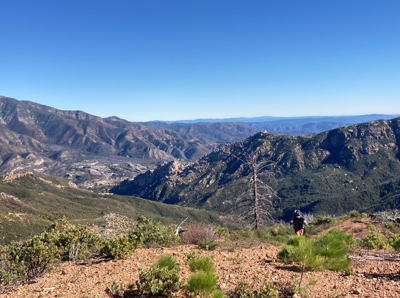

Sara Rubin here, thinking about big, open spaces. There’s something about this time of year—when the golden state turns green, the quality of the light, the crispness in the air—that makes me want to be outside. So I recently spent a couple of nights in the Ventana Wilderness, hiking near the headquarters of the magnificent Arroyo Seco River, where the maples, sycamores and willows are in full autumnal splendor. For three days, we saw zero other people on the trail, despite beautiful weather and a holiday weekend.
The solitude is a reminder of the wildness of this wilderness, how easy it can be to get away from it all. Maybe it’s no surprise; the trail conditions on my route were rough at best. I emerged with my arms scratched all over from charging elbows-first into head-high vegetation.
Despite the trail being “passable,” this is not a place to simply go for a walk in the woods. The exception was the first mile or so of the Arroyo Seco Trail, which a crew for the U.S. Forest Service worked on last spring. Where the trail crew had been, the path is clear, wide enough to walk on normally and not overgrown. It’s what most hikers might think of as normal—an identifiable trail through the woods.
But in the Ventana Wilderness, trails like that are rare. “It’s a combination of factors,” explains Richard Popchak, director of communications for the nonprofit Ventana Wilderness Alliance. “It’s the steepness of the topography, the plant types, the frequent wildfire cycles and climate—all of those things conspire to make it one of the toughest places to consistently keep trails open.”
VWA’s volunteer trail crews work on stretches to supplement the USFS work, and a volunteer crew covered some of the same miles I did just a week later. A team of three, including leader Tom Nicholson, spent Dec. 6-7 on the lower Rodeo Flats Trail, clearing brush that had taken over after the Dolan Fire of 2020 burned the area.
They left behind three larger pine trees that were growing in the trail, to return at a later date with more substantial saws. Because this is a wilderness area, there’s no motorized anything—no chainsaws, no gas, no batteries—just handheld tools used to maintain the trails. That means loppers, handsaws and pruners must do the work. Those factors, combined with the landscape factors Popchak describes, make for slow going for trail crews, whether volunteer or paid by USFS.
“Success is measured in feet sometimes on Ventana trails,” Popchak says.
Popchak reminds me that wilderness is unique in that it exists not just for human enjoyment and recreation—those benefits are secondary to other purposes in these places where, according to the U.S. Wilderness Act of 1964, “earth and its community of life remain untrammeled, where man himself is a visitor who does not remain.”
I’m grateful to the crews who make it possible for me to visit these places—thanks for clearing the path.


(1) comment
No motorized vehicles, like ambulances, or anything with wheels, like wheeled stretchers, leaving rescuers to carry patients mile, seven on freshly graded fire breaks
Welcome to the discussion.
Log In
Keep it Clean. Please avoid obscene, vulgar, lewd, racist or sexually-oriented language.
PLEASE TURN OFF YOUR CAPS LOCK.
Don't Threaten. Threats of harming another person will not be tolerated.
Be Truthful. Don't knowingly lie about anyone or anything.
Be Nice. No racism, sexism or any sort of -ism that is degrading to another person.
Be Proactive. Use the 'Report' link on each comment to let us know of abusive posts.
Share with Us. We'd love to hear eyewitness accounts, the history behind an article.