
Katie Rodriguez here, taking stock of the state of agriculture through a policy lens. As we head into 2026, there are a lot of changes happening at exhausting speed. My challenge has been making sense of what’s unfolding on the ground—and what may be coming down the pipeline.
About a week ago, the American Farm Bureau organized a letter to Congress describing the extreme economic pressures threatening the long-term viability of the U.S. agricultural sector. The letter frames the situation as an existential threat, noting that bankruptcies continue to rise and that many farmers are struggling to secure financing for their next crop.
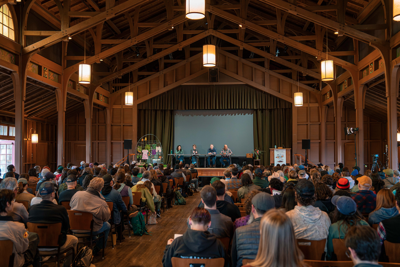
“A lot of the structure of federal agricultural policy is really geared toward large row-crop growers in other parts of the country,” says U.S. Senator Adam Schiff, who was in town today, Jan. 23 for the annual EcoFarm Conference at Asilomar Conference Grounds. Schiff is also the state’s first senator to serve on the Senate Committee on Agriculture in three decades. “Many of these programs are not fitted to the unique challenges facing specialty crop farmers.”
The letter, signed by 56 organizations—including the Western Growers Association and other groups with ties to Monterey County and specialty crop production—states: “For the last three to four years the reality of record-high input costs and rapidly declining and historically low crop and specialty crop prices have culminated in many U.S. farmers experiencing negative margins and losses approaching one hundred billion dollars nationwide.”
As we’ve reported, Monterey County has seen some consolidation in recent months, mirroring trends nationwide with specialty crops—a potential symptom of incredibly thin margins and risk that’s increasingly shifted onto growers.
Compounding this, 2026 brings sustained ambiguity around the next Farm Bill—the nation’s five-year budget package that covers everything from crop insurance subsidies to funding for more resilient farming practices. A majority of Farm Bill funding typically goes to the Supplemental Nutrition Assistance Program (SNAP), which remains a deeply divisive issue in Washington, the outcomes of which we’re following and will continue to in the coming months.
The Farm Bill is now two years overdue and has been kept alive through a series of extensions set to expire in September 2026. Although some programs were continued under the One Big Beautiful Bill Act, specialty crops were largely left out.
The same is true of the Farm Bridge Assistance Program, allocating $12 billion in short-term support for farmers operating at a loss. That funding is still primarily focused on commodity crops, and what does reach specialty crop farmers—less than 1 percent of that total funding—falls short of providing meaningful, immediate relief.
All of this is punctuated by uncertainty, driven by tariffs (and the potential for retaliatory tariffs affecting export-oriented growers), as well as intensified Immigration and Customs Enforcement activity, which complicates everything from budgeting and long-term planning to worker safety and protection. California has more immigrants than any other state, according to the Public Policy Institute of California, and Monterey County ranks in the top 10 counties statewide, with immigrants making up 29 percent of the population.
In short, the picture doesn’t look great. But Schiff notes he sees a bit of a shift driven by these pressures on a larger scale than before.
“I think in the beginning there was a real reluctance to speak out,” Schiff says. “I would hear concerns privately from a lot of farmers, but very few were willing to say anything publicly. Now, out of an interest in self-preservation, you’re seeing groups willing to speak up and say, ‘These policies are harming us.’”
Farm groups have entered the chat.


(0) comments
Welcome to the discussion.
Log In
Keep it Clean. Please avoid obscene, vulgar, lewd, racist or sexually-oriented language.
PLEASE TURN OFF YOUR CAPS LOCK.
Don't Threaten. Threats of harming another person will not be tolerated.
Be Truthful. Don't knowingly lie about anyone or anything.
Be Nice. No racism, sexism or any sort of -ism that is degrading to another person.
Be Proactive. Use the 'Report' link on each comment to let us know of abusive posts.
Share with Us. We'd love to hear eyewitness accounts, the history behind an article.