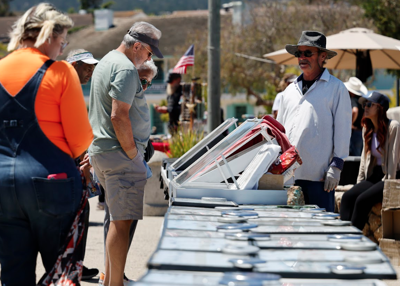

Sara Rubin here, reflecting on something I’ve observed everywhere I have traveled in the world: People selling stuff, even if it’s just a little bit of stuff, from anywhere. Maybe it is commerce that unites us as humans, I’ve found myself thinking. Put people in a place, and they will find something to sell, even on a little patch of sidewalk, or a cart, or a bag.
James Burns has had a similar thought. “Us handcrafters are the beginning of civilization,” he says. “Sidewalk vendors exist everywhere in the world but the United States, because corporations are shooting for monopoly.”
Burns is a tie-dye artist who works with his wife, India Weeks, to sell their wares in Monterey at the foot of Fisherman’s Wharf. Before California decriminalized sidewalk vending in 2018 with Senate Bill 946, Burns and Weeks would travel a circuit of craft fairs in the Bay Area and beyond.
The City of Monterey followed the state legislation in 2019 with a local ordinance, and since then, Burns and Weeks have made their living locally. They say it’s hard work—the set-up and take-down take time, plus being in the elements. “We’re really durable stock,” Burns says.
The concept caught on, with other sidewalk vendors setting up. Burns and Weeks say some are not healthy enough to hold regular jobs; this moveable business enables them to work only when they feel well. For many, it’s the only cost-effective way to run a retail business. Rents are high and online sales require packaging and digital savvy. And there’s a culture that vendors like Burns have found to be meaningful; some customers stay and chat for an hour.
It all sounds glorious, and in many ways it is. But there’s been another truth that members of Monterey City Council—and nearby business owners on Fisherman’s Wharf and Cannery Row—have observed. The business owners have voiced concerns about competition. Others have raised concerns about obstructing pedestrian and bicycle travel through the area, especially on summer weekends.
By early 2025, the issues of how many sidewalk vendors might be too many, and how much space they should take up, led the City Council to look at rewriting its sidewalk vending ordinance to address those concerns.
Sidewalk vendors united in opposition to the amendments, which limit the size and configuration of vendors in the area, shrinking the square footage of each, increasing the buffer area between vendors and forbidding customer seating and hanging clothes. Tuesday night, despite vociferous opposition from vendors including Weeks and Burns, City Council voted 5-0 to approve the new ordinance. The square footage requirements would limit the number of vendors in the area to 13.
Burns says he and others have no plans to comply—he is basically daring the city to enforce the new restrictions. And if they do, he says they plan to sue; he argues the new restrictions violate SB 946.
Whether or not it comes to that remains to be seen. I for one am glad we’ve moved beyond an all-out prohibition on sidewalk vendors, thanks to SB 946—it adds color, variety and personality to retail, and lowers the cost barriers to entry. But allowing merchants to utilize public space unlimitedly is not the answer either (nor is it what state law requires). Council tried threading the needle to maximize passage to the wharf, to the harbor view and to parking lots, while still keeping some merchant presence. Do you think they succeeded?


(0) comments
Welcome to the discussion.
Log In
Keep it Clean. Please avoid obscene, vulgar, lewd, racist or sexually-oriented language.
PLEASE TURN OFF YOUR CAPS LOCK.
Don't Threaten. Threats of harming another person will not be tolerated.
Be Truthful. Don't knowingly lie about anyone or anything.
Be Nice. No racism, sexism or any sort of -ism that is degrading to another person.
Be Proactive. Use the 'Report' link on each comment to let us know of abusive posts.
Share with Us. We'd love to hear eyewitness accounts, the history behind an article.