
Erik Chalhoub here. The first time I watched Alfred Hitchcock’s Vertigo, I was pleasantly surprised to see a shot of the eucalyptus trees on Highway 101 near San Juan Bautista. It amazed me how little the scene, just a stone’s throw away from the Monterey County line, had changed, at that time about 50 years since the filming.
Over the years, as I began commuting through that corridor daily, the fascination by the trees turned into trepidation. Eucalyptus trees are notoriously fragile and combustible, and have been known to drop limbs onto passing vehicles. Most recently, in December 2022, a tree fell onto a vehicle driving through on southbound Highway 101 in the area, killing two people in a three-vehicle pileup.
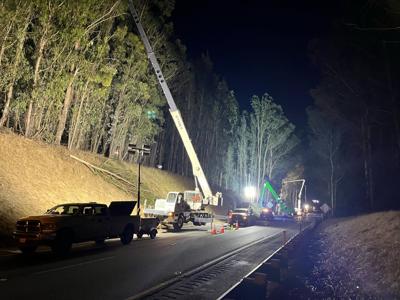
In recent weeks, crews have been working in the middle of the night to remove about 200 of the trees near the roadway in an attempt to make the area safer.
Work continues nightly this week. One lane of northbound Highway 101 will be closed from 7pm to 5am, and one southbound lane will be shut down from 8pm to 6am through Thursday, Nov. 21, with closures happening from 10pm to 7am on Friday, Nov. 22.
Expect delays of up to 30 minutes, said Caltrans spokesperson Kevin Drabinski.
Once southbound work is complete, crews will shift all of their focus to the northbound direction. Caltrans will know of an estimated completion date as the work progresses, according to Drabinski.
According to Caltrans, the $2.6 million project, being done by Community Tree Service of Pajaro, unhealthy eucalyptus trees are being removed in order to eliminate competition for space and water among the remaining trees.
Caltrans’ work near the San Benito/Monterey county line comes on the heels of a major eucalyptus removal project underway in North Monterey County.
In June, the Monterey County Board of Supervisors approved a $1 million program to help fund the removal of the non-native eucalyptus trees in areas deemed a fire hazard, and five months later, Supervisor Glenn Church reports it’s been a “major success.”
It received nearly 100 applications, using up all the matching funds allocated for the program. Under the program, the homeowner paid half of the removal, which is estimated at $5,000 per tree.
Eucalyptus tree seeds were brought from Australia to California in the 1850s to provide timber. When early settlers in California decimated much of the native oak woodlands, eucalyptus were primarily planted in their place because they grow fast. But, as it turned out, eucalyptus wood makes for a poor building material.
But ecologists say eucalyptus, while providing a habitat for hawks and owls high above in their branches, snuff out flora and fauna beneath their canopies, among other negative impacts.
As a resident of North County, I’ve seen firsthand how the removal program has transformed the landscape of the area—here’s hoping these invasive trees are replaced with native redwoods or oaks to give a boost to biodiversity.


(0) comments
Welcome to the discussion.
Log In
Keep it Clean. Please avoid obscene, vulgar, lewd, racist or sexually-oriented language.
PLEASE TURN OFF YOUR CAPS LOCK.
Don't Threaten. Threats of harming another person will not be tolerated.
Be Truthful. Don't knowingly lie about anyone or anything.
Be Nice. No racism, sexism or any sort of -ism that is degrading to another person.
Be Proactive. Use the 'Report' link on each comment to let us know of abusive posts.
Share with Us. We'd love to hear eyewitness accounts, the history behind an article.