
Katie Rodriguez here. A couple of years ago, I spent a lot of time with shepherds over the course of six months, following a couple and their seven dogs across rolling hills, vineyards and other terrain in the counties between Napa and Mendocino.
I sometimes spent the night wherever they were stationed, learning what the sheep preferred to eat—and what they merely tolerated—and witnessing how the landscape could change drastically within hours after they grazed.
They are efficient grazers, used in many places for wildfire mitigation to clear brush beneath a tree’s canopy—detritus that acts like lighter fluid for wildfires. An added benefit is that they can reach places machines can’t and help enrich the soil’s organic matter (with their poop).
I was reminded of this while working on a recent cover story about wildfire mitigation efforts. Shortly after it was published, I received an email from a reader who wrote:
“I wish that more areas would use herds of goats to eat up the various flora on the hillsides. It accomplishes the main goal of reducing hazardous brush/shrubs while also being more gentle on the ecosystem and creatures who live within it.”
That wish is coming true in parts of Monterey.
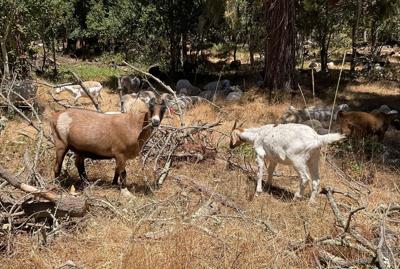
One week after receiving that message, I noticed goats along Highway 68 near CHOMP (no pun intended), part of an annual grazing program done by the Pebble Beach Community Services District. Goats are used in other areas of the county, as well.
Then I saw more goats, this time in a City of Monterey newsletter about using 400 goats and sheep at the Old Capitol Project site near Jacks Peak. I drove out to see if I could find them, and there they were—in a wooded area off Iris Canyon Road near the Highway 1 overpass.
“Overgrown grass is one of the more dangerous fuel types for fire,” says Michael Klain, co-founder of California Grazing Co., the company contracting with the City of Monterey to manage these animals. Klain is also a firefighter. “One ember can start a fire in grass. And if you put it out but leave it smoldering even slightly, it can reignite within seconds.”
Our conversation was fascinating. He described how using goats and sheep together targets different types of brush and vegetation. Sheep like to munch on grasses and weeds closer to the ground, while goats are much more nimble and adventurous; they climb up steep hillsides, often pulling down some of the low branches to nibble on the leaves.
Genista, also known as French broom, is a concern I hear about all the time when it comes to wildfires, as it grows fast and everywhere (thinking of these photos from the Robles Firewise community group). Well, they’ll eat that too.
Star thistle and mustard, which are both difficult to get rid of—down the hatch.
“To watch them eat star thistle is like…how is your mouth handling that,” Klain says, adding the animals don’t like it when it’s too dry but it’s their favorite during the winter.
Thys Norton, the City of Monterey’s Park Operations Manager, says this is the first time they were trying something like this, hopefully a pilot study of more to come. The impact of this could be huge, not to mention cost-effective, at reducing fuel loads that will inevitably grow back year after year.
“We're definitely taking a lot of notes on this,” Norton says. “When we look at different fuel reduction projects in the future, we'll have a really good idea of what works and what doesn't.”
Do you think your neighborhood would welcome this kind of fire mitigation strategy?


(0) comments
Welcome to the discussion.
Log In
Keep it Clean. Please avoid obscene, vulgar, lewd, racist or sexually-oriented language.
PLEASE TURN OFF YOUR CAPS LOCK.
Don't Threaten. Threats of harming another person will not be tolerated.
Be Truthful. Don't knowingly lie about anyone or anything.
Be Nice. No racism, sexism or any sort of -ism that is degrading to another person.
Be Proactive. Use the 'Report' link on each comment to let us know of abusive posts.
Share with Us. We'd love to hear eyewitness accounts, the history behind an article.