

One Spring Afternoon, Luis Perez, a forestry technician and firefighter, hops in a truck at Cal Fire’s King City station and heads out to conduct a home inspection near King City.
On the drive out, at first glance the terrain looks highly flammable: rolling hills covered in crunchy, dry grass. Yet, there are nuances, Perez explains, in how firefighters view the landscape. Trimmed vegetation near the road, check. Mowed lawns and fields, check. De-limbed trees and metal roofs, check.
Same goes for the home inspection. He and one other Cal Fire inspector knock on the door, and a woman who looks to be in her 70s answers. She is welcoming, she knows who they are, and she is already aware of the danger fire poses to the area, making the inspection a relatively smooth one.

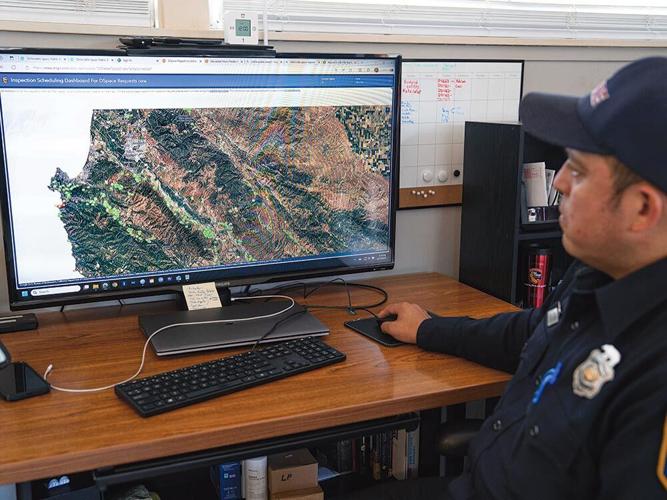
CalFire forest techinician Luis Perez shows how they track home inspections for wildfire mitigation efforts at the King City station on May 14, 2025.
“The main danger that we see is people not being aware, not being educated,” Perez says. “Normally, when people get all the information that we have, they’re proactive. They get excited to know that changing a few things in their home, it’s going to increase their chance of survival.”
He walks with a clipboard around her house, noting that the bundles of firewood are at least 10-15 feet away from the house, in addition to a good amount of clearance from any brush or plants.
The biggest concern: “See that branch hanging down on your roof?” Perez says, pointing to a branch sprinkling detritus onto the house. “We’ve got to take care of that.”
Zone Zero – the first line of defense within 0-5 feet around a home’s foundation – has been the focus of local and state fire departments in recent months. The push is to guide homeowners to remove flammable material, like mulch, leaves and bark that could become ignited by embers and light fire to someone’s home.
It’s an effort that was ramped up by the fires that destroyed tens of thousands of homes across Pacific Palisades and Altadena earlier this year. Fueled by the increasingly common cocktail of weather conditions – overgrown, dry brush, little rainfall and high winds – the simultaneous and quick-moving fires made extinguishing them difficult, straining available water pressure and firefighting personnel.
Dramatic images depicting hoards of people fleeing Southern California neighborhoods sent the rest of the state into a frenzy. That includes Monterey County, where there have been at least a dozen meetings about wildfire readiness since January. At a wildfire town hall meeting in Monterey in March, roughly 500 residents filed in to pack a Monterey Conference Center ballroom auditorium to listen to a panel of experts.
“I know that everyone has been a little rattled, myself included,” Monterey Fire Chief Andrew Miller said. “I think it’s impacted this entire nation. I can’t tell you how many phone calls and emails and concerns and questions I’ve received, and how much I’ve been interacting with the community.”
While fire departments shared their plans, as well as statewide plans for reducing fuels through practices like prescribed burning and tree thinning, most of the discussion centered on what homeowners can – and must – do.
Back at the home inspection, Perez says his notes will feed into Cal Fire’s comprehensive map documenting what they hope will be every single home in the county, in collaboration with local fire departments to maintain consistent records across jurisdictions. Inspections for existing homes will have a three-year grace period for compliance; new homes must comply immediately. Although Cal Fire can fine people for noncompliance and in rare cases pursue legal action, Perez says the goal is not to punish, and that an overwhelming majority do want to comply and are open to learning how.
“We’re trying to create this relationship of trust,” he says. “If I can talk to at least one person in a community, it’s more likely to spread.”
A CROWD OF ABOUT 50 PEOPLE fill the Tularcitos Elementary School multipurpose room in Carmel Valley at a local fire community group meeting in April. People munch on fruit snacks and popcorn as a video demonstration depicts two homes, one soon to burst into flames.

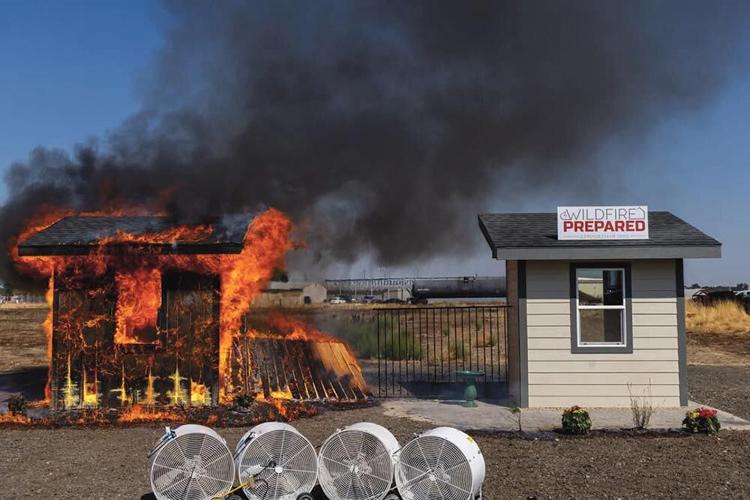
A Cal Fire demonstration shows the significant difference defensible space can make in protecting a home.
The video shows Cal Fire workers setting fire to the ground equidistant from each home. One was built to code with a 0-5 foot perimeter clear of debris. The other was not built to code, with bark and plants within that first 5 feet. The latter burns to the ground within minutes, while the former remains; the experiment took no more than 10 minutes to conduct. The video prompts the audience to ask granular questions about decision like stucco versus wood, herb bushes versus potted plants.
In response to the L.A. wildfires, Cal Fire released new Fire Hazard Severity Zone maps for Central California in March, which added over 1.2 million acres – effectively quadrupling the designated fire-hazard acreage in Monterey County.
For the first time, these maps show a more nuanced fire-hazard severity picture that include “Moderate,” “High” and “Very High” hazard zones, with many neighborhoods suddenly finding themselves in the middle of a crimson red block. The new map, for example, brought the acreage in the “Very High” hazard zone category up from 1,106 acres in 2011 to 1,220 in the city of Monterey, 221 to 278 acres in Carmel, and 82 to 167 in Pacific Grove.
In lockstep with the new maps, “Defensible Space” is the phrase that – while not new – has taken fire agencies by storm when it comes to compliance: a first layer of protection homeowners can do that’s proven to help slow wildfires by reducing the potential for flying embers to ignite.
“Am I going to put three people’s lives at risk to go down that sketchy driveway to help protect your house that you took no action to help protect?” Cal Fire Battalion Chief Richard Lopez says. “Defensible space really gives us a fighting chance.”
Though Zone Zero is the most critical area for wildfire defense, these zones are ultimately organizational tools for humans – fire knows no boundaries and rises and falls with the weather. A home cleared of debris within 5 feet can still be vulnerable if it’s surrounded by dense brush or sappy, untamed trees or neighboring homes that have done nothing to remove flammable materials. And luck always plays a part.
Drone photos and reporting from the L.A. wildfires offer a striking case study: solitary homes that remain standing amid neighborhoods reduced to ash. Some of their structural advantages? Dual-pane windows made of tempered glass, fire-resistant and slanted roofs, stucco.
Some homeowners are expanding their attention from Zone 0 to Zones 1 and 2 – the areas 5-30 feet, and 30-100 feet from a home, respectively. While the state doesn’t enforce compliance in these zones, agencies encourage actions like thinning vegetation, pruning trees and spacing out flammable plants.
“We really want to stress the importance of you as community members, property owners, homeowners,” Monterey County Regional Fire Chief David Sargenti said at the town hall, “being resilient and doing your part.”
The sense of urgency isn’t lost on many residents. But often, the challenge is overcoming the obstacles to doing their part.
Back at Perez’s home inspection near King City, the woman explains the issue with the troublesome branch. Her husband, who once handled the yard work, now has dementia, and hiring help is more than they can afford.
ATOP OF THE ROLLING HILLS along Highway 68 across from Laguna Seca, Bob Seidel, who’s somewhat of a poster child when it comes to fire prevention work, walks through the steps he’s taken to protect his home. He’s in a very high fire hazard area – in red on Cal Fire’s map – something he’s known since moving to the area in the 1980s and compounded by watching firsthand the wreckage of the River Fire in 2020.

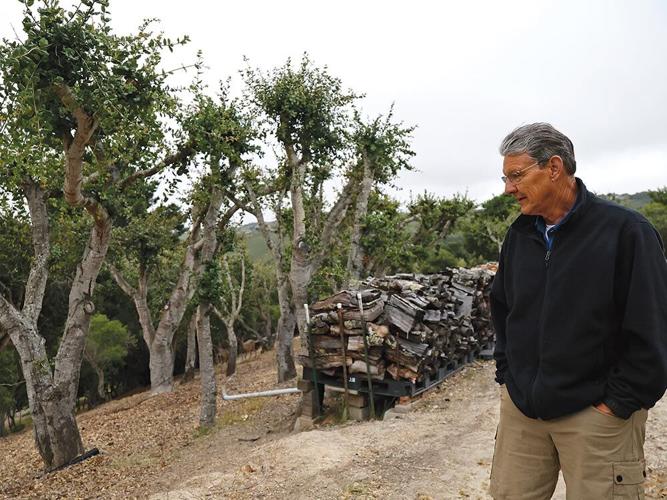
Bob Seidel walks through his backyard off Highway 68, explaining how he’s invested in fire-proofing his house since moving to the area in the 1980s.
Some of his investments: $1,400 on Cal Fire recommended fire-resistant vents (he did the labor himself), $2,500 to trim the oak trees in December, plus $2,500 for a masticator (machine and labor), which he shared with a neighbor. He replaced his patio with fire-resistant TimberTech decking, also recommended by Cal Fire, and keeps bundles of firewood about 20 feet from the house. He plans to install a standby generator for power outages.
He built the home and chose stucco “because I was concerned about fire,” he says, and selected a tile roof to fire-proof it even more.
Such fire-resistant luxuries are perhaps easier to obtain when one starts the process in the ’80s. Since then, inflation, in addition to increasing wildfires, have driven up costs. For example, the Tubbs Fire caused lumber prices to spike by 50 percent within just a few months, according to construction consultant Currie & Brown.

Fire-rated circular air vents are used to block embers and flames from intruding into his home during wildfires, while allowing for attic ventilation.
To enact such changes today, especially all at once, is costly. Living further out into Wildland Urban Interface (WUI) areas is often more affordable, although it doesn’t mean a homeowner can retroactively afford even some of the more simple fire-proofing actions.
Some funding opportunities to help homeowners are emerging. In the Monterey Fire Department’s response area, eligible residents can receive grant-funded landscaping services following an inspection. The Fire Safe Council for Monterey County is monitoring potential funds for home hardening and defensible space. Though no program has launched locally yet, Cal Fire is piloting a home hardening initiative for low-income, high-risk communities in Shasta, Lake and San Diego counties, with plans to expand.
IF THERE’S ONE INDUSTRY THAT MIGHT UNDERSTAND CLIMATE CHANGE BEST, it is insurance – often a driving force behind why homeowners are taking next steps to protect their properties. And people are already feeling the pressure, especially as new fire hazard maps place them in higher-risk zones.
“We’ve been having this conversation for a very long time,” says County Supervisor Kate Daniels, whose district includes some of the county’s most forested residential areas: Carmel Valley and Big Sur. “Even before the Palisades and Altadena fires, we were facing the insurance crisis – that also has this situation top-of-mind for the county.”
While the message at town halls has emphasized that California’s insurance market will stabilize and become more accessible, Monterey County residents still report being dropped, often for reasons that seem arbitrary.
One emerging solution may serve both insurance interests and neighborhood-level safety: Firewise groups.
DENSE VEGETATION BLANKETS MUCH OF MONTEREY COUNTY. This same earthly splendor is likely what drew many to live here in the first place. There’s an unspoken bargain: accepting the threat of wildfire in exchange for unspoiled beauty.
Of course, this bargain is tested in times of fire – and in just the last five to 10 years, many have felt that test firsthand.
The Soberanes Fire in 2016 burned over 130,000 acres and destroyed 57 homes. It lasted nearly three months and at the time, was the most expensive wildfire response in U.S. history, costing $260 million to suppress and consumed an area four times the size of San Francisco.
Then came the summer of 2020, one of the worst wildfire seasons in California’s history. The River, Carmel and Dolan fires spread concurrently, forcing thousands to evacuate and destroying over 117 structures. In total, eight fires ignited in Monterey County that year between June and August, burning 56,108 acres – roughly 2.7 percent of the county’s total land area.
For members of what are known as Firewise communities, the accepted fire mantra is: It’s not if, but when.
For John Heyl and Kathryn Greenwald, “when” came in the form of the River, Carmel, Tassajara and Soberanes fires. Since moving to their Carmel Valley home in 2010, they’ve been through multiple evacuations – many of which, they say, were positive experiences because local law enforcement coordinated staggered, orderly departures.
“When the deadline came on Saturday morning, almost everybody had been willing to leave,” Heyl says. “Whereas people in L.A., the fire was on the ridge and then two hours later, the fire was at the sea. That doesn’t give you much time. If you don’t already have a plan, that’s when the panic sets in.”
Heyl and Greenwald are one of 73 homes on their street, and they’ve come to know many of their neighbors through organizing a Firewise Community Group. These local, grassroots groups are formed by residents of a neighborhood or rural area who commit to reducing wildfire risk around their homes.
There’s a double benefit to participating, Heyl adds: “It’s not just raising awareness about fire, but it’s raising community awareness, knowing your neighbors, knowing who has a four-wheel drive vehicle and can get out.”
Considerable effort and time are demanded to form a recognized Firewise group. To earn official designation – recognized by the National Fire Protection Association and often viewed favorably by insurance providers – residents must commit time and resources. Firewise groups are popping up all over Monterey County, from Aromas to Big Sur, with the largest concentration in Carmel Valley, according to the local Fire Safe Council. There are at least 56 certified Firewise communities in the county.
For Heyl and Greewald’s neighborhood, on a south-facing slope near Carmel Valley Village, Heyl’s been developing a three-year plan to address wildfire risks like clearing brush and wooden fences, tracking volunteer hours (a minimum of one hour per household is required per year), and hosting annual community workdays and completion of a neighborhood wildfire risk assessment.
“The most challenging part is figuring out who all the people in your defined community actually are,” Heyl says. He used a combination of Google Maps and the county website to research and map out addresses, build a property spreadsheet, and send letters to every home – half of which were returned, revealing that many properties are rentals or owned by people living elsewhere.
Some insurance companies offer discounts to homeowners who live in Firewise communities, although it’s not guaranteed. Susie Brusa, a resident of San Benancio, was unexpectedly dropped by her fire insurance – even after presenting a certificate showing her community was actively working on wildfire prevention. She’s now on the FAIR Plan, insurance of last resort.

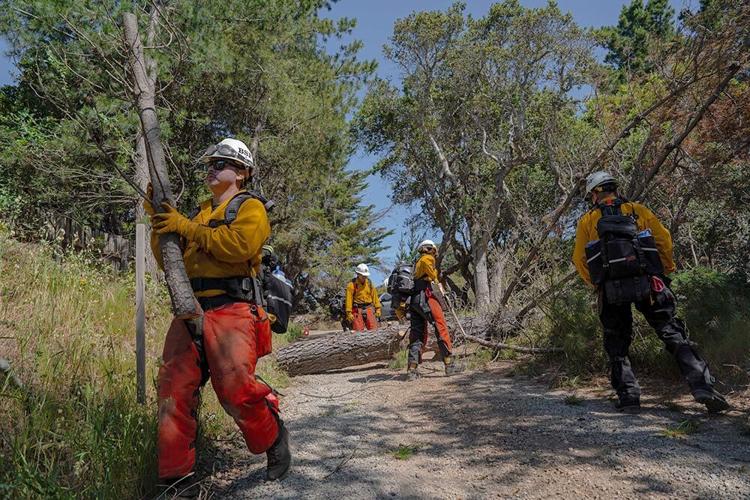
Big Sur Fire Chief Matt Harris takes the new 20 person hand crew out for a week of training using chainsaws to fell and thin trees on May 15, 2025. The fire crew is a two year staff to help residents reduce their risk to wildfires.
Firefighters, however, view Firewise communities as essential – not just for prevention, but for enabling effective response. They’ve seen these efforts reduce the intensity of wildfires and ease the strain on emergency resources.
For Heyl, the benefits go beyond logistics – they bring peace of mind.
“People are banding together because you realize you can defend your own property, but if everybody doesn’t do their part, there’s just more fuel to burn,” he says. “Your own work may be for me.”
IN A BIG SUR NEIGHBORHOOD ABOVE PFEIFFER BEACH, a group of about eight firefighters-in-training are evaluating tree stumps. They are covered in sunscreen, sweat and woodchips, and surrounded by the sweet scent of pine and oak. By 11am the crew had already been out working for about two hours, having started their day at 7am for physical training, breakfast at 8, and a hike up the hill at 9 carrying 40 to 50 pounds on their backs: water, chainsaws, gasoline – all the tools they’d need for the day’s training.
The crew is learning forest thinning ergonomics – how to assess the diameter of a tree to determine its size and weight, and how to work efficiently while conserving energy. They considered the tree’s lean, the slope of the ground, and the direction of the wind, all to carefully angle their cuts and triangulate where the tree would fall.
One crew member jams a wedge into the trunk and saws with precision, felling the tree.
“You guys saw what wind did yesterday,” says Matt Harris, Big Sur Fire Chief, evaluating the level of the stump and explaining how to tell if the chainsaw was being used correctly.
“We started off learning how to use a saw, now we’re thinking about what we can do with a saw. We can carve, contour, shape – we can actually make things look nice and cut around a tree.”
This work by Big Sur Fire, a mostly volunteer fire department, is thanks to an anonymous $2 million donation, funding a 20-person fire prevention crew for two years. The hand crew, which wrapped up training on May 31, has been deployed to individual homes to help residents create defensible space – free of charge.
Fighting fire has proven, time and time again, to be complex in this region: the terrain is steep; access roads are limited; jurisdiction is split between Cal Fire and the Forest Service.
This new hand crew, made up largely of graduates from Monterey Peninsula College Firefighter Academy, is already somewhat familiar with Big Sur’s diverse landscapes, Harris says. They now serve a dual role: creating defensible space and standing ready to fight fires when, inevitably, the next one comes.
(0) comments
Welcome to the discussion.
Log In
Keep it Clean. Please avoid obscene, vulgar, lewd, racist or sexually-oriented language.
PLEASE TURN OFF YOUR CAPS LOCK.
Don't Threaten. Threats of harming another person will not be tolerated.
Be Truthful. Don't knowingly lie about anyone or anything.
Be Nice. No racism, sexism or any sort of -ism that is degrading to another person.
Be Proactive. Use the 'Report' link on each comment to let us know of abusive posts.
Share with Us. We'd love to hear eyewitness accounts, the history behind an article.