
Katie Rodriguez here. Back in 2019, I found myself in Eindhoven, in the Netherlands. I was helping with a documentary at the time, and we attended an event called Dutch Design Week, one of the largest design events in Northern Europe. Innovators and industrial designers from around the world came together to showcase inventions that helped offer solutions to shape a sustainable future.
It’s difficult to describe the scale and reach of such an event. For example, one group was finding solutions to our plastic waste problem by developing an assortment of machines that could transform various kinds of plastics into chairs, plates—all sorts of household items. Not only were the products functional and looked beautiful, but the group had set up an open-source system so that communities around the world could create their own plastic transformation stations out of shipping containers, and sell those products back to the community.
The conference had exhibits set up across the city, where people were creatively finding ways to reuse waste, to conserve energy, to create closed-loop systems and circular economies—a model which keeps resources in use, instead of discarding them after one use.
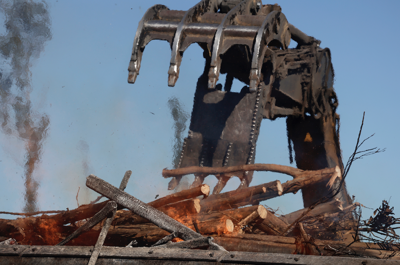
I thought of these inventions while I was writing a cover story, published in this week’s edition of the Weekly. The story is about just that: a closed-loop system being created here in Monterey County with eucalyptus groves.
Many of you are likely familiar with eucalyptus, either for their amazing smell and ubiquitous presence, or for their flammability and tendency to be messy trees at the center of wildfire mitigation efforts.
They’re also invasive and thirsty trees—and several projects have cropped up in recent years to remove or thin eucalyptus groves to help reduce wildfire risk.
The Elkhorn Slough Foundation, thanks to its access to grants, researchers and agricultural lands, is uniquely positioned to answer the question: what to do with all the leftover eucalyptus biomass?
My story highlights the process of turning these trees into biochar, a soil amendment that can be mixed with compost or manure to help increase soil fertility, retain nutrients and potentially mitigate agricultural runoff. The project, currently underway near Prunedale, is not only creating biochar but also analyzing the ways in which it could be of greatest benefit to local growers here in Monterey County.
It’s an awesome example of a closed-loop system, and provides insights that could help lift up a new circular economy that could sustain itself if enough growers find the product useful enough to continue purchasing it (especially with the support of USDA subsidies).
You can read more about this project, and see some amazing visuals to accompany it, here.


(0) comments
Welcome to the discussion.
Log In
Keep it Clean. Please avoid obscene, vulgar, lewd, racist or sexually-oriented language.
PLEASE TURN OFF YOUR CAPS LOCK.
Don't Threaten. Threats of harming another person will not be tolerated.
Be Truthful. Don't knowingly lie about anyone or anything.
Be Nice. No racism, sexism or any sort of -ism that is degrading to another person.
Be Proactive. Use the 'Report' link on each comment to let us know of abusive posts.
Share with Us. We'd love to hear eyewitness accounts, the history behind an article.