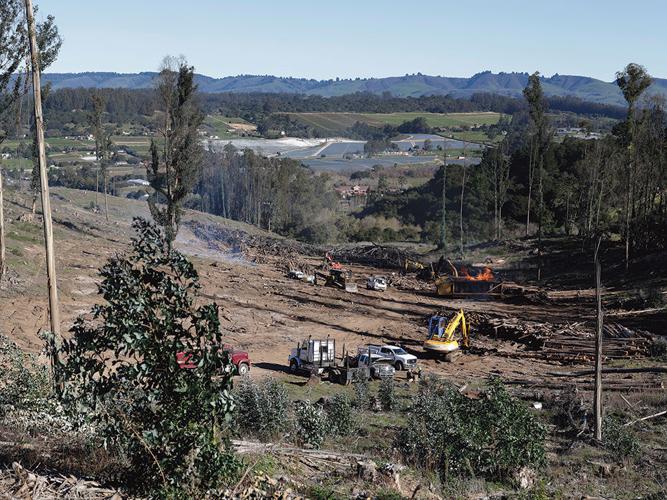
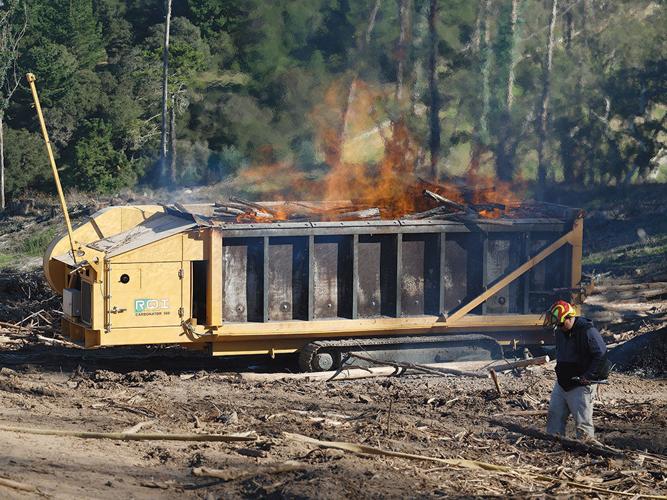

ON FIRST PASS, THE OPTICS DON’T LOOK GREAT. What appears to be a dumpster on fire sits at the center of Brothers Ranch, a 356-acre property owned by the Elkhorn Slough Foundation in Prunedale. The fire pit is surrounded by a thin patch of trees, contrasted by bucolic views of rolling hills and agricultural lands. As bits of wood and embers swirl about, two Cat excavators pick up piles of wood stationed around the site, dropping logs into the top of the container.

The Elkhorn Slough Foundation owns five organic farms, four of which are leased out to small growers, including Brothers Ranch (below), where a eucalyptus conversion project is underway.
The scene depicts a logging operation, but not the kind one might think.
“Previously, this was a complete wall of eucalyptus. You couldn’t see more than 5 feet where we’re standing right now,” says Dash Dunkell, conservation director for the Elkhorn Slough Foundation. Looking across the highlands, he explains that the eucalyptus trees were over 150 feet tall, growing since the 1980s when the land was last logged.
Eucalyptus are notorious trees familiar to most Californians. They are visually striking and aromatic, invasive and fast growing. They’re known to be oily and incredibly messy – as a result, highly flammable – thereby placing them in the crosshairs of wildfire mitigation groups, city planners and residents alike.
Counties across the state have deployed all sorts of eucalyptus grove removal projects; in Monterey County, efforts in recent years have targeted groves in Garland Ranch Regional Park, along Highway 101 in North County, at the Elkhorn Slough and more.
But what to do with all of that leftover biomass is a question the Elkhorn Slough Foundation has become uniquely well positioned to answer, thanks to its access to agricultural lands and partnerships with researchers.
“There are lots of different ways to deal with the biomass produced from fuel reduction projects like this,” Dunkell says. “For us, we wanted to try and capture as much of the carbon as possible. And we also were really interested in the product of the biochar, something useful for our organic farms, potentially for habitat restoration projects, and producing something that we could do something good with.”
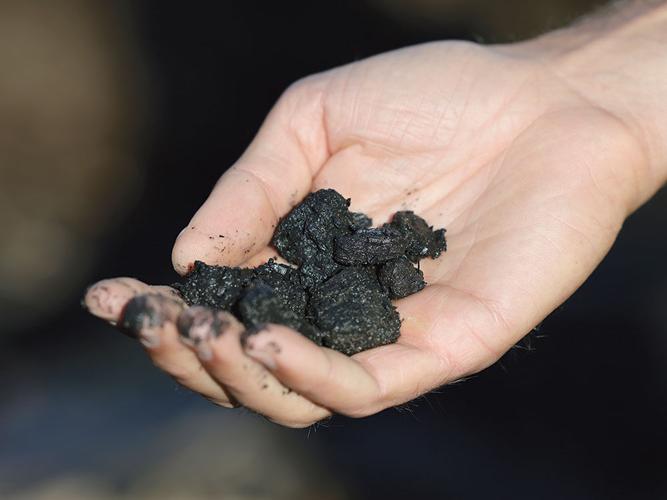
The dumpster-looking container is a carbonator: a large machine that heats up organic material in low-oxygen conditions, turning it into a charcoal product known as biochar. It’s an industrial version of a process that’s been used by Indigenous people for thousands of years as a way to create more nutrient-rich soils. In the last decade, the practice has also emerged as a critical tool to help lessen the burden of climate change impacts by removing carbon dioxide from the atmosphere.
While the use of biochar on large agricultural fields is growing, researchers still have limited understanding of where it is most effective, how long its benefits last and at what application rates.
In 2023, the nonprofit Elkhorn Slough Foundation – which leases out several organic farms – began working with a farmer and a researcher from CSU Monterey Bay on a field adjacent to the biochar operation to test those questions in real-world conditions. With a second planting season underway, the experiment could provide useful insight to help growers throughout the county improve soil fertility and, inadvertently, farm carbon.
“For centuries, Indigenous people used cultural fire to maintain healthy forests,” said Esselen Tribe Chairman Tom Little Bear Nason with Ventana Forestry, the Indigenous-owned forestry company that supplied the carbonator. “But much of today’s landscape has gone generations without beneficial burning, leaving an overload of woody material and non-native trees.”
BEFORE JOINING THE DEPARTMENT OF BIOLOGY, Agriculture and Chemistry at CSUMB in 2022, Arun Jani was researching sustainable agricultural practices in a semi-arid region of South Africa. In a dry region with low rainfall, farms he was working with there were entirely dependent on that rainfall for a successful harvest.

Ventana Forestry, an Indigenous-owned forestry company focused on fire response and prevention work, purchased a gently used Tigercat 6050 carbonator for $500,000 in late 2022. A new unit costs about $1 million today.
His focus was simple: How to help the soil retain more moisture.
“We were testing biochar as a soil amendment in corn production – basically as a subsistence crop,” Jani says. “And it worked really well. We had strong preliminary results.”
Using dead or naturally fallen eucalyptus, Jani and his team produced biochar and mixed it with manure before adding it to planting stations where corn seeds were sown. The biochar acted like a sponge, binding nutrients, improving water retention and making crops more drought-resistant – results that were visible after just one growing season.
Years later, Jani brought that experience to collaborate with the Elkhorn Slough Foundation at Brothers Ranch, a farm managed by grower Jesus Calvillo since 1978. ESF began leasing the land in the early 2000s.
“This site, we’re really excited about it, because you can even tell by looking at the soil, it’s very sandy so it’s really low fertility,” Jani says, standing beside the test plot adjacent to the former eucalyptus grove. “It really gives us a good opportunity to see what the biochar might do for improving soil fertility and also things like water retention, so we can use less water over time.”
INTRODUCED IN THE 1996 FARM BILL, the U.S. Department of Agriculture’s Natural Resources Conservation Service (NRCS) offers technical assistance to help growers improve conservation practices through the Environmental Quality Incentives Program (EQIP). The program supports conservation practices ranging from soil health improvements to water conservation and climate resilience.
But biochar took years to enter the conversation. After pilot studies began in 2015, the practice finally became eligible for EQIP support nationwide in 2022.
Under the current guidelines, EQIP supports the application of about 6 cubic yards of biochar per acre – an amount that Jani wanted to test. Specifically, Jani’s goal is to be able to provide insight into whether or not the approved amounts by the NRCS are actually effective in farming scenarios in Monterey County.
“What we’re doing is comparing the status quo of what federal payouts support to an elevated rate,” Jani says. “That way we can report back to NRCS and say: These rates work really well – or maybe we can tell them, hey, you need to up the rate that you financially support.”
Long-term research on this question, particularly in Monterey County farming systems, remains scarce.
A FEW CRITICAL BUT PRECISE INGREDENTS are needed to make biochar: heat, water, and a whole lot of biomass.
Walking through the bits of flying embers, the heat from the carbonator noticeable from more than 20 feet away, Dunkell explains that they’re hoping to process about 15 tons of eucalyptus material over the course of a few months.

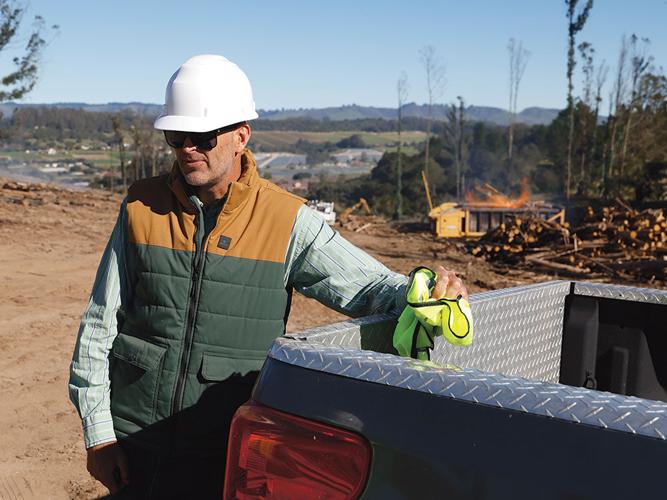
The Elkhorn Slough Foundation’s conservation director, Dash Dunkell, is leading efforts to convert biomass from eucalyptus grove removal projects into biochar, which will then be tested as a soil amendment to be used by local growers.
“You get like a 95-percent reduction in weight,” he says. “And then on volume, it’s on a similar scale – about 90-percent reduction in volume.”
The Elkhorn Slough Foundation previously used this same carbonator in 2023, partnering with Ventana Forestry to convert 8,000 tons of eucalyptus into 200 tons of biochar within the Elkhorn Highlands Reserve. Supported by Caltrans and NRCS, the project removed six acres of eucalyptus to protect sensitive maritime chaparral, oak woodland and freshwater wetland habitat.
Much of the biochar from the last project was given to a mix of recipients: a little to Grey Bears for its compost and gardens in Santa Cruz, some for Elkhorn Highlands Reserve grassland restoration, some went to Jani to begin testing. For another research purpose, a portion went to the Central Coast Wetlands Group to conduct trials on using biochar to remove phosphate from lettuce washwater that drains from Salinas salad plants.
Roughly the size of a 40-cubic-yard shipping container, the carbonator is mobile, moving on tank-like treads. Manufactured in 2020 by Tigercat Industries Inc., the unit was purchased gently used by Ventana Forestry for about $500,000.
A new unit today costs closer to $1 million.
“There’s a lot of different types of kilns or plants that make biochar,” Dunkell says. “But there are very few mobile kilns of this size.”
Inside the machine, materials are allowed to burn, or smolder, without fully burning. Historically, biochar has been made using all kinds of organic materials, called feedstock, from various types of wood to excess waste from crops. Nut shells, rice husks, tree trimmings and even waste from breweries or food production are all common feedstocks that have been used to make biochar.
Indigenous communities would make biochar by filling shallow pits with wood, bones and leaves before lighting the feedstock and then covering it with soil or clay, a method that’s still used today by some farmers. It can take anywhere from 30 minutes to several days to make biochar, depending on the feedstock, how moist the material is and how well the oxygen is controlled.
The carbonator works a similar way, just at a faster speed and at a higher capacity. Along the side of the carbonator, Dunkell points to two metal components – augers – which help move the rich charcoal material through the machine and out into a pile.
“The machine needs to have a constant water source flowing to it to cool the charcoal down,” Dunkell says. “In the absence of oxygen it gets really hot, turning it into glowing red hot coals. then has to be quenched.”
Funding for the project, which budgets out to roughly $45,000 per acre to remove the eucalyptus grove and operate the machinery, comes from a patchwork of sources. Cal Fire has provided assistance by helping fund the eucalyptus grove removal as part of wildfire resilience efforts. Through grants and private donations, the Elkhorn Slough Foundation helps support the research on biochar and land restoration. Under contract, ESF paid roughly $60,000 to the Ventana Forestry for use of the carbonator.
To continue this work, Dunkell says ESF is slated to receive funding from a $71 million grant administered through the California Marine Sanctuary Foundation as part of the federal Inflation Reduction Act. The grant, awarded in October 2024 to a group of organizations in Monterey and Santa Cruz counties, supports projects that improve coastal resilience against wildfire, drought and other climate change impacts.
The research conducted by CSUMB is funded by a $66,000 grant from the CSU Agricultural Research Institute, aimed at testing the biochar’s effectiveness on conserving soil and improving crop yields.
“It’s relatively low-cost work,” Jani says, noting that a bulk of that cost went toward getting started. He estimates the cost to continue this work averages around $5,000 per year.
“Processing the biomass directly in the forest is far more beneficial to the environment, eliminating the need to transport material to landfills and significantly reducing greenhouse gas emissions,” Nason said. “Teaming up with the Elkhorn Slough Foundation and CSUMB strengthens this work, bringing science, stewardship and land management together to protect native habitat and support the conversion of non-native forests back to native oak woodlands and greater plant diversity.”
AT BROTHERS RANCH, Jani walks the sandy plot, pointing out small colored flags marking different biochar-to-compost treatments. He and a group of students have completed one planting season with ornamental sunflowers, though no significant impacts were observed in the first year.
That’s to be expected – the real insight will come after several years of data collection to see how the mixtures transform the sand into nutritious soils.

The biochar produced by the carbonator is slightly moist. The machine uses approximately 3-5 gallons of water per minute of water to cool the newly produced material from its operating temperature of 2,800 degrees Fahrenheit.
Testing involves mixing the biochar with certified organic compost from Tri-County Landscape Supply at a ratio of 80-percent compost to 20-percent biochar. The treatments compare plots with no amendments, compost only, and varying application rates of the compost-biochar blend.
Over time, the research will not only track soil fertility and moisture retention, but also crop performance and nitrogen uptake. Something unique about the use of biochar, Jani adds, is that it’s not a material farmers will have to keep applying.
In other words, there is such a thing as too much, and their research will look at when adding the biochar has reached its maximum benefit.
“If we can show that after applying biochar for three or four years there’s no added benefit from continuing,” Jani says, “that’s valuable information. It means growers can invest confidently – and know when to stop.”
In Monterey County, certain crops like strawberries are well recognized for having issues with runoff during storms and heavy rain events due to their use of plastic. Jani’s work with ESF aims to generate long-term data that can guide farmers toward more efficient practices.
And eucalyptus, aside from its fire risk, can significantly disrupt ecosystems when left to grow unchecked. Ramping up local production of biochar, with clear guidance on how it should be used on farms, could serve a dual purpose: creating a local closed-loop system, while utilizing a tree that negatively impacts species diversity and local water tables.
“When we started all this, it was like, what do we do?” says Ross Robertson, Elkhorn Slough Foundation’s communications director. “We want to remove the eucalyptus because they’re bad for the ecosystem, and we’re going to pay for that. But if biochar could eventually prove to have economic worth as a soil amendment for these particular soils, it’s a dream scenario of being able to do forest restoration and ecosystem restoration that also helps fund farm sustainability projects.”
(2) comments
I concur with Jeff Turner's comment. "Closing the Loop" ought to at least include further use of the heat required in the bio-char process.
Great article. The good thing they are turning wood waste into biochar. The "could be possibly better"thing is that this method of making biochar (a open, staged-air system that creates a pseudo-low-oxygen” zone) puts 70-75% of the carbon in the wood, as well as most of the heat - back in the atmosphere. A sealed pyrolysis retort system with a closed burn chamber can flip those numbers around which means much of the carbon is locked away from the atmosphere for several thousand year and does not contribute to green house gases, plus it captures much of the heat which can be used for space heating, making electricity, etc. It is possible to take a sealed pyrolysis retort system to the wood, just a bit longer setup.
Welcome to the discussion.
Log In
Keep it Clean. Please avoid obscene, vulgar, lewd, racist or sexually-oriented language.
PLEASE TURN OFF YOUR CAPS LOCK.
Don't Threaten. Threats of harming another person will not be tolerated.
Be Truthful. Don't knowingly lie about anyone or anything.
Be Nice. No racism, sexism or any sort of -ism that is degrading to another person.
Be Proactive. Use the 'Report' link on each comment to let us know of abusive posts.
Share with Us. We'd love to hear eyewitness accounts, the history behind an article.