
Are you binge-watching all of the Oscar-nominated films in the next few days? Sara Rubin here, with the admission that I’m way behind and hustling to catch up in the next few days, before the Academy Award winners are announced on Sunday, March 15.
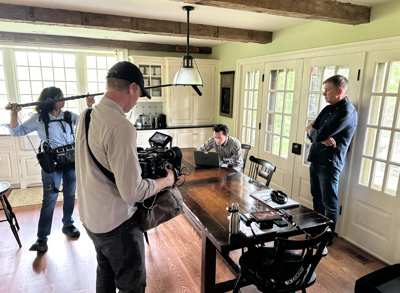
That includes not only feature-length films but short films, which take on another level of skill and artistry, to convey a message and tell a story briefly. In the case of 34-minute-long documentary All the Empty Rooms, the immensity of grief unfolds in household after household, as the viewer journeys into the bedrooms that once belonged to children who were murdered in school shootings. The film takes us to homes in Nashville, Santa Clarita and more, the camera capturing the worlds that these children left behind. Their parents left these worlds intact, physical memorials of what they suddenly lost.
In just a half-an-hour, this film transported me to places I have never been, to a dimension of loss I have never known. That is the result of the subject matter, yes, but also by the team behind the movie, which includes Carmel Valley producer Conall Jones.
Jones is notable for his film bonafides—this is his second Oscar nomination, and you can read a little bit more about the film and his relationship to Hollywood in my column in this week's paper, out today—but also because he’s succeeding in the film industry, against the odds.
He grew up in Cachagua and Carmel Valley then went to film school at San Francisco State. After college, Jones says, “I packed up my car and drove to LA and was like, ‘Here I am, I am a filmmaker.’ And then I got crushed by Los Angeles within a year.” He stuck with it, moving to New York, then South Korea, then back to Carmel Valley during the pandemic.
It is not easy to make it in Hollywood or in film, something Jones points out when I ask him what advice he would offer to aspiring young filmmakers today.
Jones recommends finding your place in the film world, which includes so many roles beyond acting, directing and cinematography. He compares his work as a producer relating to a director as that of a contractor working for an architect—he’s the get-stuff-done guy.
Some of that is relatively mundane (lots of scheduling) and in the case of All the Empty Rooms, some of it is heavy. He worked with family members to talk through what they could expect upon welcoming a filmmaking crew into their most intimate spaces.
Jones says he does it not for awards recognition, but to tell stories with an impact.
“Movies allow us to step outside ourselves and connect with people across time, across imagined worlds, or in the case of our film, with families across the country affected by an issue many of us have grown numb to,” he writes in an email. “Great films create empathy and understanding. I’ve always believed in that power, but it feels especially important now, when so much of our media landscape is designed to fragment rather than connect us.”
I hope you feel that connection in watching All the Empty Rooms, viewable on Netflix. (You can watch the trailer here.) And if you watch the Oscars on Sunday night, you may see our own Carmel Valley film producer claim an award.


(0) comments
Welcome to the discussion.
Log In
Keep it Clean. Please avoid obscene, vulgar, lewd, racist or sexually-oriented language.
PLEASE TURN OFF YOUR CAPS LOCK.
Don't Threaten. Threats of harming another person will not be tolerated.
Be Truthful. Don't knowingly lie about anyone or anything.
Be Nice. No racism, sexism or any sort of -ism that is degrading to another person.
Be Proactive. Use the 'Report' link on each comment to let us know of abusive posts.
Share with Us. We'd love to hear eyewitness accounts, the history behind an article.