
Sara Rubin here, taking a moment to think about all of the ways government impacts my life. Sometimes it’s invisible, or it’s a resource needed only in a moment of urgency. Or it becomes so ingrained in my day-to-day life that I forget to notice and appreciate it—although when there’s an issue (like potholes in the street, for example) I am quick to critique it.
I don’t think I’m unique in forgetting to appreciate what I have until it’s gone or broken. So it goes these days with the U.S. government, being dismantled by DOGE thanks to a cost-savings vision put forth by Elon Musk and President Donald Trump. As thousands of workers are terminated and entire agencies closed down, we at the Weekly will continue to cover local impacts of these closures.
But first, we decided to attempt to create a footprint of what the impact of the federal government was last year in our county, before cost-cutting measures began. The result is a collaborative cover story in the current issue of the Weekly, reflecting some of the at least $7.5 billion in federal funds that came to Monterey County last year.
This story is not a defense of those funds or allocation formulas, but simply an effort to provide a partial baseline for understanding where we go from here. (Worth noting is that despite our best efforts, we could not get a total—some agencies were nonresponsive, while others were unable to break down county-level spending when we asked, so this is just a partial number, hence the “at least.”)
Of course, there are many reasons to defend many of these expenditures. I recently wrote about the importance of funding science; in this week’s paper, Staff Writer Katie Rodriguez looks at some of the work terminated USDA employees were doing on agricultural research; and Features Editor Dave Faries offered his opinion on the role of government, which cannot be measured in a private-sector profit-and-loss framework.
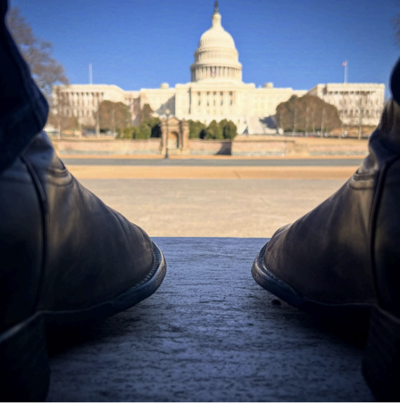
And county leaders are fighting to defend many of the line items enumerated in the cover story. County supervisors Chris Lopez, Luis Alejo and Wendy Root Askew recently traveled to Washington, D.C., where they met with members of Congress.
“Our message was mostly on the proposed slashing and burning of Medicaid in particular and some other federal programs, like SNAP and CalWorks,” Alejo says. “Any cuts would have a major, direct impact on Californians.”
Alejo has traveled to the Capitol before; in all nine years he’s served on the board he has been a member of the legislative committee. While the concept of the trip was familiar—advocating for the needs of California in general, Monterey County in particular—he says this trip felt different.
“I have never seen the dismay on the faces of congressional members,” he says. “Every day there was something extreme being proposed or being signed.”
Those extremes continue, most recently with the wholesale elimination of the Department of Education. What they mean on the ground in our communities—for road projects, for schools, for healthcare—remains to be seen. But analyzing the money will serve as a starting point.


(0) comments
Welcome to the discussion.
Log In
Keep it Clean. Please avoid obscene, vulgar, lewd, racist or sexually-oriented language.
PLEASE TURN OFF YOUR CAPS LOCK.
Don't Threaten. Threats of harming another person will not be tolerated.
Be Truthful. Don't knowingly lie about anyone or anything.
Be Nice. No racism, sexism or any sort of -ism that is degrading to another person.
Be Proactive. Use the 'Report' link on each comment to let us know of abusive posts.
Share with Us. We'd love to hear eyewitness accounts, the history behind an article.