










Agriculture
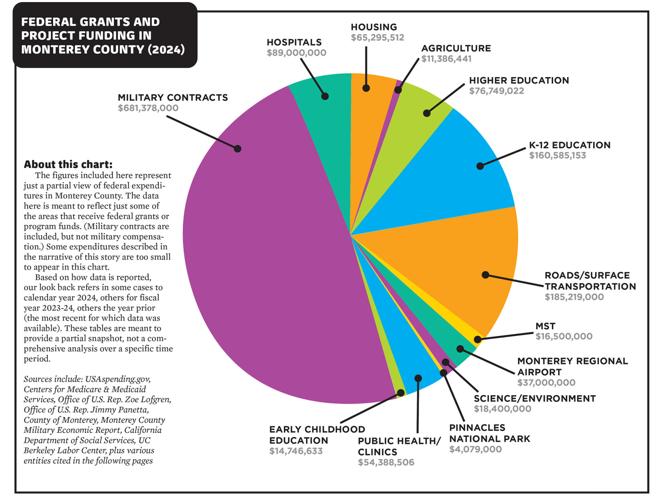
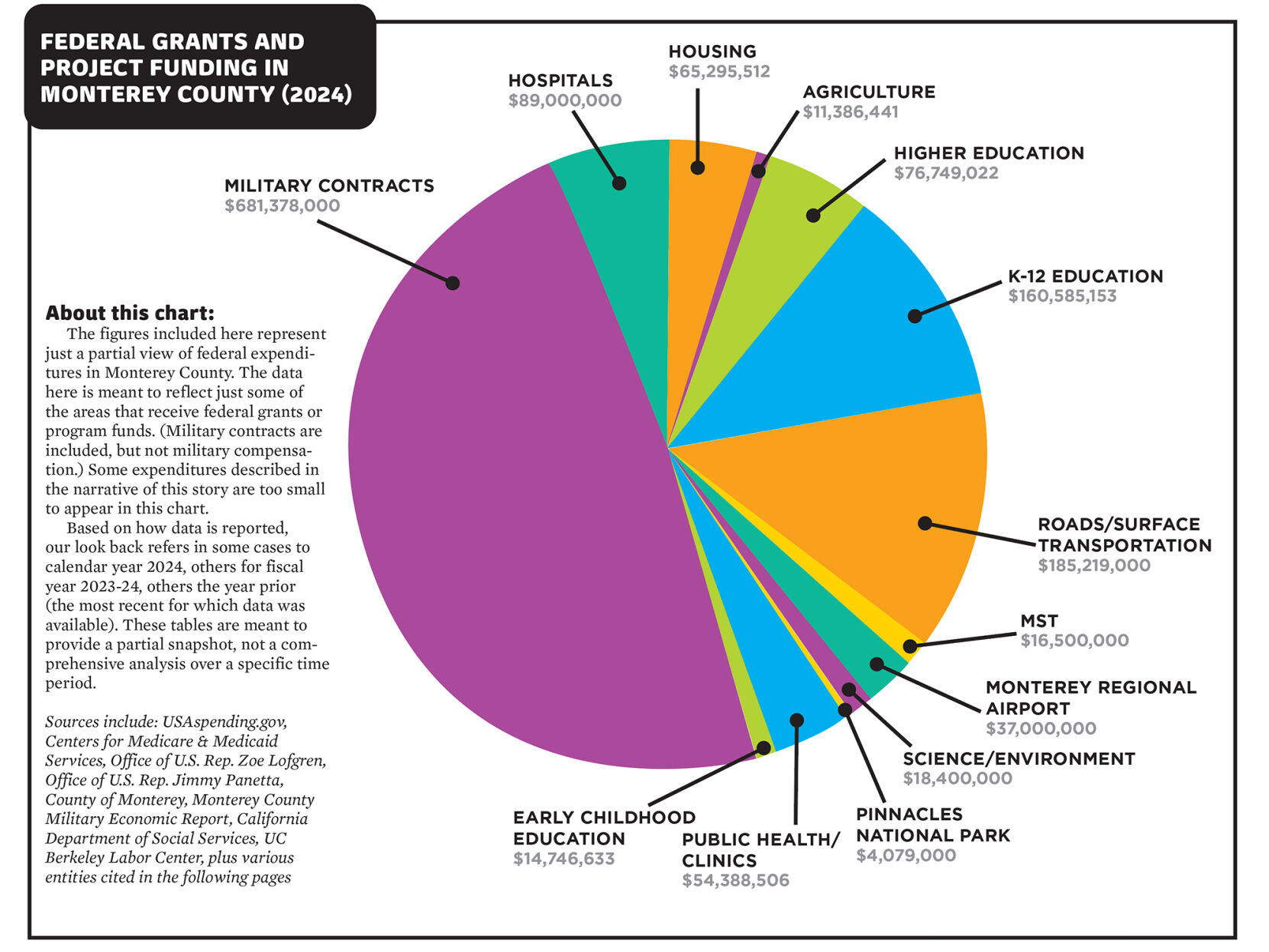
Agriculture is the largest economic driver in Monterey County, with a total estimated impact of over $11.7 billion on the local economy. Much of this sector is funded by federally run programs under the United States Department of Agriculture. A few of the key programs at risk from federal cuts include the National Resource Conservation Service’s Environmental Quality Incentives Program and the Regional Conservation Partnership Program, according to U.S. Rep. Zoe Lofgren, D-San Jose.
She notes that specific cuts include $37 million from the National Institute of Food and Agriculture, $30 million from the National Resources Conservation Service, and $27 million from the Animal and Plant Health Inspection Service. Additionally, the USDA Service Center in Salinas may close in August, and several USDA research technicians have been laid off (see story, p. 6), which will affect local farmers. “It’s worth noting, they’re really not sharing with us what they’re doing, so we’re finding out when constituents call in and tell us,” Lofgren says.
In Monterey County, over $7 million in resource protection, agricultural productivity and public safety opportunities are at risk with the Resource Conservation District alone. That funding specifically supports things like on-farm technical assistance for conservation, especially benefiting smaller farm operations and those addressing erosion and challenges with water management. Over $5 million of this goes toward fire prevention work, removing eucalyptus trees in Elkhorn Slough and the Santa Lucia Mountains. The remaining funding at risk is allocated to flood-risk reduction projects at the Salinas River. Last fiscal year (July 2023-June 2024), 36 percent ($1,581,275) of RCD’s total income was from federal grants. “All of that funding went toward work in Monterey County,” says Emily Zefferman, a PhD Ecologist with RCD.
Research from the USDA Economic Research Service (ERS) shows that every $1 invested in agricultural research yields $20 in economic returns. Yet, much of the research done in agriculture in the county is supported by federal funds. The Agriculture & Land-Based Training Association (ALBA) was allocated $415,301 for soil and water conservation programs and CSU Monterey Bay’s Agricultural Research Institute was allocated nearly $1.3 million.
Last year, nonprofit farmers market coordinator Everyone’s Harvest used a USDA grant to purchase $300,000 worth of produce from 14 local farmers to distribute 11,350 boxes of produce to low-income customers in Seaside and Salinas. That grant was suspended on March 10, then reinstated on March 14, leading to two missed drop-offs.
Military
Even after the closure of Fort Ord, the U.S. Department of Defense maintains a significant presence in Monterey County, with a variety of installations (including Fort Hunter Liggett in South County, the Defense Language Institute on the Presidio in Monterey, Naval Support Activity Monterey that is home to the Naval Postgraduate School, and others).
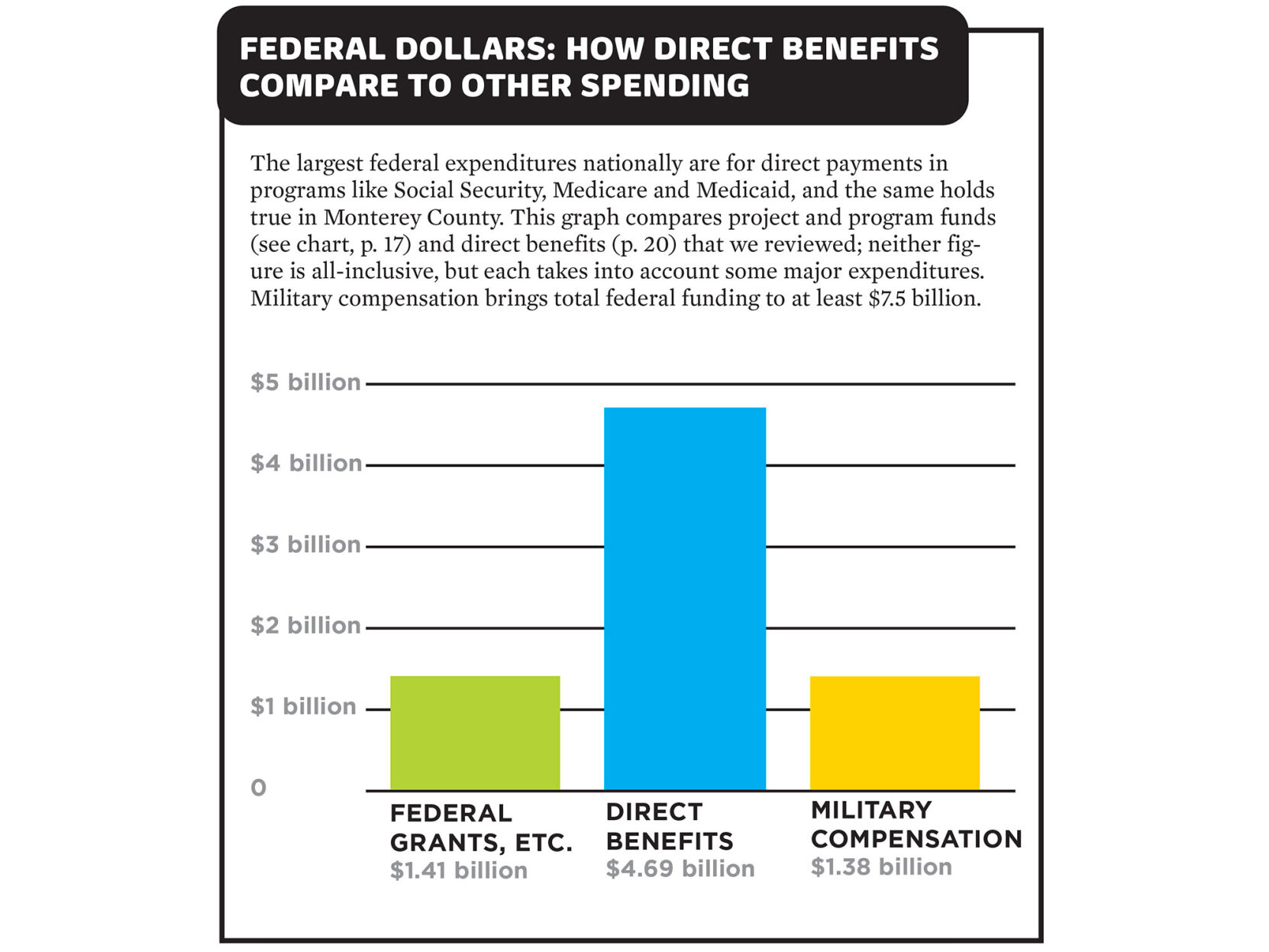
Compensation to local military members last year was a whopping $1.38 billion, according to an economic impact report produced by Matrix Consulting. That includes 11,800 uniformed service members and DoD civilian employees. The report also took into account indirect spending and taxes associated with the military, and determined the total footprint to be $4.9 billion, or 15 percent of the local GDP.
Healthcare
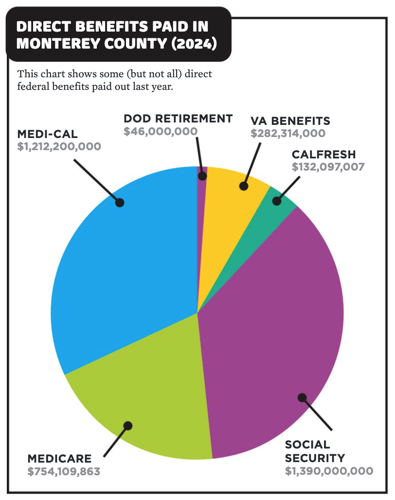
Government-funded health insurance – Medicare for those ages 65 and older, Medicaid (called Medi-Cal in California) for the indigent and Tri-Care for members of the military – represent the biggest proportion of reimbursements to local hospital systems, even though commercial insurers pay a better rate.
Federal insurance payments to Salinas Valley Health last year were about $267 million; Community Hospital of the Monterey Peninsula received some $400 million in such payments.
Natividad, the County of Monterey’s safety net hospital, reports $89 million in supplemental federal funding beyond health insurance reimbursements. “Any decision to cut federal funds to healthcare programs could have an impact on the $89 million,” according to a hospital administration representative.
Other institutions also received federal funds. The Maj. General William H. Gourley Clinic, jointly operated by the Department of Defense and Veterans Administration, received $127 million. Nonprofit Clinica de Salud del Valle de Salinas received $31.5 million.
And the County Health Department’s public health initiatives also benefit from federal funds ($15.3 million last year), which support initiatives ranging from outreach to boost enrollment in Medi-Cal to improving virus detection at the epidemiology lab.
Local Government
Many local government agencies rely on federal funding to support specific projects or simply to deliver regular services. That money is often first filtered through other agencies. “Some federal funds run first through the state and then are granted to us by the state but technically are federal funds,” says Megan Hunter, Soledad’s city manager.
Last year, the City of Marina received a $2.4 million federal grant for improvements at its airport, where Joby Aviation has grown its research and manufacturing presence. King City received a $1 million economic development grant.
Some funds are for more specific infrastructure projects. Seaside officials had planned to replace a well supplying its municipal drinking water system, with 80 percent of the $5 million project coming from federal funds – they were instructed to reapply after federal funds were frozen earlier this year.
The County of Monterey receives about $231 million in federal funding, roughly 12 percent of its nearly $2 billion annual budget. In a Feb. 14 letter to United States senators and House representatives, Chair of the Board of Supervisors Chris Lopez wrote to express the board’s concern about uncertainty. “County residents have increased access to some programs and services because of federal funds,” he wrote. “The funds support County programs combating housing instability and food insecurity. They help the County program mental health services and increase access to healthcare. As a result, the sudden pause has a direct and harmful impact on County residents who fundamentally rely on these services and programs.”
Fighting Crime
Many federal grants to local jurisdictions focus on crime prevention. For example, the Monterey County Sheriff’s Office received $600,000 for body-worn cameras; Salinas was awarded $1 million for law enforcement technology. The City of Monterey received about $11,000 for bullet-proof vests, and $250,000 to hire two police officers.
Beyond grants, there are also legislated formulas that deliver funds to local jurisdictions. For example, the Victims of Crime Act (established in 1984, with a balance today of $4.3 billion) distributes money collected from federal white collar crime prosecutions to benefit crime victim support programs across the country. That means trickling down to local prosecutors (last year the Monterey County District Attorney’s Office received about $637,000 from VOCA, roughly half of its federal funding) and nonprofits (at about $400,000, it is the single biggest source of funding to the Monterey County Rape Crisis Center). VOCA revenue is down by about 45 percent this year over last year.
Science and Conservation
As DOGE directs various agencies to cut probationary federal employees, the local scientific community has been impacted. At least seven Monterey County-based staffers for agencies within the National Oceanic and Atmospheric Administration (NOAA) were terminated in February. Those include one meteorologist at the National Weather Service, and two scientists – a marine biologist and a physical scientist – at NOAA Fisheries who were working on sophisticated multi-year modeling through Climate Ecosystems and Fisheries Initiative to forecast ocean conditions.
Nonprofits in this arena also receive federal funding. For example, the Elkhorn Slough Foundation was awarded roughly $19 million between 2020-2025. But with some of those grants having terms up to 2029, about $10 million of that funding is subject to uncertainty due to the current federal funding climate. (For comparison, the foundation was awarded $12 million between 2020-2026 from the state.)
The California Marine Sanctuary Foundation last year was awarded a whopping $71 million grant from NOAA to boost climate resilience across various projects that include wildfire and flood mitigation in Monterey and Santa Cruz. To date, only $1.6 million was paid out. The grant is meant to support 21 partner agencies involved in the Regional Adaptation for Climate Resilience of Monterey Bay Coastal Communities.
Much of the Monterey Bay Aquarium Research Institute’s funding (an oceanographic research center in Moss Landing) comes from the David and Lucile Packard Foundation, but a significant chunk comes from additional grants from federal agencies such as the U.S. National Science Foundation, NOAA and USGS – over $18.8 million in 2023 alone.
Other groups that received federal grants last year include Save the Whales ($209,685), Ventana Wildlife Society ($195,000) and the Santa Lucia Conservancy ($71,048).
Transportation
Even for road and bridge projects completed by the local agencies (like the County of Monterey) or the state (Caltrans), there is often federal funding contributed. Some examples of U.S. Department of Transportation funds outlaid last year for local projects include $35.3 million for Highway 101 improvements in Prunedale, including pavement, drainage system improvements, guardrails and overcrossings; $23.3 million for Highway 101 ramp improvements and repaving in Salinas; $19.7 million for guardrail updates on Highway 1 from Carmel to Big Sur; and $10.3 million toward a Transportation Agency for Monterey County project to construct a new interchange on Highway 156 at Castroville Boulevard.
“Funding for transportation projects in Monterey County are a mixture of local, state and federal funds,” says Theresa Wright, a TAMC spokesperson. “Federal funding is critical for implementing major regional infrastructure projects. Without federal funding it will likely take longer to get projects fully funded and construction started.
“We are not optimistic that once the projects are eligible that federal funding will be available or that there would be federal employees in place to process and implement the application process.”
Monterey Regional Airport
The Monterey Regional Airport, like all commercial airports in the U.S., doesn’t receive any federal funding on an annual basis for operations – airport operations are supposed to pay for themselves. But it can get funding through grants from the Federal Aviation Administration’s Airport Improvement Program (AIP) for developing projects at the airport. To that end, the 2024 fiscal year was a boon for MRY, with $37 million awarded toward the airport’s terminal relocation project (see story, p. 6).
In the 2025 fiscal year, MRY is eyeing more federal funding for the terminal relocation – the airport is expecting $14.2 million in grant funding from the Biden administration’s 2021 Bipartisan Infrastructure Law, and possibly more AIP grant funding in the range of $20 million.
Housing
In 2024 the Housing Authority of the County of Monterey received $56.7 million from the Department of Housing and Urban Development for a variety of housing vouchers distributed by HACM to qualified renters. While funding for vouchers was not jeopardized in the continuing resolution passed on March 14 by Congress to avoid a government shutdown through September, the National Low Income Housing Coalition argues HUD funding in the bill was insufficient to meet program expenses.
In addition, Elon Musk and DOGE have proposed at least 50-percent layoffs of HUD staff. This is a major concern, says Geoffrey Morgan, president and CEO of local nonprofit developer CHISPA, because it could lead to delays. He also says there is uncertainty about future funding for programs, such as HUD’s Home Investment Partnerships Program, a grant program that municipalities use in partnership with developers like CHISPA to build affordable housing. “It’s still a little early to tell,” he says.
Morgan adds there’s been an attempt by the Trump administration to “claw back” committed funding that has not yet been spent.
Small Businesses
The federal government doesn’t just provide grants to nonprofits or award contracts to bidders, it is also a significant lender to for-profit entities looking to start a new business or upgrade their properties.
The Small Business Administration administers the loans to businesses – about $164.5 million was lent among 3,280 businesses in California’s 19th Congressional District from 2021-2024 (total numbers for Monterey County were not readily available; part of the county is in District 18).
In 2024, Pascal Investments LLC secured a $5 million loan to purchase the former Furniture Expo building on South Main Street in Salinas, which is now being renovated into a Planet Fitness. The loan was the largest received from the SBA among Monterey, Santa Cruz, San Benito and Santa Clara counties for the last quarter of 2024, according to an analysis by the Silicon Valley Business Journal.
Other loans in 2024 include $60,000 to De Tierra Vineyards, which operates a tasting room in Carmel, and $127,300 to Terra Superfoods in downtown Monterey.
The Monterey County Workforce Development Board, meanwhile, offers grants to businesses to help them fund training programs for their workers. The grants are made possible with federal Department of Labor funds ($7.1 million this fiscal year) passed to the state’s Employment Development Department, which administers the Workforce Innovation and Opportunity Act funds.
K-12 Education
K-12 education in California is primarily funded with state and local funds, accounting for over 90 percent of funding. For the current school year, 2024-2025, about 6 percent of K-12 education funds come from the federal level, according to the Legislative Analyst’s Office. But Monterey County is unique because of its demographics, where fewer than 10,000 of 75,393 students are white. The county has the largest migrant education program in the state, and a large portion of English language learners (25,461, or 34.9 percent; most are Spanish speakers). That means qualifying for more federal programs such as Title III (for English learners), with $175.3 million slated to come to 24 local school districts and Head Start this fiscal year. According to the Monterey County Office of Education, as of Feb. 7, they have received $53 million, and $122.3 million is still pending.
MCOE Superintendent Deneen Guss says given the uncertain climate, she is not going to lay off workers, because it’s hard to anticipate which federal dollars will or will not keep flowing. “I’m going to roll the dice and not do it,” she says.
Her biggest concern is about the future of the Migrant Education Program. “That’s the one I am worried about, because of the attack on DEI [diversity, equity and inclusion] and on immigrants,” she says. “I am praying it isn’t going to be touched.”
(There are 4,361 migrant students.)
Other federally funded programs include special education for students with disabilities and child nutrition, which provides access to food and snacks during lunchtime.
These programs have a big reach locally. According to Ed-Data, 75,393 students were enrolled in K-12 education in Monterey County during the 2023-2024 school year. Of those, 55,054 students, or 75.5 percent, qualified for free and reduced-price lunch (students in California have access to free meals regardless of their family income).
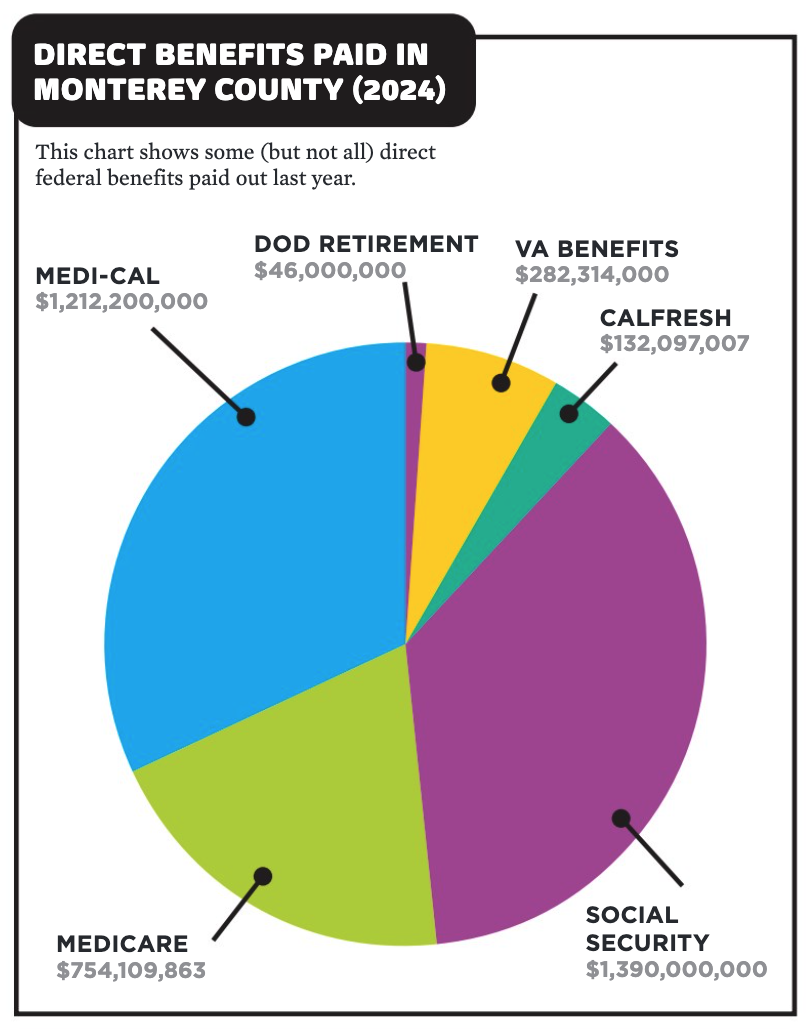
Editor's note: This graphic has been updated to reflect the following correction. A previous version stated $2 billion in federal funds for Medi-Cal was spent in Monterey County, but that figure included state funds.
Higher Education
Local colleges rely on federal funding in two realms: grants or loans to support programs and services, and financial aid to students. At Hartnell Community College last year, those numbers were $9.5 million and $13.7 million, respectively.
CSU Monterey Bay last year received $35.3 million for programs and student financial aid. Federal grant freezes are already impacting ongoing programs. The college proudly announced in 2024 that it had been awarded a five-year, $5.8 million federal Department of Education grant to support a teacher training initiative. Over five years, 94 students in the 18-month-long program were set to receive a $40,000 stipend during their first year while doing student teaching and earning a teaching credential; they would then spend six months completing a master’s degree. Graduates must commit to working for at least three years at a partnering Salinas Valley school, helping resolve a teacher shortage.
The federal government rescinded that grant funding, but CSUMB officials received notice on March 10 that a temporary restraining order issued by a federal judge in a case challenging the legality of funding freezes has been issued.
“We are awaiting additional updates as the legal proceedings move forward,” according to a spokesperson.
Senior Services
Beyond Medicare, a variety of local programs aiding seniors are dependent upon federal dollars. For Meals on Wheels of the Salinas Valley, for example, funding from the Older Americans Act accounts for a third of the nonprofit’s annual budget, benefiting 250 homebound seniors.
Meals on Wheels of the Monterey Peninsula received $1 million in federal funds in 2024. That money helped the nonprofit deliver 462,000 meals to homebound clients. They also provided communal meals at nine locations. Executive Director Christine Winge says when Trump tried to stop the flow of support during his first term, people were “up in arms” and he backed off. “That’s not to say we’re not scared,” she says of his second term.
Funds are sent to the California Department of Aging, which distributes money to each county. From the county offices, it reaches programs like Meals on Wheels based upon the number of low-income residents served. For MoWSV, that figure was $600,000 last year. “We thought [2016] was the last time we’d have to address this,” says President and CEO Regina Gage.
Smaller federal grants benefit a range of other nonprofits. For example, Alliance on Aging was awarded $16,000 to support tax counseling last year. The program, currently underway for the 2024 tax season, helps about 2,000 seniors file their taxes annually.
“If that goes away, what are those 2,000 people going to do?” says Executive Director John McPherson.
Arts and Culture
There is limited reliance locally on federal funding for the arts; the National Endowment for the Arts gives about $2 million a year to the California Arts Council, funding that then trickles down to local organizations including the Arts Council for Monterey County.
Monterey County Free Libraries last year received a federal grant of $10,000, but MCFL Director Hillary Theyer notes other ways that federal funding benefits the system indirectly, as Library Services and Technology Act funds grants to the California State Library, which then spends money on things that serve local library systems. Examples include the Palace e-book app, plus a training portal for public library staff. In addition, MCFL hosts Lunch at the Library enrichment programs in the summer; that program is funded with state monies, but the meals served are federally funded.
Public Media
While $250,000 represents just a tiny fraction of the local federal outlay numbers-wise, it is significant for one local broadcaster: KAZU (90.3 FM) gets about 10 percent of its annual revenue from a Corporation for Public Broadcasting grant.
The CPB is funded by Congress in three-year intervals, but in the current climate that is no guarantee. “This year Congress will (or maybe not) appropriate the funding for 2027-2028,” according to Doug McKnight, the station’s interim general manager. “Congress can also impound the appropriations meaning the funding could stop next year.”


(0) comments
Welcome to the discussion.
Log In
Keep it Clean. Please avoid obscene, vulgar, lewd, racist or sexually-oriented language.
PLEASE TURN OFF YOUR CAPS LOCK.
Don't Threaten. Threats of harming another person will not be tolerated.
Be Truthful. Don't knowingly lie about anyone or anything.
Be Nice. No racism, sexism or any sort of -ism that is degrading to another person.
Be Proactive. Use the 'Report' link on each comment to let us know of abusive posts.
Share with Us. We'd love to hear eyewitness accounts, the history behind an article.