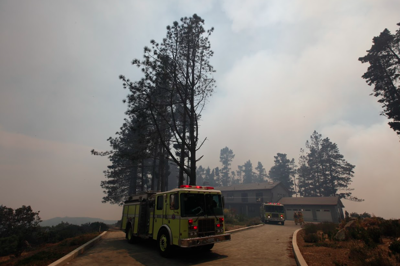

Katie Rodriguez here, thinking about fire, and the nuance in answering the question of what it means to “be ready.”
We’re learning that while firefighters can do a lot, there is only so much they can do in certain wildfire circumstances, and that the work we each put into protecting our homes and communities can be profoundly impactful.
Many of us are probably familiar with keywords like “defensible space” or “home hardening.” But enacting those principles is a totally different story. It requires time to research materials, to assess one's home and gauge just how vulnerable it is, to figure out whether or not you can remove that tree, and how much it’ll cost. Do I need a permit? What if this shrub grows back in two months? Suddenly, being “fire ready” feels like a never-ending choose-your-own-adventure story.
I’m endlessly curious about how people are feeling about this, what actions they might be taking or challenges they are encountering.
Specifically, I wonder what those living in high fire-risk zones are thinking, feeling and deciding—whether they want to act or not. I keep thinking back to the Wildfire Ready event in Monterey last week, when a woman shared with me, “It’s just too expensive, and there are too many shrubs and too much wood in our house to replace everything.”
In Big Sur, where residents are especially cozy with the wildfire risks to property, I was pretty amazed when I heard about a groundbreaking project slated to begin in May of this year.
An anonymous donor has fully funded a 21-person, full-time hand crew to assist with critical fuel reduction and preventative work for the next two years. This is huge for an area that entirely relies on volunteer firefighters—frankly, huge for any fire department. My colleague Erik Chalhoub recently reported that the North County Fire Protection District, which serves the communities of Castroville, Elkhorn, Las Lomas, Moss Landing, Oak Hills, Pajaro, Prunedale and Royal Oaks, increased its staffing from 21 to 30 full-time firefighters with the help of a 2021 voter-approved property tax.
Over the next few months, Big Sur Fire will work to recruit, train and deploy the new personnel—not only to fight fires but to be proactive, to help residents mitigate fire risks, all at no cost.
“My vision of this is that, yes, it's a 21-person crew when they're working on a large fire,” Big Sur Fire Chief Matt Harris says. “[But] the crews of five in these four other trucks are [also] going to go to individual properties. Can you imagine five people with chainsaws, hand tools, training and equipment all going to do work on your property? That’s a huge boost—and for free.”
The ability to have crews out at properties concurrently, he adds, allows them to maximize their staffing efficiently. The plan is to collaborate with Fire Adapted Big Sur (a program under the Community Association of Big Sur) to integrate into their online platform, allowing people to sign up.
How do they prioritize properties? They’ll focus on those that need the most work first. “That will be my job, working with the crew boss,” Harris says.
If you have thoughts or wildfire plans you’d be willing to share, I’d love to hear from you.


(0) comments
Welcome to the discussion.
Log In
Keep it Clean. Please avoid obscene, vulgar, lewd, racist or sexually-oriented language.
PLEASE TURN OFF YOUR CAPS LOCK.
Don't Threaten. Threats of harming another person will not be tolerated.
Be Truthful. Don't knowingly lie about anyone or anything.
Be Nice. No racism, sexism or any sort of -ism that is degrading to another person.
Be Proactive. Use the 'Report' link on each comment to let us know of abusive posts.
Share with Us. We'd love to hear eyewitness accounts, the history behind an article.