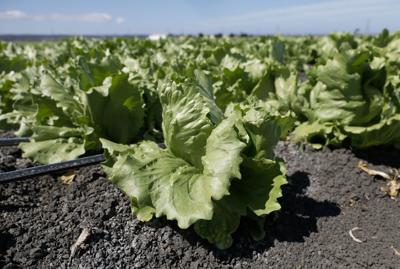

Lettuce needs little introduction in Monterey County—the nickname “Salad Bowl of the World” was given to this county for good reason. More than half of the nation’s supply of lettuce is grown right here in the Salinas Valley along with a significant portion of other types of leafy greens.
So what happens when there’s a record-breaking outbreak of a diarrheal illness called cyclosporiasis tied to the produce? Katie Rodriguez here, reporting that as many consumers saw firsthand, people panicked. Although this summer’s outbreak was not linked to anything grown in Monterey County—or even California—people stopped buying lettuce, which inevitably has an economic impact on growers here.
There are two angles to consider when looking at an outbreak. These were some of the questions tossed around between myself and Editor Sara Rubin, who contributed to this week’s cover story for the Weekly: First, what food-safety protocols are in place to catch a parasite before it leads to an outbreak? And second, once an outbreak happens, what should the response look like?
Cyclospora is a notoriously tricky parasite to study and locate in the field, as I learned from scientists who spoke with me for this story. And, it’s seasonal, typically thriving in warmer weather conditions that overlap with the traditional lettuce harvest season. The illness is not typically seen as deadly, but since May 1 nearly 19,600 people have been sickened by the food-borne illness across almost every state, with more than 1,000 hospitalizations and two deaths recorded.
The outbreak put a spotlight on the gaps in the food safety system at a time when federal agencies responsible for working with state agencies on detection and investigation have been significantly downsized. Not only have the Food and Drug Administration and the Centers for Disease Control and Prevention lost some of their experienced, senior people in divisions that have dealt with the pathogens, but the U.S. Department of Agriculture is decommissioning a research center that has ongoing experiments that study how this pathogen (and others) behave.
Industry groups in California and Arizona have been leaders when it comes to developing food safety protocols, inspiring the FDA’s “Produce Safety Rule” under the Food Safety Modernization Act.
But as cyclospora season comes to a close, and lawsuits from plaintiffs impacted by the outbreak file in, there are things to be learned about this record-breaking outbreak and its fallout.
“Longer term, we need to look really holistically about our food system and how we want it designed,” Joelle Mosso, associate vice president of science programs with Western Growers Association, told me. “Do we want to design it such that we just chase outbreaks, or do we design it such that we identify ways to prevent them?”
Check out this week’s cover story here.


(0) comments
Welcome to the discussion.
Log In
Keep it Clean. Please avoid obscene, vulgar, lewd, racist or sexually-oriented language.
PLEASE TURN OFF YOUR CAPS LOCK.
Don't Threaten. Threats of harming another person will not be tolerated.
Be Truthful. Don't knowingly lie about anyone or anything.
Be Nice. No racism, sexism or any sort of -ism that is degrading to another person.
Be Proactive. Use the 'Report' link on each comment to let us know of abusive posts.
Share with Us. We'd love to hear eyewitness accounts, the history behind an article.