
David Schmalz here, with a mini-update on the Fort Ord Regional Trail and Greenway, aka FORTAG, a 28-mile bike and pedestrian trail loop from Marina to Monterey that will connect the former Fort Ord to the coast.
Major infrastructure projects take years to build in California, and require overcoming any number of challenges along the way, which almost always include funding dependent on state or federal grants.
And though FORTAG is already more than a decade in the planning—and its first segment, running through Del Rey Oaks and cutting up to Seaside, is currently under construction—it’s a project that will take multiple decades, as it’s being tackled in pieces that are strategically positioned for specific types of grant funding.
By necessity, it is the very definition of a piecemeal approach, and last Wednesday, June 18 at the Marina Equestrian Center, the Transportation Agency for Monterey County hosted its second community meeting about the next (and second) FORTAG segment that will be built, a 1.4-mile stretch—mostly alongside California Avenue—that will culminate at the Jerry Smith Access Corridor at Imjin Road and 9th Street.
The $10.6 million project—with $8.4 million coming from a state active transportation grant—is still in the final design stages, and construction is expected to begin next spring. (Construction for the adjoining 2.25-mile Jerry Smith Trailhead segment, which has been awarded a $7.148 million Federal Lands Access Program grant, is expected to begin in 2028.)
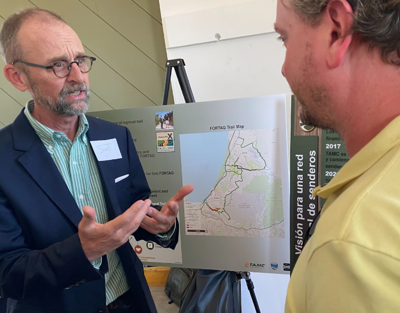
I dropped into the June 18 meeting, where the room was packed with attendees talking to TAMC officials and FORTAG founders Fred Watson and Scott Waltz, who stood alongside various posterboards and explained various aspects of the project.
TAMC Executive Director Todd Muck says 83 people signed into the event, though he estimates between 90 and 100 swung through. That’s one reason I like attending such events: to see who, and how many, from the public show up.
Later last week, I caught up with Watson, who articulated something I’ve observed, but never put to words. “People’s capacity to be active and involved in the community comes in cycles,” Watson says, noting that he met people at the June 18 event he’d never seen before. Some perhaps were new residents, he said, though others could just be longtime locals at a different stage in their lives. “Scott and I have been [at FORTAG meetings] for 12 years,” Watson says. “We’ve cycled through two generations of people.”
The FORTAG segments that have been funded so far are all near neighborhoods, which Watson says is largely why they’ve been so costly on a per-mile basis.
“The really expensive stuff is the intersections, both in terms of construction and engineering and planning,” Watson says. He’s hoping the cost-per-mile “will go down quite a bit” once the trail gets into the former Fort Ord, where the main cost will be the material to put on the ground for the trail.
“There are a lot of trails out there in America,” Watson says. “They can’t all be spending the money per mile that we’re spending on the dense urban segments right now. There must be some economy we can get once we get into open country.”
I sure hope so, and I hope that some of that economy is captured through speed, because the price of most everything seems to move in only one direction.


(0) comments
Welcome to the discussion.
Log In
Keep it Clean. Please avoid obscene, vulgar, lewd, racist or sexually-oriented language.
PLEASE TURN OFF YOUR CAPS LOCK.
Don't Threaten. Threats of harming another person will not be tolerated.
Be Truthful. Don't knowingly lie about anyone or anything.
Be Nice. No racism, sexism or any sort of -ism that is degrading to another person.
Be Proactive. Use the 'Report' link on each comment to let us know of abusive posts.
Share with Us. We'd love to hear eyewitness accounts, the history behind an article.