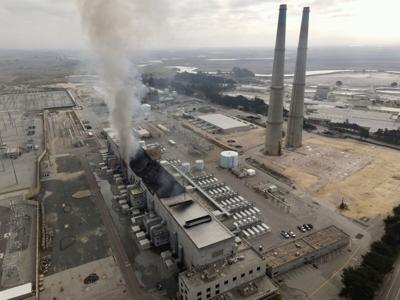

Erik Chalhoub here. As I was driving home from Seaside to Royal Oaks last evening, I could see a fireball in the distance lighting up the night sky around the Moss Landing Power Plant.
Another week, another disaster, I thought, while having a brief moment of worry that the fire was relatively close to my North County neighborhood–would this be our version of the Los Angeles fires?
My thoughts transitioned to how we would cover the fire at the Weekly, and by the time I got home, it was just another night.
Been there, done that. But that’s the problem.
Disasters, whether natural or human-made, have seemed to be the norm, rather than the exception, over the past decade. Last year’s severe storms, the Pajaro flood in 2023, the Big Sur fires in 2020, drought, Covid…it’s exhausting. We’ve become numb to the constant messaging of emergency preparedness.
There have been a dozen disaster declarations in Monterey County since 2017, according to FEMA.
“This has created a disaster fatigue not just in Monterey County, but nationwide,” Kelsey Scanlon, director of the County of Monterey’s Department of Emergency Management, said at a press conference at the Castroville Branch Library today, Jan. 17.
The “tried and true” methods of preparing a disaster are still the best ways to do so, she said: build a supply kit, create an evacuation plan and sign up for emergency alerts at alertmontereycounty.org. (You can read more tips in a post by staff writer Pam Marino here.)
As recent years have shown, how emergencies are responded to have required a mindset shift, Scanlon said.
“It is no longer acceptable for just nonprofits to respond, it is no longer acceptable for just government agencies to respond, it is no longer acceptable for us to expect residents to protect themselves,” she said. “It really is a team effort.”
With only 24 hours having passed since the fire broke out in Moss Landing, how it started is an open question.
Assemblymember Dawn Addis, D-Morro Bay, says Senate Bill 38, a bill she co-authored with Senator John Laird in 2022 that was signed by Gov. Gavin Newsom, was a startーit requires battery energy storage operators to come up with emergency management plans.
“But we need to do a lot more,” she says. “We’ve been working on it all night last night and into this morning on what we’re going to do legislatively to make sure that we are preventing these types of accidents. I hope to have an announcement in the next couple of days.” (By Friday afternoon, Addis and County Supervisor Glenn Church were calling on owner/operator Vistra to keep the plant offline until the company can make assurances a similar fire will never happen again.)
What are some steps you’ve taken to prepare for the next, inevitable disaster?


(0) comments
Welcome to the discussion.
Log In
Keep it Clean. Please avoid obscene, vulgar, lewd, racist or sexually-oriented language.
PLEASE TURN OFF YOUR CAPS LOCK.
Don't Threaten. Threats of harming another person will not be tolerated.
Be Truthful. Don't knowingly lie about anyone or anything.
Be Nice. No racism, sexism or any sort of -ism that is degrading to another person.
Be Proactive. Use the 'Report' link on each comment to let us know of abusive posts.
Share with Us. We'd love to hear eyewitness accounts, the history behind an article.