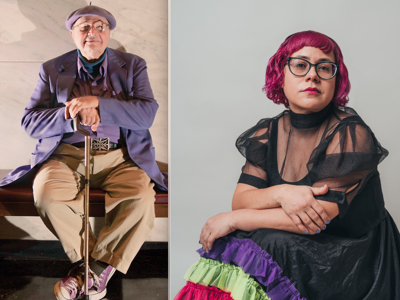

Agata Popęda here. There is one color that keeps showing up in this year's Carmel Bach Festival coverage, and it doesn’t belong to Bach. It is the purple beret, jacket and high-tops that artist Emile Norman wore to every concert and rehearsal for more than 60 years. Then there is the purple hair of Angélica Negrón, this year's featured composer, who finds music in beach waves, houseplants and a Strawberry Shortcake music box.
They never met. One died in 2009; the other was still in conservatory, learning that living composers existed at all. But put their stories side-by-side, as we do in this week's cover story, and something clicks: both are about refusing to let sound stay where it's supposed to stay. Both are heroes of this week’s centerpiece, which serves as an invite for the 89th Carmel Bach Festival that began yesterday, July 11.
Norman was a sculptor and mosaic artist who fell for the festival in 1946 and cultivated this love for the rest of his life—with a 948-pipe Baroque organ at a house on a Big Sur cliff, which he gave his partner as a birthday gift and then spent a year decorating. He wasn't a musician by trade. He played, as he put it, "for my own amazement." Now his trust and the festival are honoring that devotion with a $1,250 (per ticket) concert at his home next July, and an exhibition of his work opening this week at Sunset Center.
Negrón, meanwhile, is a Puerto Rican-born, Brooklyn-based composer who scores for the New York Philharmonic one week and her indie band Balún the next, and doesn't see much difference between the two. She writes string quartets that carry field recordings of Puerto Rican beaches inside them, transforms a lullaby her grandmother might have sung into something you half-recognize without knowing why, and curates a program built on the premise that a snake plant can be an instrument. Two of her pieces and a program she's assembled herself, Field of Sound, anchor several of the festival's marquee nights this month.
Separately, these are a portrait of a beloved local eccentric and a profile of a rising composer. Together, they're something closer to an argument this year's festival is making about itself: that Bach isn't a museum piece, that music doesn't stay inside a concert hall, and that the people who love it best are often the ones listening for something no one told them to listen for.
Read both, and you'll understand why the 89th Carmel Bach Festival—with two weeks of programming already bursting past its own edges—sounds less like a tribute to the past than a live argument about where music is allowed to happen.


(0) comments
Welcome to the discussion.
Log In
Keep it Clean. Please avoid obscene, vulgar, lewd, racist or sexually-oriented language.
PLEASE TURN OFF YOUR CAPS LOCK.
Don't Threaten. Threats of harming another person will not be tolerated.
Be Truthful. Don't knowingly lie about anyone or anything.
Be Nice. No racism, sexism or any sort of -ism that is degrading to another person.
Be Proactive. Use the 'Report' link on each comment to let us know of abusive posts.
Share with Us. We'd love to hear eyewitness accounts, the history behind an article.