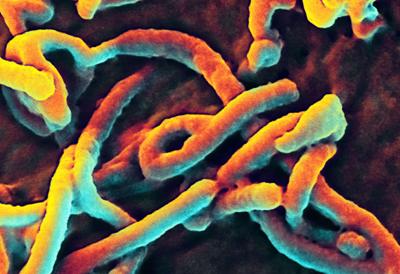
Actually, you probably won't believe the Monterey County Health Department is saying anything at all about Ebola, a hemorrhagic virus that's really, really hard to contract, but really really horrible if you do. (How bad? Think soaring fever, pounding headache, your insides liquifying and leaking from various orifices before you probably die bad.)
And yet, there it was, a "health update" email on Ebola virus disease from Monterey County Public Health Officer Dr. Edward Moreno and Epidemiologist Kristy Michie.
The jist: "It's not likely we will see Ebola here, but we like to keep everyone informed and to answer questions," says Karen Smith, the department's public information officer.
The update comes a day after state public health officials acknowledged a Sacramento patient was being tested for the Ebola virus; that patient had been in one of the West African countries impacted by the disease and is currently being kept in isolation at Kaiser Permanente's South Sacramento Medical Center.
Here are the fast facts the department wants local medical professionals to know:
-
The World Health Organization announced Wednesday there have been 2,473 suspected cases of Ebola virus disease cases reported in West Africa since March;
-
At least 1,350 of those cases have been fatal;
-
At the time, the outbreak is limited to countries of Liberia, Guinea, Sierra Leone and Nigeria;
-
While the reality and risks of Ebola for Californians is very different from what is seen overseas, medical facilities and laboratories should be prepared to appropriately care for travelers returning from West Africa with clinical symptoms;
-
And those symptoms include a fever greater than 101.5 AND a history of travel to Liberia, Guinea, Sierra Leone or Nigeria within the past 21 days, or a fever greater than 101.5 AND a history of contact with blood or bodily fluids from a person known to have Ebola.
And if you're a doc or other medical professional and you suspect a patient has Ebola, isolate that patient and call the Health Department immediately.
Complete guidelines for clinicians and lab professionals can be found on the Centers for Disease Control website.


(0) comments
Welcome to the discussion.
Log In
Keep it Clean. Please avoid obscene, vulgar, lewd, racist or sexually-oriented language.
PLEASE TURN OFF YOUR CAPS LOCK.
Don't Threaten. Threats of harming another person will not be tolerated.
Be Truthful. Don't knowingly lie about anyone or anything.
Be Nice. No racism, sexism or any sort of -ism that is degrading to another person.
Be Proactive. Use the 'Report' link on each comment to let us know of abusive posts.
Share with Us. We'd love to hear eyewitness accounts, the history behind an article.