Nuclear war—there’s an app for that.
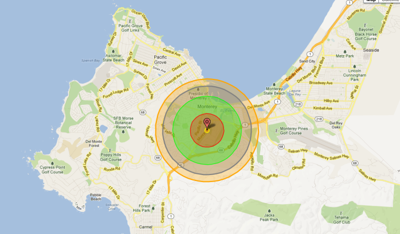
NUKEMAP, a web app that uses Google Maps to demonstrate the range of a nuclear blast on a city, has gotten a lot of attention as the threat of a nuclear strike percolates into the public’s imagination.
Since Feb. 2012, the app has had 2.6 million unique page views and there have been 14 million simulated detonations, said app creator Alex Wellerstein during a talk Monday at the Monterey Institute of International Studies’ Center for Nonproliferation Studies. It’s no LOLCats, but the Internet has its priorities.
The interest in NUKEMAP shows how the public conversation is shifting back to nukes, an afterthought following the Cold War.
“I have conversations with my barber about nuclear weapons,” said Wellerstein, who has a Ph.D. in the history of science from Harvard and is now a historian at the Center for the History of Physics at the American Institute of Physics. “For me, that didn’t happen a decade ago.”
The app is simple: Pick a place, then a type of bomb. You can choose from a variety of weapons, from the “Little Boy” dropped on Hiroshima, to a bomb successfully tested in North Korea. Click detonate. The resulting map shows you how big the resulting fireball would be, what the radiation radius would be and how far the heat could travel to set things on fire.
It’s a morbid exercise, made all too easy with the click of a button. Wellerstein said he’s seen his app described around the web as “fun” or “a game.”
“It’s not a game at all,” he said. But he’s glad people are are using the tool to learn more about nuclear weapons.
Many people—especially those who didn’t grow up under the specter of the Cold War—don’t have a real sense of what a nuke does, he said. People see pictures of test explosions in the desert, but have no concept of how large those explosions truly are. You might see a big fireball light up the sky, but don’t realize that the burst is actually five miles wide.
For young people, that knowledge gap is even more pronounced. Wellerstein noticed that many of his undergraduate students at Harvard lumped atomic bombs and hydrogen bombs into the same general category: nuclear weapons. Using the app, Wellerstein can demonstrate the enormous difference between the two devices.
If, for example, the Little Boy—the atom bomb used in Hiroshima—was dropped on the Weekly office in Seaside, the resulting fireball would be about 0.1 miles in diameter and damage would extend to the Naval Postgraduate School, based on the app’s crude calculations. But if the weapon was the hydrogen bomb Tsar Bomba—the biggest weapon ever tested by the Soviet Union—damage would stretch well into Santa Cruz and Pinnacles National Park.
“Hiroshima, Nagasaki, look like nothing when you compare them to megaton weapons,” Wellerstein said.
Now, Wellerstein is working on updating his app to provide more information, like estimated casualty counts.
After all, it isn’t really a game until imaginary people are dead.


(0) comments
Welcome to the discussion.
Log In
Keep it Clean. Please avoid obscene, vulgar, lewd, racist or sexually-oriented language.
PLEASE TURN OFF YOUR CAPS LOCK.
Don't Threaten. Threats of harming another person will not be tolerated.
Be Truthful. Don't knowingly lie about anyone or anything.
Be Nice. No racism, sexism or any sort of -ism that is degrading to another person.
Be Proactive. Use the 'Report' link on each comment to let us know of abusive posts.
Share with Us. We'd love to hear eyewitness accounts, the history behind an article.