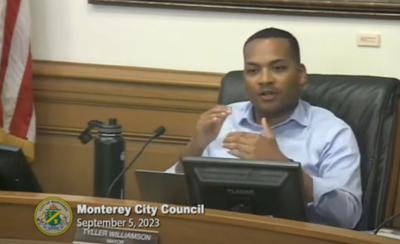

The landlords, property managers and real estate industry representatives came out in force on Tuesday, Sept. 5, to vociferously voice their objections to the Monterey City Council’s creation of a rental registry. Renters stayed away—save for one long-time representative—but their voices were on the minds of councilmembers who voted 4-1 in favor of an ordinance that will spell out the details of the registry, with some changes.
Some of the anti-registry speakers were visibly angry, chastising the council for even considering a plan that they said would impinge on their property rights and would eventually lead to rent control. They argued that the fact that no one was speaking in favor of the registry was reason enough for the council to vote it down.
“Renters don’t have the luxury to come and speak out like you guys do,” said Esther Malkin, founder of Monterey County Renters United. “Renters have repercussions to worry about, they are the ones who become homeless, they are the ones who leave companies without workers because they cant afford to live here.”
The registry seeks to gather information and create a public database detailing the city’s supply of rentals, in which over 60 percent of residents live. Information collected would include things like, how much rent is paid, the name and contact information of the landlord at each address, whether there is a property management company, how many units there are and number of bedrooms and bathrooms in each unit, among other data.
Each landlord would be required to pay an annual fee to be a part of the registry. The proposed ordinance included making it an infraction or misdemeanor for not registering but the council removed that from the ordinance.
Other changes included language to reflect: that 50 percent of the fee is payable by the landlord and 50 percent by the tenant; to the extent feasible, the 50 percent pass through charge to the tenant will be itemized on an invoice or statement; exemption of accessory dwelling units and junior accessory dwelling units. (The fee amount has yet to be determined.)
Councilmember Ed Smith, who has consistently opposed a registry since it was first discussed last year, was the lone “no” vote. During discussions on Tuesday he expressed concerns over privacy of tenants with a public database. City Attorney Christy Davi said the information was public and could be subject to requests under the California Public Records Act.
Smith’s main concern was that the city was deviating from providing basic services, and insisted the money spent on a registry—which could cost approximately $400,000 a year to manage, paid for by fees—would be better spent on helping renters, for example, with assistance to come up with first and last month’s rent and security deposit.
Mayor Tyller Williamson replied that he wasn’t hearing from renters that those costs were the problem. “What I hear the problem is that folks are now being asked to have three to five times the salary in order to even qualify for the unit,” he said. The requirement makes the assistance proposal a “moot point.”
The hyperbole from the angriest property owners included claims that those who own property have more rights to make decisions than those who do not. There were also promises to sell their properties should Monterey put a rental registry into effect. Someone suggested that the city was engaging in a “war against landlords.”
Williamson rejected that they were “attacking” good landlords, the issue was the “landlords and property management companies that are taking advantage of tenants. Because that is absolutely happening. For us to sit here today and completely ignore that and not provide an outlet for those constituents that live in this city and are our neighbors and treat them like equals is a slap in the face,” the mayor said.
“Property rights aren’t the only rights. I think housing is a human right, I think someone living in decent and adequate housing is just as much as a right as someone who has [property rights],” Williamson said.
Calmer voices in the anti-rental registry debate argued that a registry would be a mistake and that adding more housing was the answer.
“If we look at the data across California, when rent control is put in place it has a very negative impact on the housing market,” said Mike Avila, owner of Avila Construction. He called on the city to streamline processes for developers in order to add more housing and said the registry is a mistake. “More housing is the path to success.”
Jeff Davi, whose family owns numerous properties said a registry is “a step in the wrong direction. The problem is we didn’t build enough housing. My parents are responsible, your parents are responsible. Whoever has been here for the last 30 years is responsible for not building enough housing,” Davi said. He called on the city to secure enough water as possible through water projects to lift the cease and desist order against pumping water from the Carmel River currently in place by the California State Water Board
Williams said later he hoped speakers who argued for more housing would come back when the city is increasing density to add more units into the city’s housing element, as required by the state.


(0) comments
Welcome to the discussion.
Log In
Keep it Clean. Please avoid obscene, vulgar, lewd, racist or sexually-oriented language.
PLEASE TURN OFF YOUR CAPS LOCK.
Don't Threaten. Threats of harming another person will not be tolerated.
Be Truthful. Don't knowingly lie about anyone or anything.
Be Nice. No racism, sexism or any sort of -ism that is degrading to another person.
Be Proactive. Use the 'Report' link on each comment to let us know of abusive posts.
Share with Us. We'd love to hear eyewitness accounts, the history behind an article.