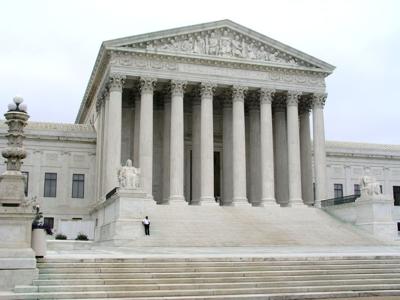
The Supreme Court on Tuesday struck down a provision in the Voting Rights Act that helps the Department of Justice monitor states and localities—including Monterey County—that have a history of discrimination.
In a 5-4 ruling the court declared unconstitutional the provision that determines which areas must get federal approval for proposed election changes, according to The Associated Press. Nine states—mostly in the South—are subject to the requirement, as well as counties and jurisdictions in six others states including California and New York.
The provision was considered to be a key component of the landmark Civil Rights legislation first passed in 1965.
Chief Justice John Roberts, writing for the conservative majority, said the law, which was most recently renewed in 2006, relies on 40-year-old data and doesn’t reflect racial progress in the United States, the AP said.
"Our country has changed, and while any racial discrimination in voting is too much, Congress must ensure that the legislation it passes to remedy that problem speaks to current conditions," Roberts wrote.
Congress can still reinstate federal oversight by coming up with a new formula for determining what areas are subject to extra scrutiny, but must base their decision on current conditions, Roberts wrote. But given a deeply divided Congress, lawmakers think passing a new law would be very difficult, USA Today reports.
Monterey County is one of three California counties, including Kings and Yuba, affected by the Voting Rights Act. The county must submit any proposed redistricting or polling place changes to the U.S. Department of Justice for review.
Earlier this year Assemblyman Luis Alejo rallied the legislature to pass a resolution to uphold Section 5 of the Voting Rights Act, which requires the Justice Department to approve any changes to district lines, polling locations, or other election changes. The Supreme Court left Section 5 intact, but declared Section 4—the provision that determines which states and localities are covered—unconstitutional, The New York Times reported. Without Section 5, Section 4 has no significance unless Congress passes a new bill, the Times said.
Civil rights groups argue there’s a continuing need for the law’s coverage, pointing to the Justice Department’s efforts to block voter ID laws in South Carolina and Texas last year, as well as a Texas redistricting plan that a federal court found discriminated against Hispanics, the AP said.
Alejo said in 2004 when a voting site closed in Pajaro, residents were required to go to an Aromas site. Because there was no bus transportation to the new polling place, some Latino residents would have been disenfranchised if the DOJ hadn’t stepped in to re-open the Pajaro election office and hire bilingual workers, he said. At the time, Alejo was an attorney with California Rural Legal Assistance.
President Barack Obama said in a statement that he was “deeply disappointed” in the ruling, according to the AP. “I am calling on Congress to pass legislation to ensure every American has equal access to the polls,” he said.
“I’m with Obama on this one,” said local activist and Monterey County Board of Education member David Serena. “I think it’s a bad decision.”
“In this last election you had the largest amount of Latinos in this country that have voted,” he said. “You see the increase of people of color’s voting power, and you see the increase of right wing groups trying to stop the voter’s right.”
Nevertheless, he isn’t too concerned that the ruling will have too much of an effect on Monterey County, which already has a diverse voting population. There are still other provisions of the Voting Rights Act that can protect the people, Serena said.
Because of today's decision, states that have voting laws pending Justice Department approval can push them through. This includes voter identification laws in Alabama and Mississippi, the AP said.
Weekly reporter Sara Rubin contributed to this report.


(0) comments
Welcome to the discussion.
Log In
Keep it Clean. Please avoid obscene, vulgar, lewd, racist or sexually-oriented language.
PLEASE TURN OFF YOUR CAPS LOCK.
Don't Threaten. Threats of harming another person will not be tolerated.
Be Truthful. Don't knowingly lie about anyone or anything.
Be Nice. No racism, sexism or any sort of -ism that is degrading to another person.
Be Proactive. Use the 'Report' link on each comment to let us know of abusive posts.
Share with Us. We'd love to hear eyewitness accounts, the history behind an article.